
Games / Guides / Strategy articles / Mancala strategy
Mancala strategy: free turns, captures and endgames
Mancala rewards counting more than any other skill. Once you can see where a sow will end before you lift the seeds, the game opens up: free turns chain together, captures appear, and the endgame becomes a sum you can do in your head.
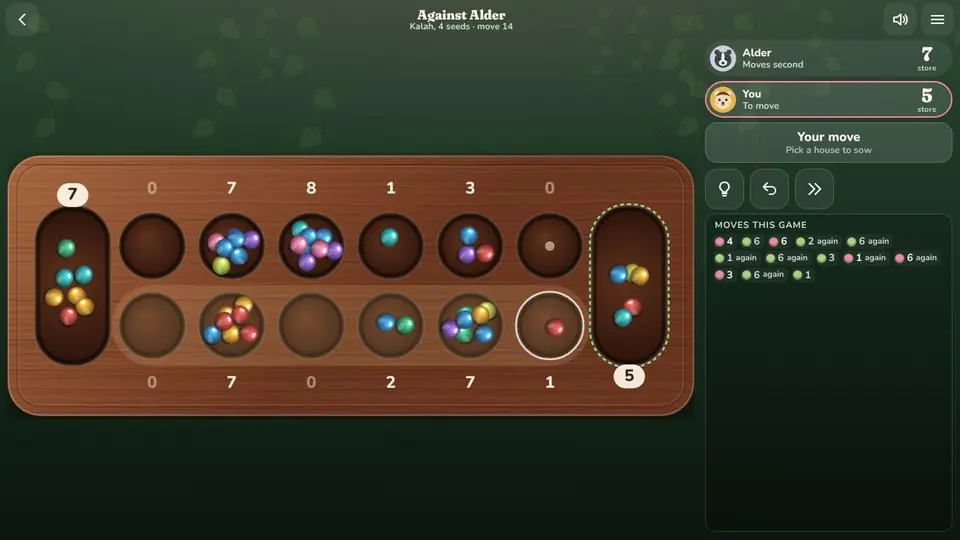
Kalah in brief
This guide is mostly about Kalah, the version most people learn as mancala, with a section on Oware at the end. In Kalah each player has six houses and a store on their right. You lift every seed from one of your houses and sow them one at a time counterclockwise: along your row, into your store, then along your opponent's row, skipping their store. Land your last seed in your store and you go again. Land it in an empty house on your side and you capture it plus everything in the house directly across. When one side's houses are empty, the other player keeps the seeds left on their own side.
We'll number your houses 1 to 6 from left to right, so house 6 sits next to your store.
Free turns: the count to remember
A house earns a free turn when it holds exactly enough seeds to reach your store: house 6 needs 1, house 5 needs 2, house 4 needs 3, house 3 needs 4, house 2 needs 5 and house 1 needs 6. With 4 seeds in every house at the start, only house 3 lines up, which is why sowing house 3 is such a common first move in Mulberry Mancala.
| House | 1 | 2 | 3 | 4 | 5 | 6 |
|---|---|---|---|---|---|---|
| Seeds for a free turn | 6 | 5 | 4 | 3 | 2 | 1 |
A house with 13 more than that also ends in your store, after going all the way round, so house 6 with 14 seeds is a free turn too. It doesn't come up often, but it's worth knowing late in a game with big piles.
Chain free turns in the right order
Say houses 4, 5 and 6 hold 3, 2 and 1 seeds. All three are free turns. Sow them nearest the store first: house 6, then 5, then 4. Each one lands in your store, and none of them changes the others.
Do it the other way round and it falls apart. Sowing house 4 first drops a seed in houses 5 and 6, which then hold 3 and 2, and neither lines up any more. The rule: when two houses are ready, sow the one closer to your store first.
Free turns are worth more than the single seed they put in your store. Each one is a whole extra move, and a long chain can reshape the board before your opponent touches it.
Captures: making them and stopping them
To capture, your last seed has to land in one of your own empty houses, and the house across should be worth taking. Here's a simple one. Your house 2 holds 2 seeds, house 4 is empty, and the house across from house 4 holds 7. Sow house 2: one seed goes to house 3, the last to house 4. That's 1 plus 7, so 8 seeds to your store.
Defending is the same count from their side. Before every move, look at each empty house on your opponent's side and ask whether one of their sows can end there. If it can, the seeds across from it on your side are at risk. Moving a big pile out of that house is often worth more than a small capture of your own. You can also fill their empty house by sowing into it, which removes the threat.
Mulberry Mancala offers two capture rules. With the standard rule nothing happens if the house across is empty. With the empty capture rule you still take your lone last seed. It changes a few close endgames, so check which one you're playing.
Keep seeds on your side late
When one side runs out of seeds, the other player keeps everything left on their own side. That makes hoarding a real strategy in the second half. A growing pile in house 6 or 5, close to your store, can quietly decide the game, because you can leave it there until the end. The danger is a pile that sits across from one of their empty houses, where a single sow can take the lot.
The flip side: if your opponent is building a big hoard and you're running low, think about whether you want the game to end now. Sometimes emptying your side quickly, before their pile grows, is the better plan.
Count the endgame
There are 48 seeds in a 4 seed game, so 25 wins. Once your store reaches 25, nothing your opponent does can catch you. Late in the game, add up your store plus the seeds you can be sure to keep, and compare. If you're ahead with the seeds on your side counted, try to end the game. If you're behind, keep it going and look for captures.
In Kalah, once about 20 seeds are left in the houses, the hint in Mulberry Mancala tells you the exact result with perfect play. It's a great way to check your own counting after a game.
Oware: a different kind of game
Oware has no free turns, and stores only hold captures. You capture when your last seed lands in a house on your opponent's side and makes it hold exactly 2 or 3, then you take any houses just before it that also hold 2 or 3.
- Think in 1s and 2s. Their houses with 1 or 2 seeds are your targets. Your own 1s and 2s are theirs.
- Build a big house. A house with 12 or more seeds sows all the way round, skipping the house it came from, and can end with a run of captures on the far side. Save one and release it when their row is full of 1s and 2s.
- Keep moves in reserve. If your opponent's side is empty you must give them seeds. Running out of good moves is how many Oware games are lost, so keep seeds spread across several houses.
- Grand slams capture nothing. Under our rules, a sow that would take every seed on their side is allowed but captures nothing, so don't plan around one.
What perfect play says
Kalah with 4 seeds has been solved by computer, and the first player wins with perfect play. Oware is a draw with perfect play. Real games are full of small mistakes, so either player can win, but it explains why Linden, our expert, is so tough when moving first in Kalah. By default you and the house player take turns going first.
Mistakes that lose mancala games
- Sowing free turns far from the store first and breaking the chain.
- Leaving a big pile across from an empty house on their side.
- Grabbing a small capture while a bigger one is threatened against you.
- Emptying your side while you're behind on the count.
- In Oware, leaving lots of houses with 1 or 2 seeds.
For the full rules, house players and the Daily Sowing, read our Mulberry Mancala guide. For more counting games, try our dots and boxes strategy or our backgammon strategy for beginners.
Questions
What is the best first move in mancala?
In Kalah with 4 seeds a house, sowing the third house from your left lands the last seed in your store and earns a free turn, so it's a very common opening.
How do you get a free turn in mancala?
In Kalah, land your last seed in your own store. A house needs exactly as many seeds as its distance from the store.
Does the first player always win at mancala?
In Kalah with 4 seeds, the first player wins with perfect play. Oware is a draw with perfect play. Real games depend on mistakes.
How many seeds do you need to win Kalah?
With 4 seeds per house there are 48 in all, so 25 in your store guarantees a win.
Game guides

More strategy articles


You might also like
 10 minSaves
Bracken Backgammon
BackgammonClassic backgammon with the doubling cube, match play and the Crawford rule. Five house players, hints and a game review, pass and play, online with a friend and Daily Dice.