
Games / Guides / Strategy articles / Backgammon strategy for beginners
Backgammon strategy for beginners: openings, odds and the cube
Backgammon has dice, but the same few decisions come up again and again: how to play the opening roll, whether to leave a blot, when to hit, when to run, and when to double. Learn a few numbers and those decisions get much easier.
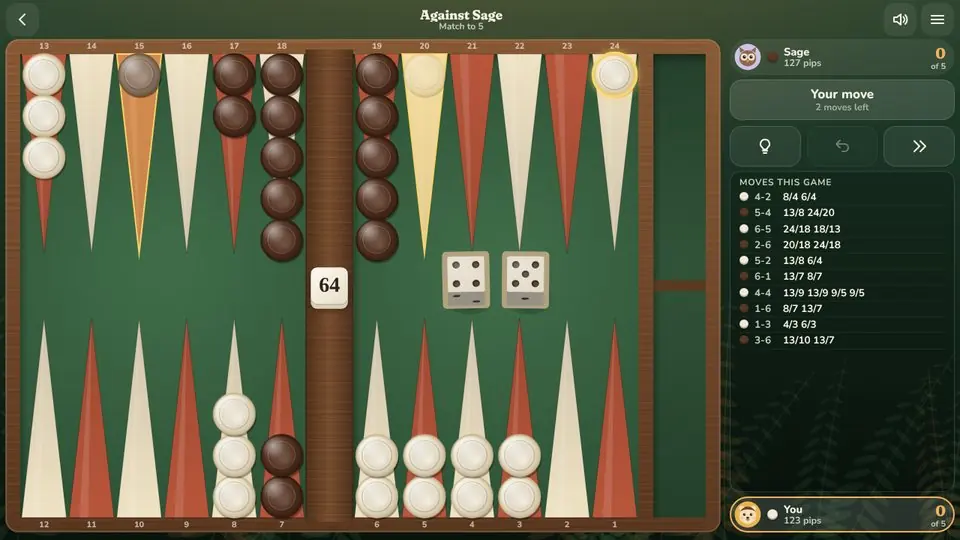
Before you start: pips
A pip is one point of movement. Your pip count is the total distance all your checkers still have to travel to bear off, and both sides start at 167. In Bracken Backgammon the pip counts sit under each name, so you always know who is ahead in the race. That one number shapes most of the strategy below: the side that's ahead wants to race, and the side that's behind wants contact.
How to play the opening roll
The opening roll can't be a double, since a tie is rolled again. Here are the plays most strong players use. Points are counted from your side, so your 8 point is three steps above your 5.
| Roll | Common play | Why |
|---|---|---|
| 3-1 | 8/5 6/5 | Makes your 5 point, the best point on the board. |
| 4-2 | 8/4 6/4 | Makes your 4 point. |
| 6-1 | 13/7 8/7 | Makes your 7 point (the bar point), starting a block. |
| 5-3 | 8/3 6/3 | Makes your 3 point. |
| 6-5 | 24/13 | Runs a back checker all the way to safety. |
| 5-2 | 13/8 13/11 | Brings two builders down from your 13 point. |
| 6-4 | 24/14, or 8/2 6/2 | Either runs or makes a deep point. |
| 6-3 | 24/18 13/10 | Splits the back checkers and brings a builder. |
| 6-2 | 24/18 13/11 | Same idea as 6-3. |
| 5-4 | 24/20 13/8 | Splits, and brings one down safely. |
| 4-3 | 24/20 13/10 | Splits and adds a builder. |
| 5-1 | 13/8 24/23 | Safe builder plus a small split. |
| 4-1 | 24/23 13/9 | Small split and a builder. |
| 3-2 | 24/21 13/11 | Splits and builds. |
| 2-1 | 13/11 6/5 | Slots the 5 point, hoping to cover it next turn. |
You don't need to memorise all of them. Remember the first five, which make a point or escape, and the general idea for the rest: bring builders down from your 13 point and split your back checkers a little.
Shot odds: how risky is a blot?
A blot is a single checker that can be hit. How likely is it to be hit? It depends on the distance from the enemy checker, and the answer surprises most beginners. These figures count every roll of two dice and assume nothing is blocking the way.
| Distance | Rolls that hit (of 36) | Chance |
|---|---|---|
| 1 | 11 | 31% |
| 2 | 12 | 33% |
| 3 | 14 | 39% |
| 4 | 15 | 42% |
| 5 | 15 | 42% |
| 6 | 17 | 47% |
| 7 | 6 | 17% |
| 8 | 6 | 17% |
| 9 | 5 | 14% |
| 10 | 3 | 8% |
| 11 | 2 | 6% |
| 12 | 3 | 8% |
Two lessons. Within six pips (a direct shot), the risk is high, and six away is the worst of all. Seven or more away (an indirect shot) is much safer, because only combinations of both dice can reach it. When you must leave a blot, leave it seven or more pips away if you can.
Hit or play safe?
Hitting sends a checker back to the bar, and it has to re-enter in your home board before your opponent can move anything else. How much that costs them depends on how far it had travelled. Hitting a checker that's nearly home costs them close to 20 pips. Hitting one that's barely moved costs very little.
- Hit when it costs them a lot of pips, or when your home board is strong enough that they may not get back in.
- Hit when it also makes a point or gains a tempo.
- Think twice about hitting loose in your own home board when they have checkers on the bar that could hit back.
Coming in from the bar gets harder as you close points. With k points closed in your home board, their chance of entering at least one checker is 1 minus (k/6) squared: 97% against one point, 89% against two, 75% against three, 56% against four and 31% against five. Against six, they can't come in at all.
Build a prime
A prime is a row of blocked points. Six in a row can't be jumped at all, and even four or five in a row trap checkers behind them for a long time. The points that matter most are your 5, 4 and 7 points, because together with your 6 point they block your opponent's back checkers just as they try to escape. Make points in a row rather than scattered ones.
Race or contact?
Check the pip count every few turns. If you're well ahead, stop taking risks, break contact and run for home. If you're well behind, you need to hit a shot, so hold an anchor (a point in their home board) and keep your position flexible. A rough guide: in a pure race, each 10% of pips you lead by is a big edge, since the dice even out over many rolls.
The doubling cube, simply
Before rolling, you can offer to double the stakes. Your opponent takes, and plays on for twice as much while owning the cube, or passes and loses the game at the current value.
- Take when you still have about a quarter of the winning chances, a bit more if you could lose a gammon. A take loses less than a pass in the long run once you're above that line.
- Double when you're a clear favourite but not so far ahead that they should pass and you'd rather play on for a gammon. Around two chances in three is where doubling usually starts to be right.
- Racing rule of thumb: many players use the 8-9-12 guide. Double when your pip lead is about 8% of your count, redouble at about 9%, and take when you're no more than about 12% behind.
New players pass far too often. If you're unsure, the hint in Bracken Backgammon gives the exact call for any position, and the game review points out doubles you missed or took badly.
Mistakes beginners make
- Leaving blots six pips from an enemy checker.
- Hitting a checker that has barely moved and leaving two blots behind.
- Racing when behind, and fighting when ahead.
- Stacking many checkers on one point instead of spreading builders.
- Passing doubles they should take.
For the full rules, Crawford rule and fair dice details, read our Bracken Backgammon guide. If you like games of odds and judgment, our farkle odds article is a natural next step, and our mancala strategy covers another ancient race and capture game.
Questions
What is the best opening move in backgammon?
With 3-1, play 8/5 6/5 to make your 5 point. It's widely considered the best opening roll.
How likely is a blot to be hit?
With nothing blocking, a blot six pips away is hit 17 times in 36 (about 47%), one pip away 11 times in 36, and seven or more away 6 times in 36 or fewer.
When should you accept a double in backgammon?
When you have roughly a 25% chance or better of winning, a little more if you might lose a gammon.
What is a prime in backgammon?
A row of consecutive blocked points. A full prime of six can't be passed at all.
Game guides
More strategy articles
You might also like
 10 minSaves
Foxglove Farkle
FarkleRoll six dice, set aside the scorers and push your luck or bank. Real odds on every roll, Classic or Old style rules, five house players, pass and play, online with a friend and a Daily Posy.