Games / Strategy Games / Bracken Backgammon / Guide
Bracken Backgammon
Bracken Backgammon is the classic race game on a walnut board with green felt. Roll the dice, hit a lone checker, build a wall of points, turn the doubling cube at the right moment and bring all fifteen of your checkers home first.
Quick answers
Does Bracken Backgammon work on my phone?
Yes. Bracken Backgammon works with touch on phones and tablets, and with a mouse or keyboard on a computer. It runs in the browser you already have, so there is no app to download.
Do I need an account to play Bracken Backgammon?
No. Just open it and play, with no sign-up. If you like, a free account (username only, no email, for players 13 and older) puts your scores on the leaderboards and backs up your progress so it follows you to any device.
Is there a daily challenge in Bracken Backgammon?
Yes. Bracken Backgammon has a new daily challenge every day, the same one for every player, with its own daily leaderboard. Find it alongside the others on our daily challenges page.
Does Bracken Backgammon save my progress?
Yes. It saves on this device on its own, so you can close the page and pick up where you left off. Sign in with a free account to keep the same progress on your phone and your computer.
Is Bracken Backgammon OK for kids?
Yes, players of any age can enjoy it. There is no chat and no way to message other players, and nobody needs an account to play. Accounts are for players 13 and older, so younger players just play and their progress stays on their device. For ages 4 to 11 we also have learning games in their own kids area, with no ads, no accounts and no tracking.
What is backgammon?
Backgammon is one of the oldest board games there is, a race for two players around a board of 24 narrow triangles called points. Each side has 15 checkers and moves them by the roll of two dice, toward its own home corner, and then off the board. The first side to bear off all 15 wins.
The dice make every game different, but skill wins out over time. Knowing when to hit, when to play safe, when to run and when to double is what separates a good player from a lucky one. We built Bracken Backgammon to be quick to play on a phone, clear to read, and honest about the dice. It's free, it runs in your browser and there's nothing to download.
How to play
- Setup. You start with two checkers on your 24 point, five on your 13, three on your 8 and five on your 6. Your opponent's checkers sit in the mirror image. You move from your 24 point round to your 1 point, which in our game means from the top left, along the top, then right to left along the bottom.
- The opening roll. Each side rolls one die. The higher number goes first and plays both of those numbers. A tie means both roll again.
- Moving. Each die is a separate move. You can move one checker by both numbers or two checkers by one each. A checker can land on any point that does not hold two or more of your opponent's checkers.
- Doubles are played four times. A roll of 4 and 4 gives you four moves of 4.
- Use as much of the roll as you can. If both numbers can be played, you must play both. If only one can be played, you play it; if either one could be played but not both, you must play the bigger one.
In our game you never have to remember these last rules. The board only offers moves that follow them, and when there is only one legal way to play a roll we make it for you.
Hitting and the bar
A single checker on a point is a blot. If your opponent lands on it, it is hit and goes to the bar in the middle of the board. A checker on the bar has to come back in before you can move anything else. It enters on your opponent's home board, on the point that matches one of your dice. If both of those points are blocked, you lose the whole turn.
Two or more of your checkers on a point make it safe and block your opponent from landing there. Six blocked points in a row, a prime, can't be jumped at all.
Bearing off
Once all 15 of your checkers are in your home board (your 1 to 6 points), you can start taking them off. A roll of 5 bears off a checker from the 5 point. If that point is empty, you must use the 5 to move a checker from a higher point. If there is no checker higher up, you bear off from the highest point you do have. If one of your checkers gets hit during the bear off, it has to come all the way back around before you can bear off again.
Gammons and backgammons
A normal win is worth one point (times the doubling cube). If you bear off all 15 before your opponent has borne off even one, it's a gammon and worth double. If they also still have a checker on the bar or in your home board, it's a backgammon and worth triple.
| Result | Points |
|---|---|
| Single game | 1 x the cube |
| Gammon | 2 x the cube |
| Backgammon | 3 x the cube |
| Double passed | The cube before the double |
The doubling cube
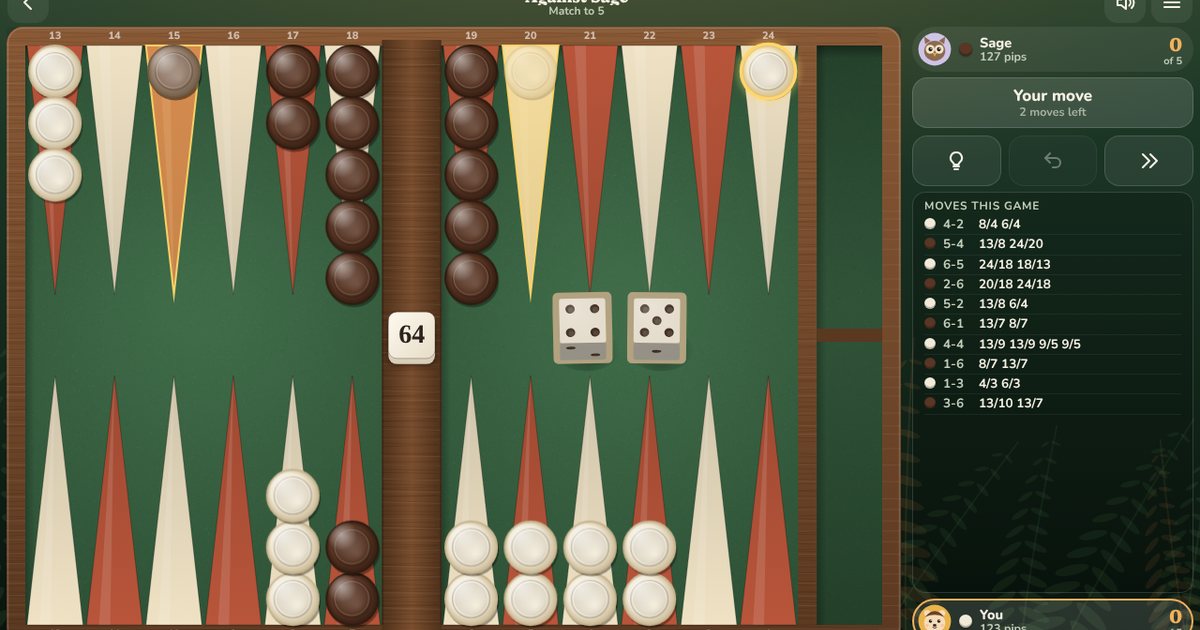
The doubling cube is what turns backgammon from a dice game into a game of judgment. At the start of your turn, before you roll, you can offer to double the stakes. Your opponent can take, and play on for twice as much while owning the cube (only the owner can double next), or pass, giving up the game at the current value. The cube goes 2, 4, 8, 16, 32, 64.
As a rough guide, a take is right when you still have about a quarter of the winning chances, a bit more when you might lose a gammon. Doubling usually starts to be right somewhere around two chances in three. Our hint button gives the exact call for any position, and the game review points out doubles you missed or took badly.
Match play and the Crawford rule
Serious backgammon is played in matches to a set number of points, such as 5 or 7. Each game adds its points to the score, and winning by more than you need gives nothing extra. When one side gets within one point of the target, the next game is the Crawford game and nobody can double in it. After that the cube is back in play, and the player who is behind will usually double straight away.
For single games you can switch on the Jacoby rule, common in casual play: gammons and backgammons only count once the cube has been turned.
Playing Bracken Backgammon
- Tap or click a checker to see where it can go, then tap a glowing point. You can also drag it.
- Tap a picked checker again to move it by the bigger die. Tap the tray on the right to bear off.
- Undo takes moves back until you press Done. A setting can hand over the dice as soon as your last checker lands.
- Pip counts under each name show how far each side still has to travel. The start is 167 each.
- Keys: Space rolls or finishes the turn, U undoes, D doubles, H shows a hint. Tab to the board and use the arrow keys and Enter to pick and move.
- Rolls can be skipped with a tap, and there are Quick and Instant speeds, a Less motion mode, high contrast and full screen reader labels for every point.
House players
There are five, from gentle to genuinely tough. Thistle is a beginner who moves on a whim. Hazel plays safe and counts her pips. Rowan knows the game but has the odd wild move. Ash is steady and sharp. Sage looks a full roll ahead on every play and handles the cube well.
Our engine is a neural network we trained from scratch, by letting it play itself more than two million times. We tested every player against the one below it over hundreds of games, and each one wins clearly. None of them can see the dice before they're rolled.
Fair dice
Every backgammon app gets accused of rigged dice, so here is exactly what we do. Each roll uses your browser's secure random numbers, drawn at the moment you roll, and every number comes up exactly one time in six. The house players only see the board and the dice already on it. The Stats screen keeps a running tally of every roll you and the house players have made, so you can check for yourself.
Online, both devices put in a secret for every roll before either one is shown, and the dice come from both secrets together. Neither player can choose or peek at the dice, and each device checks the other's secret.
Daily Dice and the ladder
The Daily Dice is one game against Ash without the cube, and everyone gets the same dice today: the same opening roll, the same second roll and so on. A win scores 100, plus 10 for every one of Ash's checkers still on the board, plus 50 for a gammon or 100 for a backgammon. A loss scores 5 for each checker you bore off. Your first game of the day goes on the daily leaderboard, and you can share your result without giving away the dice.
The ladder is a rating that starts at 1500 and moves after every game or match against a house player. Beating a stronger player moves it more, and longer matches count for more. Your best rating goes on the all time board.
Tips and strategy
- Make your 5 point early. It blocks your opponent's back checkers and is the best point on the board. With 3-1 on the opening roll, play 8/5 6/5.
- Count the race. If you're well ahead on pips, stop taking risks and run home. If you're well behind, you need to hold points and hope for a shot.
- Don't leave blots in direct range (six pips or fewer from an enemy checker) unless you gain a lot for the risk. A direct shot is hit about a third of the time.
- Hit when it hurts them. Hitting a checker late in the game, a long way round the board, costs them far more pips than hitting one that has barely moved.
- Build points in a row. Four or five blocked points together trap checkers behind them. A full prime of six is the dream.
- Take more doubles than feels comfortable. New players pass too often. With a quarter of the chances, a take loses less than a pass in the long run.
- Use the review. After a game, the review shows your costliest plays and cube calls with our engine's pick. It's the fastest way to improve.
Questions
Is Bracken Backgammon free?
Yes. It's free to play in your browser on a phone, tablet or computer, with no ads and nothing to install.
Are the dice fair?
Yes. Every roll uses your browser's secure random numbers at the moment you roll, and the house players can't see what's coming. Online, both devices add a secret to every roll so neither side can choose the dice.
What is a gammon in backgammon?
A gammon is a win before the loser has borne off a single checker. It counts double. If the loser also has a checker on the bar or in the winner's home board, it's a backgammon and counts triple.
What is the Crawford rule?
In match play, when one player gets within one point of winning, the next game is played without the doubling cube. After that one game the cube can be used again.
When should I accept a double?
Take when you have roughly 25 percent winning chances or better, a little more if you could lose a gammon. Our hint button tells you the right call for any position.
Can I play backgammon with a friend?
Yes. Play a friend online with a four letter room code or a link, or pass one device back and forth. Online games can be single games or matches, with or without the cube.