Games / Strategy Games / Kingsway Chess / Guide
Kingsway Chess
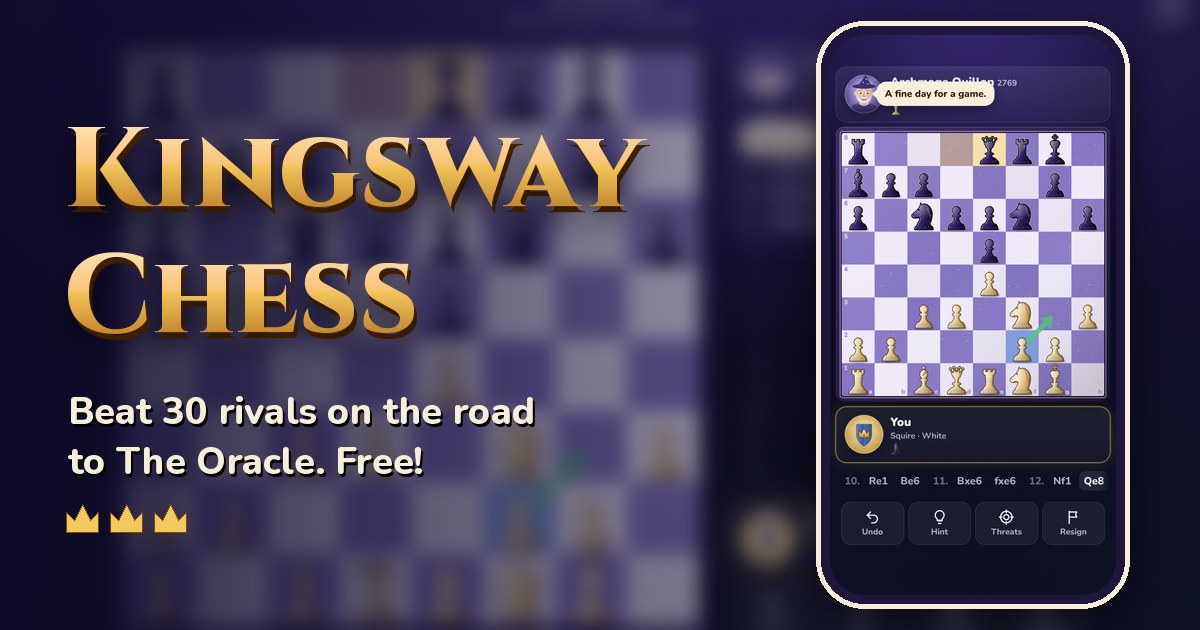
Walk a road across a hand-drawn kingdom and beat 30 rivals, from a squire who drops his pieces when he's nervous to The Oracle, who plays at full engine strength. Puzzles, a daily puzzle and game reviews come free with it.
What is Kingsway Chess?
Kingsway Chess is real, full-rules chess against computer opponents with names and faces. The Kingsway is a winding road through five regions: The Meadows, Riverbend Town, Greyspire Pass, The Frozen Keep and The Sky Citadel. Six rivals live in each region, and beating one opens the road to the next.
The first rivals play like real beginners. They leave pieces hanging, miss forks and love a flashy check. By Riverbend Town they're steady club players, and the last three in the Sky Citadel play at the engine's full strength with several seconds of thought per move. It's free, runs in your browser on a phone, tablet or computer, and there's nothing to download.
Off the road you'll find Quick Play against any rival you've reached (or a strength slider), Pass and Play for two people, a rated puzzle mode, a three-minute Puzzle Rush and a Daily Puzzle that's the same for everyone.
Chess rules in plain words
Chess is played on an 8 by 8 board with a light square in each player's bottom right corner. Each side starts with 16 pieces: a king, a queen, two rooks, two bishops, two knights and eight pawns. White moves first, then you take turns, one move each. You can't pass.
How each piece moves
| Piece | How it moves | Rough value |
|---|---|---|
| King | One square in any direction | Priceless |
| Queen | Any number of squares in a straight line or diagonal | 9 |
| Rook | Any number of squares along a row or column | 5 |
| Bishop | Any number of squares diagonally, so it stays on one color | 3 |
| Knight | An L shape: two squares one way, then one square sideways. It jumps over pieces | 3 |
| Pawn | One square forward, or two from its starting square. Captures one square diagonally forward | 1 |
Only the knight can jump. Every other piece stops when something is in its way, and it captures by moving onto an enemy piece's square. The values are a guide for trades, not a rule of the game.
Check and checkmate
When a king is attacked, it's in check, and that player must get out of check right away: move the king, block the attack, or capture the attacker. You can never make a move that leaves your own king in check. If a king is in check and there's no way out, that's checkmate and the game is over.
The three special moves
- Castling. Your king moves two squares toward a rook, and that rook hops to the square on the king's other side. It's allowed only if neither piece has moved yet, the squares between them are empty, and the king is not in check, doesn't pass through an attacked square and doesn't land on one.
- En passant. If a pawn moves two squares and lands right beside one of your pawns, your pawn can capture it as if it had moved only one square. You must do it on the very next move or the chance is gone.
- Promotion. A pawn that reaches the far row turns into a queen, rook, bishop or knight, your choice. Our game shows a picker. Most of the time you want a queen, but a knight is sometimes the move that gives check.
How a game can be drawn
- Stalemate: the player to move is not in check but has no legal move.
- Threefold repetition: the same position appears three times with the same player to move and the same castling and en passant rights.
- Fifty-move rule: fifty moves by each side pass with no capture and no pawn move.
- Not enough pieces: neither side can ever checkmate, such as king against king, or king and one bishop or knight against a king.
- Agreement: both players agree to a draw.
In Kingsway Chess the first four are applied for you automatically, so nobody has to claim them. Draw by agreement is a button in Pass and Play. If you play with a clock and your time runs out, you lose, unless your opponent has only a king or a king and one minor piece left, in which case it's a draw because they could never mate you.
How to play on phone and computer
Tap one of your pieces and its legal moves light up: dots for empty squares, rings for captures. Tap a dot to move. You can also drag pieces if you prefer. On your very first game the coach walks you through this one step at a time.
On a computer, click or drag with the mouse, or use the keyboard: the Arrow keys move a cursor and Enter or Space picks up and drops a piece. U undoes, H asks for a hint, T shows threats, F flips the board, N loads the next puzzle and Esc goes back.
Under the board you'll find Undo, Hint, Threats and Resign. Hint draws a green arrow with a strong move. Threats circles every piece of yours that can be taken for free or for less than it's worth, with arrows from the attackers. Your game saves after every move, so you can close the tab and pick it up later with Play.
The Kingsway, crowns and titles
Every rival offers three crowns. You earn one for winning, one for winning without undo or hints, and one for winning within 40 of your moves or finishing at least 5 points of material ahead. Your best result per rival counts, so you can come back later for crowns you missed. There are 90 in all.
Each region ends with a boss: Sir Rowan, Lady Seraphine, the Iron Abbot, King Hallorn and finally The Oracle. Beating a boss unlocks a new board and piece set: River Marble, Mountain Slate, Frozen Glass, Sky Starlight and Gold and Obsidian. Rosewood comes from solving 50 puzzles and Jade Garden from a Puzzle Rush score of 15.
Crowns raise your title from Squire through Page of the Road, Knight-Errant and Castellan up to Warden of the Kingsway at 78 crowns. Beat The Oracle and you're Grandmaster of the Kingsway. The Sky Citadel masters are so strong that a draw against rivals 25 to 29 also opens the road to the next one.
| Region | Rivals | Rating shown |
|---|---|---|
| The Meadows | 1 to 6, Pip to Sir Rowan | 250 to 1000 |
| Riverbend Town | 7 to 12, Ferryman Gil to Lady Seraphine | 1130 to 1642 |
| Greyspire Pass | 13 to 18, Grest to the Iron Abbot | 1722 to 2125 |
| The Frozen Keep | 19 to 24, Old Hrolf to King Hallorn | 2206 to 2608 |
| The Sky Citadel | 25 to 30, Aeris to The Oracle | 2689 and up, full strength from 28 |
Puzzles, Puzzle Rush and the Daily Puzzle
Puzzles come from real-looking games. The board shows the opponent's last move, then it's your turn to find the winning idea: mate in 1, 2 or 3, a fork, a promotion, or a move that wins material. When a line has several moves, the computer answers for the other side and you keep going. In mate puzzles, any move that checkmates on the final step counts.
Your puzzle rating starts at 800 and moves up or down after each puzzle, the way a player rating does. Solve it clean and you gain points. A wrong first try or tapping Solution costs points and resets your streak. Hints are free, and a puzzle solved with a hint simply doesn't change your rating.
Puzzle Rush gives you three minutes and three lives. Puzzles start easy and climb steadily, and your score is the number you solve. The Daily Puzzle is the same position for everyone and changes at midnight UTC. You start with 1000 points, lose 200 for each wrong try and 250 for each hint (up to two), and earn up to 500 more for speed. Playing every day builds your streak, and both Rush and Daily scores go on the leaderboards.
Game review
After any game, tap Review. The engine checks every move and draws an evaluation graph across the top. Moves get labels: Brilliant, Best, Good, Inaccuracy, Mistake or Blunder. The Mistakes button jumps to your next slip, and Best shows the engine's move as a green arrow next to what was played. You also get an accuracy score for each side, which feeds the average accuracy in your stats.
Tips and strategy
Openings
- Put a pawn in the center on move one (e4 or d4 for White), then bring out knights and bishops before moving the same piece twice.
- Castle early. A king left in the middle gets hit along the open center files once pawns start trading.
- Don't rush your queen out. The early rivals love chasing a queen around while they develop for free.
Beating the early rivals
- Before every move, ask two questions: what did their last move attack, and is any piece of yours loose? Turning on Threats answers the second one for you.
- The Meadows rivals hang pieces often. The coach points out an unprotected piece for the first five rivals, and grabbing free material is how you win those games.
- Once you're a piece up, trade pieces, not pawns. Every even trade makes your extra piece count for more.
Against the masters
- From Greyspire Pass on, the rivals rarely blunder. Aim for solid positions with no weak squares, and accept a draw-ish endgame when you're not sure.
- Watch for checks, captures and threats for both sides, in that order. Most lost games start with a forcing move nobody checked.
- Use the review after a loss. The first big drop in the graph is usually the one move worth remembering.
Finishing the game
- With king and queen against a lone king, use the queen to box the king toward an edge, then walk your own king up to help. When the enemy king is down to a square or two, check that it still has a legal move after yours, or it's stalemate and only a draw.
- A passed pawn (no enemy pawns in front of it or on the files beside it) is worth a lot in the endgame. Push it with your king close by.
- If you're ahead, avoid repeating the same position. Three times is an automatic draw.
Questions
Is Kingsway Chess free?
Yes. Every rival, puzzle, hint and review is free, with no ads and no purchases. It runs in your browser with nothing to install.
Can you castle out of check in chess?
No. You can't castle while in check, through a square the enemy attacks, or onto an attacked square. Once the check is gone and the other conditions hold, you can castle again later.
What is en passant?
When an enemy pawn moves two squares and lands right next to your pawn, your pawn can capture it diagonally as if it had moved one square. It's only allowed on the very next move.
Is stalemate a win or a draw?
A draw. If the player to move has no legal move and isn't in check, the game ends level, even if the other side has far more material.
How strong is The Oracle?
It's the chess engine at full strength with about seven seconds of thought per move, far beyond any human player. Beating it, or even drawing, is a real achievement.
Can two people play on one device?
Yes. Pass and Play is chess for two on one phone, tablet or computer, with an optional clock and a setting that turns the board toward whoever is to move.