Games / Guides / Strategy articles / Euchre strategy
Euchre strategy: when to call trump and how to play it
Euchre hands are short, so every decision carries weight. Calling trump with the wrong hand gives away 2 points. Passing a good one wastes a hand. Here's how we decide, seat by seat, and how to play the five tricks once trump is set.
Seven trumps, five tricks
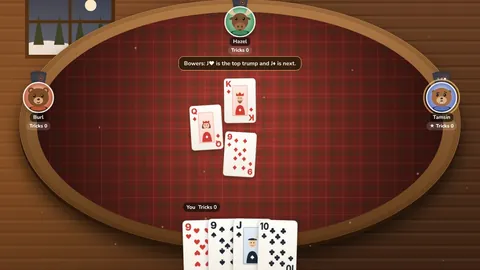
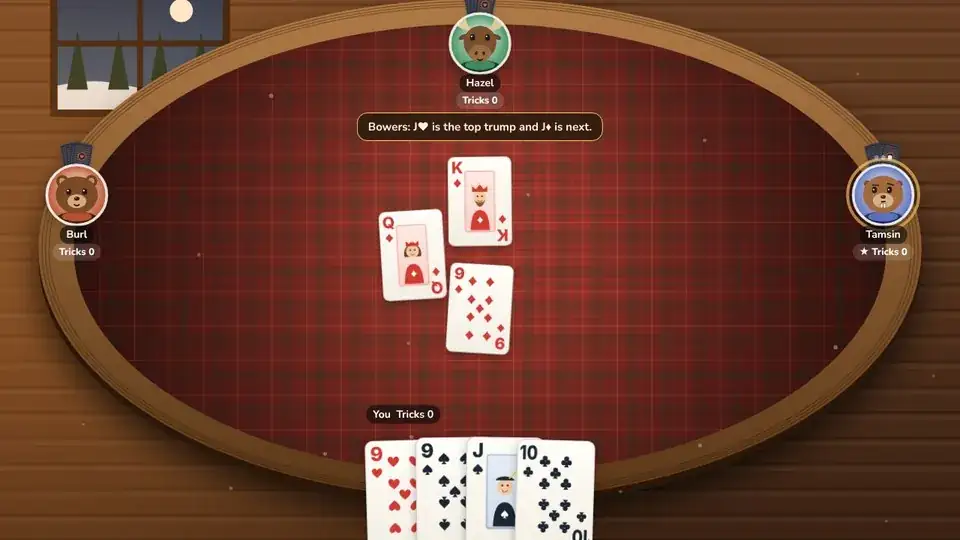
Euchre uses 24 cards, so 20 are dealt and 4 sit in the kitty. When a suit is trump it has seven cards: the right bower (jack of trump), the left bower (the other jack of the same color), then ace, king, queen, 10 and 9. The suit of the same color as trump has only five cards, because its jack has moved over. The makers need 3 of the 5 tricks; taking all 5 is a march for 2, and falling short is a euchre, 2 points to the defenders.
Everything below assumes the rules in Euchre Lodge: four players in two partnerships, stick the dealer in round two, and going alone allowed.
A starting rule for calling
A simple rule of thumb: call trump when you hold three trumps, or two trumps including a bower plus an off-suit ace. Your partner is expected to take about one trick, so you need to be confident of about two.
Then adjust for your seat. Where you sit relative to the dealer changes what ordering up actually does.
Calling by seat in round one
| Seat | What ordering up does | How strong you should be |
|---|---|---|
| Left of dealer (first to speak) | Gives the opposing dealer a trump | Strong. You also lead first, which helps. |
| Dealer's partner | Gives your partner a trump | Medium, but it uses up your chance to call your own suit in round two. |
| Right of dealer | Gives the opposing dealer a trump | Strong, though by now you know two players passed. |
| Dealer | You pick it up yourself | The lightest, since the upcard joins your hand. |
The dealer's position is special. If you're the dealer and the upcard is a bower or the ace of trump, even a modest hand can be worth picking up, because that card is yours.
The dealer's discard
When the dealer picks up the upcard, they discard one card face down. Use that discard to make a void: throw your only card of a side suit, ideally a low one. With no cards in that suit, you can trump it when it's led. A 9 or 10 that's alone in its suit is the classic throw. Keep off-suit aces unless you have a very strong trump hand.
Round two: playing next
If everyone passes the upcard, it's turned down and that suit can't be trump. In round two, a common call is next: the suit of the same color as the turned-down card. The reasoning is that the dealer's team chose not to pick up that color, and if you hold the jack of the turned-down suit, it becomes your left bower in next.
Sitting left of the dealer in round two, you speak first. Many players call next here with a little less than they'd normally need, since the turned-down card hints that the dealer wasn't strong in that color. The opposite color (the other two suits) is called reverse next, and it needs a genuinely good hand.
With stick the dealer, a dealer with a weak hand still has to choose. Pick the suit where you hold the most trumps, even if it's only two. Your partner knows you were forced and will help.
Going alone
Going alone means your partner sits out and you play your five cards against both opponents. A lone march scores 4, nearly half a game, but a lone hand that takes only 3 or 4 tricks scores just 1, and a euchre gives them 2.
Go alone when your hand can take all five by itself: both bowers and the ace of trump, for example, with a short side suit or an off ace. If you'd need a little help from your partner to march, play with them and settle for 2. A good test: picture the opponents leading their best side suit. Can you still take every trick?
Playing as the makers
- Lead trump early, especially if you hold the right bower. Pulling the defenders' trumps protects your side aces from being trumped.
- Count the trumps. There are seven. Once both bowers have fallen, the ace of trump is the boss card.
- If your partner called, lead them a trump. It's often the most helpful thing you can do.
- Don't trump your partner's winner. If Hazel's card is taking the trick, throw your lowest.
Playing as the defenders
- Lead off-suit aces. You want to cash your tricks before the makers trump them.
- Don't lead trump into the makers unless you're trying to strip a weak maker who was forced to call.
- Save your trumps for their winners. Trumping a side ace that the makers led is often how a euchre happens.
- Two tricks is not enough. You need three to euchre them. Count what's left before you throw a high card on a lost trick.
Worked example
Hearts are turned up and the opposing dealer is to your right, so you speak first. You hold J♦, A♥, A♣, 10♣ and K♠. In hearts, that's two trumps (the left bower and the ace) plus an off-suit ace. That meets the rule of thumb, and you lead first. Order it up.
Now play it. Lead the A♥: it draws trump, and since you hold the left bower, only the right bower beats you. If the right bower falls on that trick, your J♦ is now the highest trump left, so lead it next. If it doesn't, cash the A♣ and keep the J♦ to trump in later. With your two top trumps and an ace, you need one trick from your partner, which is exactly what the rule of thumb assumed.
Mistakes that cost points
- Ordering up the opposing dealer with a borderline hand.
- Forgetting the left bower counts as trump when following suit.
- Going alone without a sure march.
- Trumping your partner's winning card.
- Leading trump as a defender for no reason.
For the full rules, scoring and the Daily Deal, read our Euchre Lodge guide. If you like partnership trick-taking, our Spades bidding strategy and our Hearts article are good next reads.
Questions
When should you call trump in euchre?
A common rule is three trumps, or two trumps including a bower plus an off-suit ace. Be stronger when ordering up an opposing dealer, and a little lighter as the dealer.
What does calling next mean in euchre?
In round two, naming the suit of the same color as the turned-down card. You might hold its left bower, and the dealer's team passed on that color.
When should you go alone in euchre?
When your hand can take all five tricks by itself, such as both bowers and the ace of trump with good side cards.
How many trump cards are there in euchre?
Seven: the right bower, the left bower, then ace, king, queen, 10 and 9 of the trump suit.