
Games / Guides / Strategy articles / Mahjong tiles and layouts
Mahjong tiles and layouts explained
A mahjong solitaire set has 144 tiles in three suits (dots, bamboo and characters), two kinds of honor tiles (winds and dragons) and eight bonus tiles (flowers and seasons). You match identical pairs, except that any flower matches any flower and any season matches any season. Here's what every tile means, how the classic layouts change the game, and how we handle all of it in Mahjong Cloud Steps.
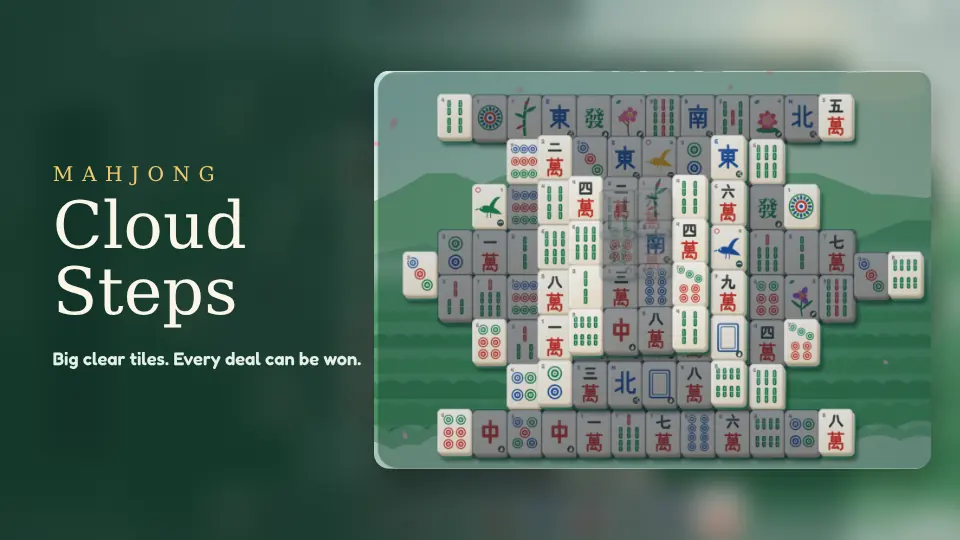
What's in a full set
Mahjong began as a four player game in China, and mahjong solitaire borrows its tiles for a one player matching puzzle. You don't need to know the four player game at all. You only need to recognize the tiles well enough to spot a pair.
A full set has 144 tiles, and they come in groups of four. That matters more than it sounds: there are four of almost every tile, so every kind can be cleared as two pairs.
| Group | Tiles | Copies | Total |
|---|---|---|---|
| Dots | 1 to 9 | 4 of each | 36 |
| Bamboo | 1 to 9 | 4 of each | 36 |
| Characters | 1 to 9 | 4 of each | 36 |
| Winds | East, South, West, North | 4 of each | 16 |
| Dragons | Red, Green, White | 4 of each | 12 |
| Flowers | 4 different | 1 of each | 4 |
| Seasons | 4 different | 1 of each | 4 |
Count the kinds and you get 36: 27 suited tiles, 4 winds, 3 dragons, plus the flowers and seasons, which each act as one kind. Thirty six kinds times four is 144, which is why every classic board starts with exactly that many tiles.
The three suits
The suits are the numbered tiles, like the suits in a deck of cards. Each runs from 1 to 9.
- Dots (also called circles or coins) show that many round coins. The 1 of dots is one big circle, and the 9 is a neat block of nine.
- Bamboo (also called bams or sticks) show that many bamboo sticks. The odd one out is the 1 of bamboo, which is traditionally drawn as a bird, so beginners often mistake it for a flower tile. It isn't. It matches only another 1 of bamboo.
- Characters (also called cracks) show a Chinese numeral from one to nine above the character for ten thousand. If you can't read the numeral, look for the small number many sets print in the corner.
In mahjong solitaire, suit and number must both match. A 5 of dots goes with a 5 of dots, never with a 5 of bamboo. In Mahjong Cloud Steps every suited tile shows its number in the corner, so you never have to count coins or read characters to find a pair.
Honor tiles: winds and dragons
Honor tiles have no numbers. There are seven of them, four copies each.
Winds
The four winds are East, South, West and North. On a classic tile each one is a single Chinese character, often with a small letter E, S, W or N in the corner. East matches only East, and so on.
Dragons
The three dragons are Red, Green and White. The red dragon is the character for center, the green dragon is the character for fortune, and the white dragon is usually a blank tile or a plain blue frame. Many first time players think the white dragon is a spare or a mistake. It's a real tile, and there are four of them to match.
We draw all of these our own way. In our default Cloud critters style the winds are swirly gust friends blowing the way their letter points, and the dragons are round little sky dragons in red, green and white. Prefer the old look? The Classic ivory set is in the Collection, and Large print and High contrast are open from the very first board.
Bonus tiles: flowers and seasons
The eight bonus tiles are the exception to the one rule of mahjong solitaire. There's only one of each, so they can't match an identical twin. Instead:
- Any flower matches any other flower.
- Any season matches any other season.
- A flower never matches a season.
In Mahjong Cloud Steps, birds take the place of the seasons. Any bird matches any bird, and a flower never matches a bird. Since you only get four of each group, think of them as one kind with four members: two pairs to clear, in whatever combination you like.
Which tiles you can take
Knowing the tiles is half of it. The other half is knowing which ones are in play. A tile is free when nothing sits on top of it and at least one of its long sides, left or right, is open. Tiles above or below it in the same layer don't matter.
So a tile at the end of a row is free, and a tile in the middle of a row is stuck until a neighbor on one side is gone. Our boards shade blocked tiles darker, so the bright ones are always the ones you can play. Once you're comfortable with that, our article on how to win at mahjong solitaire covers which pair to take first.
The classic layouts
A layout is the shape the 144 tiles are stacked in. The tiles are the same in every layout, but the shape changes which tiles start out blocked, and that changes the whole game. The Classic big board in Mahjong Cloud Steps has five, and every deal on every one of them can be cleared.
Pyramid
Four layers that get smaller toward the top, with 76 tiles on the bottom, then 44, then 20, then 4. It's the gentlest of the five because each layer is a simple stepped block. Start at the top and the ends of the long rows.
Turtle
The best known mahjong shape. The shell is four layers, a single tile sits right on the very top, and a few tiles stick out at the sides as the head and tail. Those side tiles block the ends of the two middle rows, so clearing them early opens a lot of the board. The tile on top must go before the four under it are free.
Butterfly
Three layers spread into two wings with gaps at the top and bottom of the middle. The wings give you more row ends to work from, but the raised body down the center holds tiles you'll need late, so dig into it early.
Fortress
A wide walled base of 92 tiles, a second layer built like a wall with an open courtyard in the middle, and four single towers on the corners. The courtyard floor has nothing on top of it, but they sit in the middle of full rows, so they stay blocked until the row is opened from one end.
Bridge
The flattest layout: six long rows of 16 tiles on the bottom and two narrower raised layers across the middle. Long rows mean lots of tiles stuck in the middle of a row, so the game is all about opening row ends evenly instead of tunneling down one side.
Open the Classic big board from the menu and tap Pick a layout to choose. On a phone held upright, each layout turns to fit the tall screen. The Classic big board plays by traditional rules, with no fog and no tile powers, and Hint, Shuffle, Undo and the holding tray are all free.
Where to start if you're new
Don't jump straight to 144 tiles. The climb in Mahjong Cloud Steps starts in the Tea Garden with small boards where every match is a safe one, and the boards grow a layer at a time as you go. By the time you reach the full size boards in the Cloud Temple, spotting a 7 of characters next to a 7 of bamboo will feel automatic. Our full Mahjong Cloud Steps guide covers the climb, the stars and every mode.
Along the way, the honor and bonus tiles pick up powers. Match two winds and a gust blows the top tile off the tallest stack. Two dragons burn away a blocked tile and its twin. A flower pair grows a vine that frees a blocked tile, and a bird pair lifts a buried tile into your tray. They're a nice way to learn the honor tiles, because you start looking for them on purpose.
When you want a change, Carousel Tiles puts mahjong tiles on a carousel you spin, and Frost Pairs is a pairs puzzle on a frozen pond. Our mahjong games page has them side by side.
Questions
How many tiles are in a mahjong solitaire set?
144: four each of the 27 suited tiles, four each of the 4 winds and 3 dragons, plus 4 flowers and 4 seasons. Smaller boards, like the early levels in Mahjong Cloud Steps, use fewer tiles but always in matching sets.
What are the three suits in mahjong?
Dots (circles), bamboo (sticks) and characters (cracks), each numbered 1 to 9. A tile only matches the same number in the same suit.
What does the blank mahjong tile mean?
It's the white dragon, a real honor tile with four copies in the set. It matches only another white dragon.
Do flower tiles match each other in mahjong solitaire?
Yes. Any flower matches any other flower, and any season matches any other season. A flower never matches a season. In Mahjong Cloud Steps, birds take the place of seasons.
What is the turtle layout in mahjong?
The best known mahjong solitaire shape: a shell of four layers with one tile on top and a few tiles sticking out at the sides as the head and tail. You can play it free on our Classic big board.
Game guides


More strategy articles



You might also like
 10 minSaves
Carousel Tiles
Mahjong 3DMahjong pairs wrapped around a spinning carousel. Spin it, match free tiles and light up the ride as the painted horses appear.