
Games / Guides / Strategy articles / How to solve kakuro
How to solve kakuro
Kakuro is a crossword made of numbers. Instead of word clues you get sums, and instead of letters you write the digits 1 to 9. It looks like a lot of arithmetic, but most of the solving comes from a short list of sums that can only be made one way. Learn those and kakuro turns into a calm, steady puzzle.
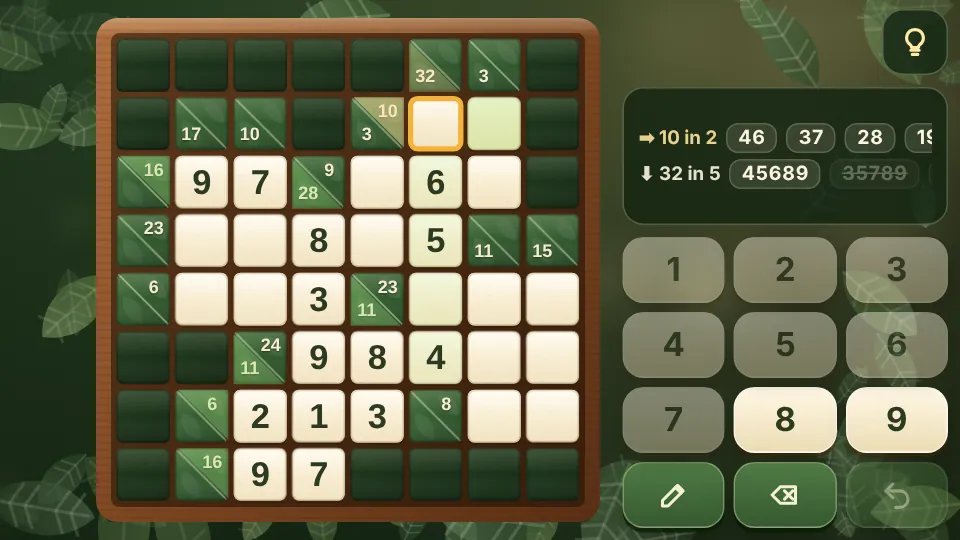
The rules
The board is a grid of empty squares and clue blocks. A line of empty squares going across is an across run, and a line going down is a down run. Every empty square belongs to one of each.
A clue block holds one or two numbers split by a diagonal line. The number above the line is the across clue: the squares to its right must add up to it. The number below the line is the down clue: the squares under it must add up to that.
Two rules decide everything. Each square takes a digit from 1 to 9, and a digit can't appear twice in the same run. That's why a two square run with a clue of 4 must be 1 and 3: 2 and 2 repeats a digit, and there is no 0.
The sums that can only be made one way
This is the heart of kakuro. For every run length, the smallest and largest few sums have exactly one set of digits. Spot them and you know which digits go in the run, even before you know their order.
| Squares in the run | Small sums with one answer | Large sums with one answer |
|---|---|---|
| 2 | 3 = 1+2, 4 = 1+3 | 16 = 7+9, 17 = 8+9 |
| 3 | 6 = 1+2+3, 7 = 1+2+4 | 23 = 6+8+9, 24 = 7+8+9 |
| 4 | 10 = 1+2+3+4, 11 = 1+2+3+5 | 29 = 5+7+8+9, 30 = 6+7+8+9 |
| 5 | 15 = 1+2+3+4+5, 16 = 1+2+3+4+6 | 34 = 4+6+7+8+9, 35 = 5+6+7+8+9 |
| 6 | 21 = 1 to 6, 22 = 1+2+3+4+5+7 | 38 = 3+5+6+7+8+9, 39 = 4 to 9 |
| 7 | 28 = 1 to 7, 29 = 1 to 6 and 8 | 41 = 2 and 4 to 9, 42 = 3 to 9 |
| 8 | Any sum: the missing digit is 45 minus the sum | |
| 9 | 45 = 1 to 9 |
You don't need to memorize the whole table. The two square runs and the three square runs come up all the time, and after a few puzzles you'll know them on sight.
Where two runs cross
Every square sits where an across run meets a down run, and its digit has to work for both. That's where the real solving happens.
Say an across run is 4 in two squares, so it uses 1 and 3. The down run through its first square is 7 in three squares, which has to be 1, 2 and 4. The only digit both runs allow is 1, so that square is 1, and the other square in the across run is 3. Hunting for crossings like that, where two runs agree on just one digit, is most of kakuro.
A step by step way to solve
- Start with the runs from the table above. Write their digits as small notes in each square.
- At each crossing, keep only the digits both runs allow. A square left with one note is solved.
- When a run has one square left, the last digit is simply the clue minus what's already there.
- Use leftovers. If a run of three adds to 15 and two squares are already 4 and 5, the last one is 6.
- Look for a digit that can only go in one place within a run, even if that square still has other notes.
Repeat the loop. Each solved square narrows the runs it belongs to, and those narrow the next crossings.
Tips for bigger boards
- Count in whole arrangements. On a long run, list the sets that make the clue and cross out the ones a crossing run makes impossible.
- Big clues love big digits. A clue near the top of its range must use 7, 8 and 9, so those digits are spoken for elsewhere in the run.
- Watch for pairs. If two squares in a run can only be 1 and 3, no other square in that run can use 1 or 3.
- Never guess. A good kakuro always has one answer you can reach by reasoning, so if you feel a guess coming, there's a crossing you haven't checked.
Kakuro or sudoku?
If you like sudoku, kakuro will feel familiar and new at the same time. Sudoku gives you some digits and asks for 1 to 9 in every row, column and box. Kakuro starts empty, gives you only sums, and changes shape from puzzle to puzzle. Many players enjoy alternating the two, with Ninebark Sudoku for sudoku days.
Practice kakuro free
Sumleaf Kakuro is our kakuro, free in your browser in a quiet garden. Every puzzle has exactly one answer, five levels run from 6 by 6 up to 12 by 12, and the Daily Puzzle is the same for everyone that day. A sum helper under the board lists every set of digits that can make the clues for the square you pick and crosses out the ones your digits rule out, so it's a lovely way to learn the table above without memorizing it. Notes, undo and hints that explain the next step are always there.
For more number logic, try Cagewise or browse our logic puzzles.
Questions
What are the rules of kakuro?
Fill each empty square with a digit from 1 to 9 so every run adds up to its clue, and never use the same digit twice in one run.
Is kakuro hard?
It's easier than it looks. Small and large sums can only be made one way, and those give you a starting point on every board.
Is kakuro like sudoku?
They're cousins. Both use the digits 1 to 9 without repeats, but kakuro uses sums instead of starting digits, and its board changes shape every puzzle.
Where can I play kakuro free?
Sumleaf Kakuro is free in your browser with five levels, a Daily Puzzle, a sum helper, notes and hints, and every puzzle has exactly one answer.
Game guides
More strategy articles
 Shut the box strategyPinewood Shut the Box
 Liar's dice odds and strategyFibberfern Liar's Dice
 How tennis scoring worksClover Court Tennis
 Cornhole rules and scoringConeflower Cornhole
 Archery scoring and aimingFeatherfield Archery
 Go for beginnersAirscape Go
 Darts 501 checkout tipsAirscape Darts
 Jigsaw puzzle tipsMossnook Jigsaw
You might also like
 10 minSaves
Ninebark Sudoku
SudokuClassic sudoku from Easy to Master, rated by the techniques each puzzle needs. Hints that explain the next step, notes, unlimited undo and a daily sudoku with streaks.