
Games / Puzzle Games / Sumleaf Kakuro / Guide
How to play Sumleaf Kakuro
Kakuro online free, in a quiet garden: fill the squares so every run of digits adds up to its clue, with no digit used twice in a run.
This is our guide to playing Sumleaf Kakuro. Want to jump straight in? Play Sumleaf Kakuro right here in your browser.
Quick answers
Does Sumleaf Kakuro work on my phone?
Yes. Sumleaf Kakuro works with touch on phones and tablets, and with a mouse or keyboard on a computer. It runs in the browser you already have, so there is no app to download.
Do I need an account to play Sumleaf Kakuro?
No. Just open it and play, with no sign-up. If you like, a free account (username only, no email, for players 13 and older) puts your scores on the leaderboards and backs up your progress so it follows you to any device.
Is there a daily challenge in Sumleaf Kakuro?
Yes. Sumleaf Kakuro has a new daily challenge every day, the same one for every player, with its own daily leaderboard. Find it alongside the others on our daily challenges page.
Does Sumleaf Kakuro save my progress?
Yes. It saves on this device on its own, so you can close the page and pick up where you left off. Sign in with a free account to keep the same progress on your phone and your computer.
Is Sumleaf Kakuro OK for kids?
Yes, players of any age can enjoy it. There is no chat and no way to message other players, and nobody needs an account to play. Accounts are for players 13 and older, so younger players just play and their progress stays on their device. For ages 4 to 11 we also have learning games in their own kids area, with no ads, no accounts and no tracking.
Kakuro online free, in your browser
Sumleaf Kakuro is our kakuro, free to play online in your browser on a phone, tablet or computer, with nothing to install. Kakuro is often called cross sums, and the easiest way to picture it is a crossword made of numbers. Instead of word clues you get sums, and instead of letters you write digits from 1 to 9.
Every puzzle we serve has exactly one answer, and you can reach it by reasoning alone. Our generator proves both before a puzzle ever reaches you, so you never have to guess. There are five levels from a gentle 6 x 6 up to a roomy 12 x 12, a Daily Puzzle that everyone plays on the same day, a sum helper that lists the ways to make each clue, pencil notes, unlimited undo and hints that explain themselves.
How to play kakuro
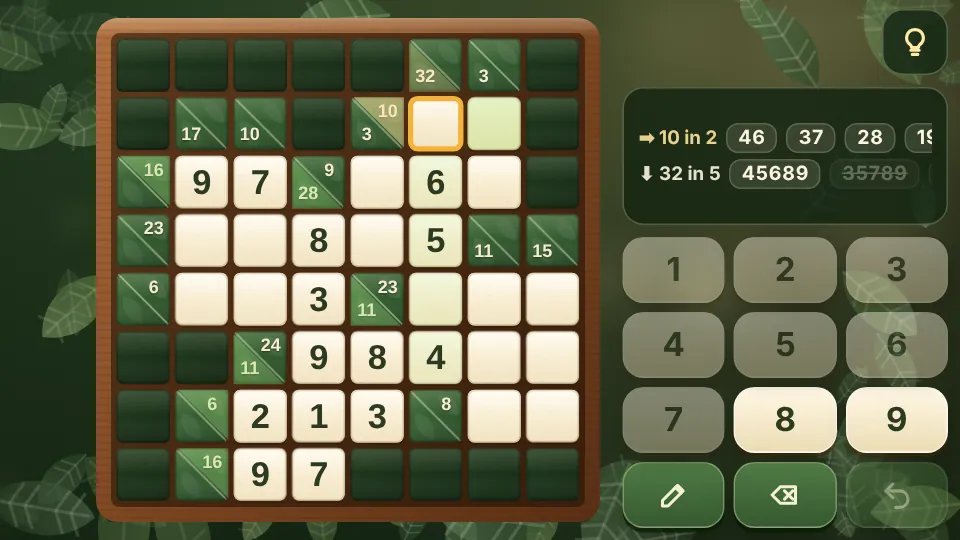
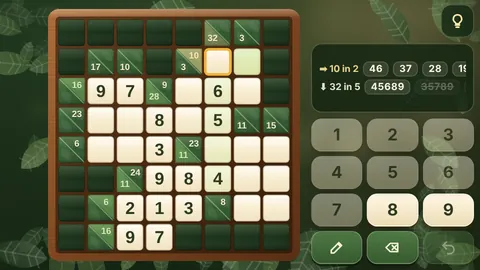
The board is a grid of cream squares and green clue blocks. A row of cream squares running across is an across run, and a column of them running down is a down run. Every cream square belongs to one of each.
A clue block can hold two numbers, split by a diagonal line. The number above the line is the across clue: the squares to its right, up to the next block, must add up to it. The number below the line is the down clue: the squares under it must add up to that.
Two rules decide everything. Each square takes a digit from 1 to 9, and a digit can't appear twice in the same run. So a run of two squares with a clue of 4 has to be 1 and 3. It can't be 2 and 2, and 4 and 0 isn't allowed because there is no 0. A digit can repeat elsewhere in the same row, as long as a block sits between the two runs.
You've solved the puzzle when every square is filled and every run adds up.
How kakuro differs from sudoku
If you play our Ninebark Sudoku, kakuro will feel related but different. Sudoku hands you some digits to start and asks for every row, column and box to hold 1 to 9 once. Kakuro starts with an empty board. All you have are sums, the shape of the board changes from puzzle to puzzle, and a run can be anything from two squares to nine.
It's also different from Cagewise, where no digit may repeat in a whole row or column and cages can use any of the four operations. Kakuro only ever adds, and the blocks break rows into separate runs.
Controls on a phone and on a computer
Tap a square to pick it. The two runs through it light up, and the clue halves that belong to them glow. Then tap a digit on the big keypad. Tapping the same digit again clears the square. Tap a square you've already picked to switch which of its two runs the helper puts first. Tap a clue block and we jump to the first empty square of that run.
The keypad also has Notes for small pencil marks, Erase and Undo. The lightbulb at the top gives a hint, and the pause button holds settings, Clear the board and New game.
On a computer, the arrow keys move, 1 to 9 fill a square, 0 or Backspace erases, N switches notes, H shows a hint, U or Z undoes and P pauses.
The sum helper
Under the board sits the sum helper. For the square you picked it shows both clues, for example "23 in 3", and every set of digits that makes them, such as 689. When a digit you've placed rules a set out, that set is crossed out, so you can see at a glance what's still possible. You can turn the helper off in Settings if you'd rather work the combinations out yourself.
Keys that can't fit the picked square fade a little, based on both clues and the digits already in its runs. They still work if you tap them. That setting can be switched off too.
Levels, the Daily Puzzle and stars
| Level | Board | What it asks |
|---|---|---|
| Seedling | 6 x 6 | Short runs; the sum tables do most of the work |
| Sprout | 8 x 8 | Look at what the crossing run allows |
| Leaf | 9 x 9 | Pairs of runs working together |
| Bloom | 11 x 11 | Long runs; think in whole arrangements |
| Grove | 12 x 12 | Our biggest boards, runs up to nine squares |
The board size counts the clue row and column, the way kakuro boards are usually quoted, so a 6 x 6 puzzle has a 5 x 5 area of squares and blocks.
The Daily Puzzle is the same for everyone on the same day and changes at your own midnight. It's gentler early in the week (8 x 8) and grows to 10 x 10 by the weekend. Your score starts at 400, loses 40 for each hint and 10 for each wrong digit, and gains a quick bonus of up to 300. Scores go on the daily leaderboard.
Each solved puzzle earns up to three stars: one for solving it, one for using no hints and one for placing no wrong digits. Stars unlock new tray finishes (Birch, Moss, Plum blossom and Lantern dusk), and three small goals each day pay two bonus stars when you finish all of them.
Tips for solving kakuro
Learn the sums with one way
Some clues can only be made one way, and they're the doors into every puzzle. Two squares: 3 is 1 and 2, 4 is 1 and 3, 16 is 7 and 9, 17 is 8 and 9. Three squares: 6 is 1, 2 and 3, 7 is 1, 2 and 4, 23 is 6, 8 and 9, 24 is 7, 8 and 9. Four squares: 10 is 1 to 4, 11 is 1, 2, 3 and 5, 29 is 5, 7, 8 and 9, 30 is 6 to 9.
Cross the two runs
The fastest progress comes where two short runs meet. If the across run needs a 1 or a 2 and the down run needs a 2 or a 4, the square where they cross must be 2. The sum helper shows both lists side by side for exactly this.
Look for a digit with one home
Sometimes every way to make a clue includes the same digit, say a 9, and only one square of the run can still take a 9 because of its crossing run. That square is the 9, even if you don't know the rest yet.
Use notes for long runs
On Bloom and Grove boards, pencil the possible digits into a long run and trim them as the crossing runs fill in. Placing a digit clears it from the notes of both its runs, so the notes stay honest.
When you're stuck
Tap the lightbulb. If a digit on the board is wrong, it points at that square first. Otherwise it picks the next square we can be sure of and says why, in plain words. Tap it again to fill the square in.
Questions
Is Sumleaf Kakuro free?
Yes. Every level, the Daily Puzzle, hints and the sum helper are free in your browser, with no download.
Does every kakuro puzzle have one answer?
Every one of ours does. Our generator counts the answers of each puzzle and keeps it only when there is exactly one and plain reasoning can reach it.
What do the two numbers in a clue block mean?
The number above the diagonal is the sum of the run to its right. The number below the diagonal is the sum of the run below it.
Can a digit repeat in kakuro?
Not within one run. The same digit can appear twice in a row or column when a block separates the two runs.
Can I turn off mistake checking?
Yes. In Settings, switch off Show mistakes and wrong digits won't turn red. A full run that doesn't add up still shows a red clue, since that only uses the clue itself.
How big are the puzzles?
From 6 x 6 on Seedling to 12 x 12 on Grove, counting the clue row and column. The Daily Puzzle runs from 8 x 8 to 10 x 10.
Related guides
 How to play Ninebark SudokuSudoku
 How to play CagewiseMath logic puzzle
 How to play Mosaic LogicPicture logic
 How to play Moon JarDrop and merge
 How to play Jelly JarsSort puzzle
More to read
 How to solve kakuroStrategy articleSudoku techniques, from hidden singles to X-wingsStrategy article · Ninebark SudokuHow to solve nonograms: a worked 5x5 and the harder tricksStrategy article · Mosaic LogicPlay Sudoku OnlineRules, tips and games like thisLogic PuzzlesRules, tips and games like this
You might also like
10 minSavesNinebark Sudoku
SudokuClassic sudoku from Easy to Master, rated by the techniques each puzzle needs. Hints that explain the next step, notes, unlimited undo and a daily sudoku with streaks.