Games / Guides / Strategy articles / Sudoku techniques
Sudoku techniques, from hidden singles to X-wings
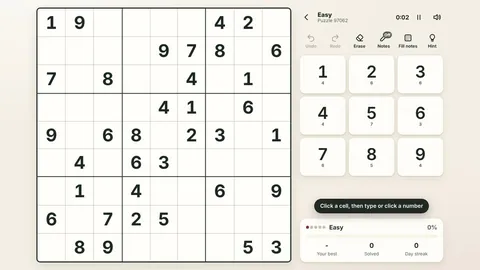
Every sudoku in Ninebark Sudoku can be solved with logic alone, but the logic changes as the levels climb. These are the techniques that matter, in the order you'll need them, each with a small worked example.
How to read this guide
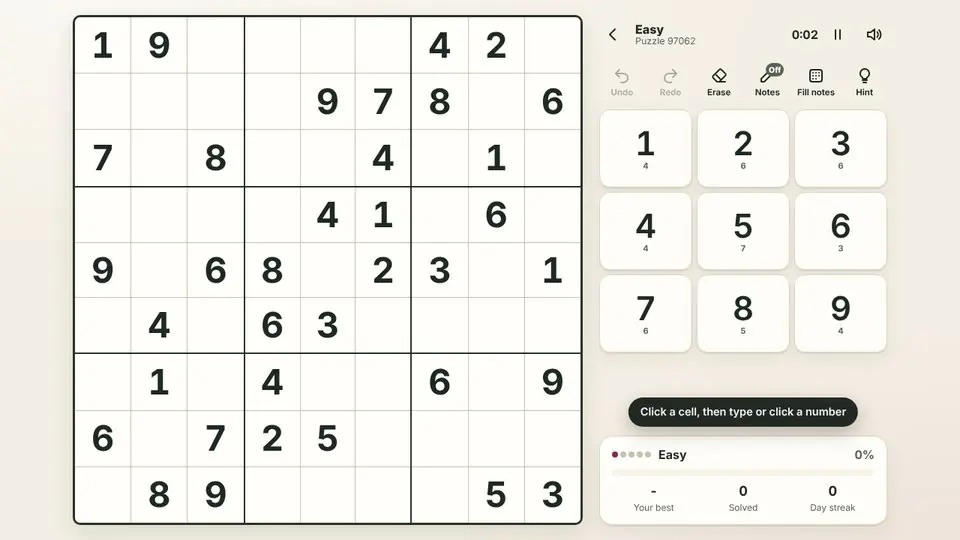
We name rows 1 to 9 from the top and columns 1 to 9 from the left, so r4c7 is row 4, column 7. Boxes are numbered 1 to 9 across and down, like a phone keypad: box 1 is the top left, box 5 the middle, box 9 the bottom right. Candidates are the numbers a cell could still be, the small notes you pencil in.
In Ninebark Sudoku each level is set by the hardest technique a puzzle needs. Easy needs only singles. Medium adds pointing and box lines. Hard adds pairs. Expert adds X-wings and triples. Master needs at least one of the big ones, like an XY-wing or a swordfish. So this guide follows the same ladder.
Naked single: the cell with one candidate
Flip the question around. Pick a cell and list what it can't be: every number in its row, column and box. If eight numbers are ruled out, the ninth is the answer. Naked singles are hard to see without notes, which is why many players switch to notes once hidden singles dry up. Fill notes in Ninebark Sudoku writes every candidate for you, and the game tidies notes when you place a number.
Pointing: when a box points down a line
Suppose that in box 1, the only cells where a 4 can go are r2c1 and r2c3. Both are in row 2. Wherever the 4 ends up in that box, it will be in row 2, so no other cell in row 2 outside box 1 can be a 4. Cross 4 out of r2c4 through r2c9.
The reverse also works, and it's usually called a box line. If in row 7 the only cells for a 2 are inside box 8, then the 2 in box 8 must be in row 7, and you can remove 2 from the other cells of box 8. These two moves unlock most Medium puzzles.
X-wing: two rows, two columns
Pick one number and look for two rows where it has exactly two possible cells, and those cells sit in the same two columns. Say the 6 in row 2 can only go in c3 or c7, and the 6 in row 8 can also only go in c3 or c7.
| c3 | c7 | |
|---|---|---|
| r2 | 6? | 6? |
| r8 | 6? | 6? |
Either the 6s sit at r2c3 and r8c7, or at r2c7 and r8c3. In both cases, columns 3 and 7 each get their 6 from rows 2 and 8. So no other cell in column 3 or column 7 can be a 6. Cross them all out. The same pattern works with columns and rows swapped.
A swordfish is the same idea with three rows and three columns. It's a Master level move, so if you're on Expert, X-wings are enough.
A look at the XY-wing
The XY-wing uses three cells with two candidates each. A pivot cell has candidates X and Y. It can see two other cells (it shares a row, column or box with each): one with X and Z, one with Y and Z. Whatever the pivot turns out to be, one of those two wings must be Z. So any cell that can see both wings can't be Z.
Example: the pivot r5c5 is 1 or 4. It sees r5c2, which is 1 or 9, and r2c5, which is 4 or 9. If the pivot is 1, r5c2 is 9. If the pivot is 4, r2c5 is 9. Either way there's a 9 in one of the wings, so r2c2, which sees both, can't be 9.
Which technique to look for next
- Hidden singles, number by number, box by box.
- Naked singles, once notes are in.
- Pointing and box lines.
- Naked and hidden pairs, then triples.
- X-wings, one number at a time.
- Wings and chains, only on Master.
After every placement, go back to step one. A single new number often opens two or three more singles, and players who jump straight to fancy patterns miss them. When you're stuck, the Hint button in Ninebark Sudoku names the technique and explains the step, which is the fastest way we know to learn to see these patterns on your own.
Common mistakes
- Guessing. A good sudoku never needs it, and a guess can quietly break the whole grid.
- Wrong notes. One missing candidate leads to a false single. Fill notes, then trust the tidy-up.
- Hunting for X-wings before checking singles again.
- Forgetting that pairs work in boxes too, not just rows and columns.
For the controls, levels and the Daily Sudoku, read our Ninebark Sudoku guide or our play sudoku online page. If you enjoy this kind of logic, our nonogram techniques article and our mines puzzle patterns use the same habit of ruling things out.
Questions
What is the easiest sudoku technique?
The hidden single: pick a number and a box, and find the only cell where that number can go.
Do you ever have to guess in sudoku?
Not in a well made puzzle. Every puzzle in Ninebark Sudoku has one answer that can be reached with logic alone.
What is an X-wing in sudoku?
Two rows where one number has exactly two possible cells, in the same two columns. That number must take both columns from those rows, so it can be removed from the rest of those two columns.
Should I use notes in sudoku?
Yes, once singles run out. Notes make naked singles, pairs and X-wings visible.