Games / Guides / Strategy articles / Mines puzzle patterns
Mines puzzle patterns: 1-2-1, 1-2-2-1 and the rest
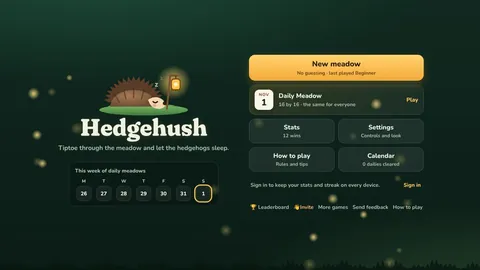
Good mines players don't work out every number from scratch. They recognise a handful of shapes along the edge of the open ground and know the answer at a glance. Here are the patterns we use in Hedgehush, why each one works, and how to spot the harder reads.
How to read the diagrams
In Hedgehush the mines are sleeping hedgehogs under leaves, and you hang a lantern where you're sure one sleeps. Each number on open soil counts the hedgehogs in the eight squares around it. In the diagrams below, numbers are open squares, … is a square that doesn't matter for the pattern, ? is a leaf we haven't decided yet, H marks a hedgehog we've worked out, and S marks a leaf that's safe to lift.
Most patterns happen along a border: a straight line of numbers with unknown leaves on one side only. That's where we'll start.
Start with the free reads
- A number equal to its unknown neighbors. A 2 with exactly two unopened leaves around it has a hedgehog under both. Hang both lanterns.
- A number already satisfied. A 1 that already touches a lantern has no more hedgehogs nearby, so every other leaf around it is safe. In Hedgehush you can tap that number to lift them all at once.
Everything else is just these two ideas applied cleverly.
The 1-1 from a wall
Two 1s side by side along a border, with the first one next to a wall or an opened square, so it touches only two unknown leaves.
| a | b | c | |
|---|---|---|---|
| Leaves | ? | ? | S |
| Numbers | 1 | 1 | … |
The first 1 touches leaves a and b, so its hedgehog is in one of those. The second 1 touches a, b and c. Its one hedgehog is already accounted for by a or b, so c must be safe. Lift it.
The 1-2: subtract the smaller number
This is the most useful idea in the game: compare two numbers that share leaves, work out how many hedgehogs the shared leaves can hold, and give the rest to the leaves only one of them touches.
| w | a | b | c | |
|---|---|---|---|---|
| Leaves | S | ? | ? | H |
| Numbers | … | 1 | 2 | … |
Along a flat border, the 1 touches w, a and b, and the 2 touches a, b and c. The 1 has only one hedgehog, so a and b hold one at most. The 2 needs two, so c must be a hedgehog, and a and b hold exactly one. That one satisfies the 1, so w is safe. Whenever a 1 and a 2 share all but one leaf, the extra leaf by the 2 is a hedgehog.
The 1-2-1
Three numbers in a row along a flat border, 1 then 2 then 1, with three unknown leaves above them.
| a | b | c | |
|---|---|---|---|
| Leaves | H | S | H |
| Numbers | 1 | 2 | 1 |
Use the 1-2 subtraction from both ends. The left 1 and the 2 say c holds a hedgehog. The right 1 and the 2 say a holds one. That's both of the 2's hedgehogs, so b is safe. Once you've seen it a few times you won't think about it again: hedgehogs under the 1s, safe leaf over the 2.
The 1-2-2-1
Four numbers along a flat border: 1, 2, 2, 1.
| a | b | c | d | |
|---|---|---|---|---|
| Leaves | S | H | H | S |
| Numbers | 1 | 2 | 2 | 1 |
This time the hedgehogs sit over the two 2s and the leaves over the 1s are safe. Check it with the 1-2 rule. Read the left 1 and the first 2 together and c must be a hedgehog. Read the right 1 and the second 2 together and b must be one. The first 2 touches a, b and c, and b and c already give it two, so a is safe. The same from the other side makes d safe.
Corners and walls
Walls shrink the number of neighbors, which makes numbers stronger. A 1 tucked into an inside corner of the open ground often touches just one leaf, which makes it an instant lantern. A 3 on a wall that touches only three leaves is the same: all three are hedgehogs.
The edges of the board count as walls too. Expert boards have long straight edges, and many of the biggest openings come from reading patterns along them.
When the patterns stop
Sometimes the border is ragged and no named pattern fits. Then go back to subtraction and look for two numbers whose unknown leaves overlap a lot. Write the sums in your head: if a 3 touches leaves p, q, r, s and a nearby 2 touches q, r, s, then p is a hedgehog by itself, and q, r, s hold two.
If you still can't find a move, look further away. Every no-guess meadow in Hedgehush has a sure step from any position a player could reach, and it's often on the far side of a long border or at the very end of a wall.
Endgame counting
The counter at the top shows how many hedgehogs still have no lantern. Near the end that number is a clue in its own right. If two hedgehogs are left and only one pocket of two leaves remains, they're both hedgehogs. If two are left, and one pocket has to hold two by its numbers, then every other unknown leaf on the board is safe.
When a guess is truly forced
In Classic mode, where hedgehogs land anywhere, you'll occasionally face a real fifty-fifty. A few honest tips. Take forced guesses early rather than late, so you don't throw away a long solve at the last step. If you have a choice, pick the guess that would give you the most new information if it's safe, such as a leaf that would open up a stuck region, over one that tells you nothing. And remember that a leaf far from any number has roughly the board's average chance of hiding a hedgehog, which is sometimes better than the local choice.
Speed habits
- Only hang the lanterns you need. Fast players mark a hedgehog when it lets them open around a number, and skip the rest.
- Open around satisfied numbers instead of lifting leaves one by one. It raises your efficiency, which Hedgehush shows after every win.
- Learn the patterns on Beginner, then try them on Intermediate, where long borders are common.
For controls, sizes and the Daily Meadow, read our Hedgehush guide, and our mines puzzle page explains the rules from scratch. For more pure logic, our sudoku techniques article uses the same subtraction thinking with numbers.
Questions
What does the 1-2-1 pattern mean?
Along a flat border, a 1, a 2 and a 1 with three leaves above them: the hedgehogs (mines) sit above the two 1s and the leaf above the 2 is safe.
What is the 1-2-2-1 pattern?
Four numbers along a flat border: the hedgehogs sit above the two 2s, and the leaves above the two 1s are safe.
Do you have to guess in a mines puzzle?
In classic random boards, sometimes. In Hedgehush's no-guess meadows and the Daily Meadow, never: our solver checks every board so a sure step always exists.
Do I need to flag every mine to win?
No. In Hedgehush you win by lifting every safe leaf. Lanterns are only there to help you.