
Games / Guides / Strategy articles / Checkers strategy
Checkers strategy: how to win more games
Checkers looks simple until someone takes three of your pieces in one move. Almost every game between casual players is decided by those shots, and nearly all of them come from the forced jump rule. Here's how to set them up, how to avoid them, and how to turn a lead into a win.
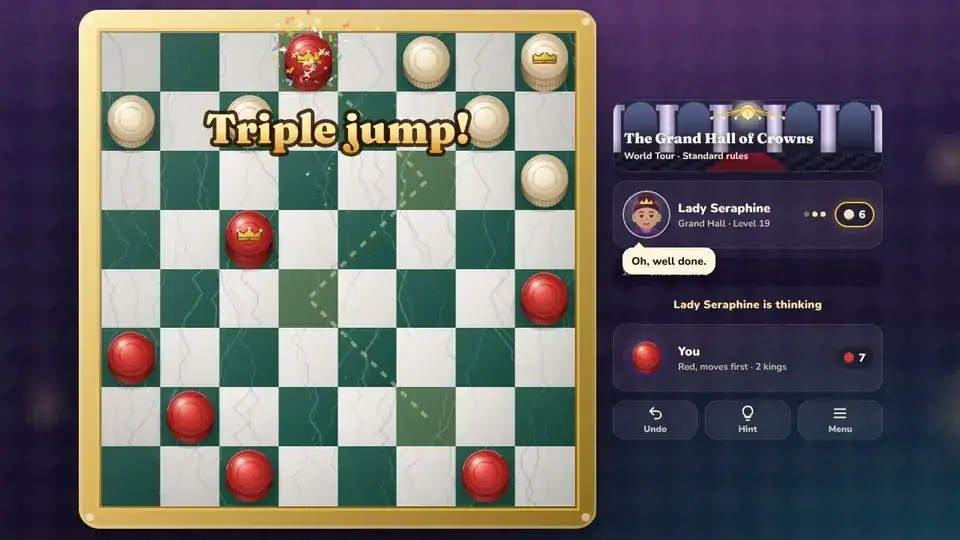
The rule that decides most games
In standard American checkers, jumping is a must. If any jump is available you have to take one, though you can choose which. That single rule means your opponent's moves are sometimes chosen for you. If you can force them to jump onto a particular square, you can plan what happens next.
Everything in this guide assumes the standard rules used in the World Tour, the puzzles and the Daily Puzzles of Crown Jump Checkers: men move and jump forward only, kings move one square at a time in any diagonal direction, and crowning ends the move.
A two-for-one shot, worked out
We'll name squares like a chess board: files a to h from left to right, ranks 1 to 8 from your side. You move up the board. Here's a small position.
| Side | Pieces |
|---|---|
| You | a1, b2, c3, f2, g1 |
| Them | c5, e5 |
You play c3 to d4, offering a man. They must jump it, and they have two ways to do it.
- If e5 jumps d4 and lands on c3, your man on b2 jumps c3 and lands on d4, then keeps going over c5 to b6. Two for one.
- If c5 jumps d4 and lands on e3, your man on f2 jumps e3 and lands on d4, then keeps going over e5 to f6. Two for one again.
Notice the men on a1 and g1. They're doing quiet but vital work: they fill the squares their jumping man would land on, so it can't carry on through your back row. Shots usually need that kind of support. Before you offer a piece, check where their jumping piece lands and whether it could keep jumping from there.
How to avoid walking into shots
- Look at the square you're leaving. Most lost pieces come from moving a man so that it leaves an empty square behind another one. That empty square is a landing spot for an enemy jump.
- Keep pieces in pairs. A man with a friend right behind it can't be jumped from the front, because there's no empty landing square.
- Count their forced jumps too. If your move gives them a jump, follow it to the end: where do they land, and what can they jump next?
- Use the hint and the review. Crown Jump's hint explains its move, and the game review marks your Mistakes and Blunders with a short sentence about what the move allowed.
Control the center
Men in the middle of the board have two forward moves. Men on the side have one. Center men also block more of your opponent's paths and support each other. Early in the game, aim to bring men toward the center squares and keep them connected. A piece on the edge is hard to capture, but it does little, and a side full of edge pieces is easy to lock up.
Guard your back row, then let it go
As long as your back row is occupied, your opponent can't crown. Moving those men early hands out free kings. A common compromise is the bridge: two back-row men, one in your double corner and one two squares along from it, with a gap between them. Together they make it very hard for a lone enemy man to slip through and crown. In Crown Jump you can turn on Square numbers in Settings to follow the standard notation.
Later in the game, once the enemy has few men left that could ever reach your back row, those guards are just idle pieces. Bring them into play.
Trade when you're ahead
Every even trade makes a lead bigger in proportion. Twelve against eleven is close. Four against three is a real edge. Two against one is a win. So when you're a piece up, look for one-for-one exchanges: offer a man where they must take it and you take one back. When you're behind, do the opposite. Keep pieces on the board, avoid trades, and look for a shot or a draw.
Race for the first king
A king moves backward as well as forward, so it can attack men from behind and pick off stragglers. The first king of the game often decides it. If a man has a clear run to the far row with nothing able to stop it (a runaway), it's usually worth more than an extra man somewhere else. Keep an eye on the enemy's runaways too, and block their path before they get going.
Winning the endgame
Two kings beat one, but you have to know the double corner. The two-square corners are where a lone king hides, because it can shuttle back and forth between the two squares. To win, bring both kings close, take away the shuttle squares one at a time and force the lone king out into the open. If you're the one who is behind, head for a double corner: our game calls a draw after 40 moves each with no capture and no man moved, so a stubborn defense can save the game.
In endings with only a few men and no kings yet, count moves. Sometimes the side that has to move is the one that loses, because every move walks a man into danger. Before you trade down into an ending, ask who will be forced to move first once the board locks up.
Mistakes that lose checkers games
- Moving back-row men early.
- Leaving single men out in front with no support.
- Forgetting that their forced jump might not stop after one hop.
- Trading when you're behind.
- Letting a lone king sit in a double corner while you chase it with one king.
For the rules, the World Tour rivals and the other rule sets, read our Crown Jump guide or our play checkers online page. If you like board games of pure calculation, our reversi strategy article and our chess openings article are good next reads.
Questions
Do you have to jump in checkers?
Yes, in standard American checkers. If any jump is available you must take one, though you may choose which one.
What is the best strategy in checkers?
Keep your men together and toward the center, guard your back row early, use forced jumps to set up multi-jumps, and trade pieces when you're ahead.
Can two kings beat one king in checkers?
Yes, with care. The lone king tries to shuttle in a double corner, so the stronger side must bring both kings close and force it out.
Is it better to move pieces on the edge?
Edge pieces are hard to capture but have only one forward move. Center pieces usually do more work, so most players keep the edges for later.
Game guides
More strategy articles
 Reversi strategyRosehip Reversi
 Backgammon strategy for beginnersBracken Backgammon
 Mancala strategyMulberry Mancala
 Four in a row strategyDamson Drop
 Dots and boxes strategyPrimrose Paddocks
 Sea battle strategySamphire Salvo
 Farkle odds and strategyFoxglove Farkle
 Cribbage pegging strategyAirscape Cribbage
You might also like
 Long playSaves
Kingsway Chess
ChessTravel the Kingsway and beat 30 rivals, up to an opponent no human has beaten. Puzzles, hints and game review, all free.