Games / Guides / Strategy articles / Chess openings for beginners
Chess openings for beginners
You don't need to memorize long lines to play a good opening. Learn three rules and a few first moves, then practice them against rivals who know the main lines too.

Three rules that beat memorizing
Every good opening follows the same ideas. If you remember nothing else, remember these.
- Claim the center. Put a pawn on e4 or d4 as White (e5 or d5 as Black). Pieces in the middle of the board reach more squares.
- Develop your knights and bishops. Bring each one out once, toward the center, before you move any piece twice. Knights usually go to f3 and c3 (f6 and c6 for Black).
- Castle early. Castling tucks your king behind pawns and brings a rook toward the middle. A king left in the center gets hit once pawns start trading.
Two things to avoid: bringing your queen out early, where it gets chased while your opponent develops for free, and grabbing pawns on the edge of the board while your pieces are still at home.
How to read the moves
Openings are written in standard notation. The board's columns are a to h from White's left, and the rows are 1 to 8 from White's side. A move like e4 means a pawn goes to e4. A capital letter is a piece: N is a knight, B a bishop, R a rook, Q the queen and K the king, so Nf3 is a knight to f3. An x means a capture, and O-O is castling on the king's side. Move numbers count one White move and one Black move together, so 1.e4 e5 is the first move for both.
As White: the Italian Game
1.e4 e5 2.Nf3 Nc6 3.Bc4. This is the best first opening we know. Every move follows the rules above: a center pawn, a knight that attacks Black's e5 pawn, and a bishop aimed at f7, the weakest square near Black's king because only the king guards it. After 3...Bc5, a calm and solid plan is 4.c3, 5.d3 and 6.O-O. You're developed, castled and set to push d4 later.
If Black plays 3...Nf6 instead, you can keep it simple with 4.d3 and castle. You don't need to know the sharp lines to play the Italian well.
As White: the Queen's Gambit or the London System
If you'd rather start with the queen's pawn, there are two good choices.
Queen's Gambit: 1.d4 d5 2.c4. You offer the c-pawn to pull Black's d-pawn away from the center. If Black takes with 2...dxc4 (the Queen's Gambit Accepted), you usually get the pawn back later while you build a big center. If Black holds with 2...e6 (the Queen's Gambit Declined), develop with Nc3, Bg5, e3 and Nf3, then castle.
London System: 1.d4 d5 2.Bf4. The London is a setup more than a line. You get the dark-squared bishop out to f4, then play e3, c3, Nd2, Nf3 and Bd3, and castle. It works against almost anything Black does, which is why so many club players use it.
As Black against 1.e4
The simplest answer is 1...e5. It claims your share of the center, and you can follow the same rules: knights to c6 and f6, a bishop out, castle. Against the Italian, 3...Bc5 is natural. Against the Ruy Lopez (3.Bb5, attacking the knight that guards e5), the main reply is 3...a6, asking the bishop what it wants.
The Sicilian, 1...c5, is the most popular answer at master level and leads to lively, unbalanced games. It's worth trying once you're comfortable, but it asks for more knowledge than 1...e5 does.
Don't fall for the four-move mate
Against beginners, White sometimes plays 1.e4 e5 2.Bc4 Nc6 3.Qh5, with the queen and bishop both aimed at f7. If you play the natural looking 3...Nf6??, then 4.Qxf7 is checkmate. Block the threat instead with 3...g6, and after 4.Qf3 defend again with 4...Nf6. White's queen is now out early and you can develop with tempo by chasing it.
As Black against 1.d4
Meet it with 1...d5, and against 2.c4 play 2...e6, the Queen's Gambit Declined. Your d5 pawn stays rooted in the center, your king's bishop is free to come out to e7, and you castle quickly. It isn't flashy, but it has held up against the best players in the world for over a century.
Practicing openings in Kingsway Chess
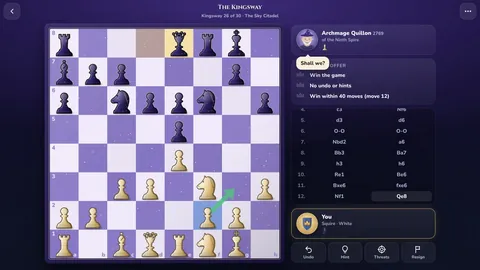
Kingsway Chess is a good place to try these because of how the rivals are built. The first eight play like real beginners: they look only a few moves ahead, slip on purpose and miss mates, and they don't use an opening book. That's where you practice the three rules with no pressure. From rival 9, the rivals start opening with named main lines, and from rival 23 on they play the book whenever the position is in it, for roughly the first dozen moves. Their book includes the Ruy Lopez and its Berlin line, the Italian Game, the King's Gambit, seven Sicilian lines (the Najdorf, Dragon, Taimanov, Sveshnikov, Rossolimo, Alapin and Closed), the Queen's Gambit Accepted and Declined, the London System, the English and the Reti.
In Quick Play you can pick any rival you've reached, or a strength slider, and choose White, Black or Random. Play the same opening five games in a row and it starts to feel natural.
After the game, tap Review. The engine labels every move from Brilliant to Blunder and draws an evaluation graph. Look at the first ten moves: if the graph drops early, that's the opening mistake worth fixing. Hint draws a green arrow with a strong move when you're stuck, and Threats circles any piece you've left hanging, which is the most common way beginners lose in the opening.
A simple plan to start
- Pick one opening as White (the Italian or the London) and one answer to each of 1.e4 and 1.d4 as Black.
- Play them against the first rivals until the first six moves come without thinking.
- Check the first ten moves in Review after every game.
- Only then add a second opening.
Once the opening is under control, the middle game is where games are won. Our Kingsway Chess guide covers tactics, endgames and the rules people most often get wrong, like en passant and castling through check. For more board games, see play chess online and play checkers online.
Questions
What is the best chess opening for beginners?
The Italian Game (1.e4 e5 2.Nf3 Nc6 3.Bc4) for White, because every move follows the basic opening rules. As Black, 1...e5 against 1.e4 and the Queen's Gambit Declined against 1.d4 are simple and sound.
How many opening moves should a beginner memorize?
Five or six moves of one or two openings is plenty. Understanding why you claim the center, develop and castle matters far more than long lines.
How do I stop the four-move checkmate?
After 1.e4 e5 2.Bc4 Nc6 3.Qh5, play 3...g6 to block the queen, then 4...Nf6 after 4.Qf3. Avoid 3...Nf6, which allows 4.Qxf7 checkmate.
More strategy articles
 How to win at Spider SolitaireMoonlit Spider
 Three stars every timeCopper Pot Kitchen
 How to catch rare bugsBramble Bug Museum
 How to win at Mahjong SolitaireMahjong Cloud Steps
 Pinball tips for beginnersPocket Pinball
 Bubble shooter strategyBubble Bay
 How to win at FreeCellFour Cells
 How to win at Klondike solitaireCanyon Klondike
 Color sort puzzle tipsJelly Jars
 Daily word puzzle strategyLetter Lantern
 How to shoot the moon in HeartsHearts Hollow
 Peaks solitaire strategyStar Solitaire
 Sprout Parade tipsSprout Parade
 How to beat the computer at chessKingsway Chess
 Orbit Hop tipsOrbit Hop
You might also like
 Long playSaves
Crown Jump Checkers
CheckersClassic checkers with a world tour of rivals, chain-jump fireworks and a champion who never slips.