Games / Guides / Strategy articles / Orbit Hop tips
Orbit Hop tips: when to chase perfects and when to play safe
Orbit Hop is one button and one decision per hop. We ran hundreds of runs through the game itself with different aiming styles and different amounts of timing wobble, to see what really moves your score.

How a hop works
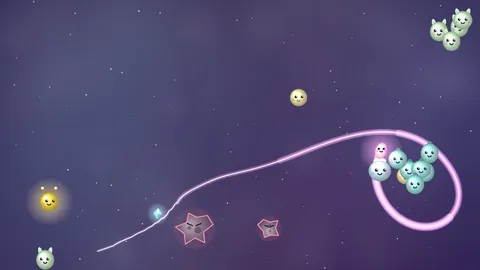
In Orbit Hop your comet circles a planet. Tap and it leaves in a straight line in the direction it was moving. If that line crosses another planet's orbit ring, you're caught. If not, you drift off into the dark, or you stay in flight too long, and the run is over.
Every new planet pays 10 points times your multiplier. A perfect skim, where your line passes right along the surface of the planet that catches you, doubles the multiplier, up to x32. Any ordinary catch on a new planet drops it back to x1. So score is mostly about chains of perfects, and distance is mostly about not missing.
What we tested
The game has a built-in practice bot that plays real runs through the same physics you do. We ran it 60 times for each setup. It either aimed at the middle of the next planet or at its edge, for a perfect, and we added a little random error to every tap: a very steady thumb (typically off by about two hundredths of a second), a normal one (about four hundredths) and a shaky one (about seven hundredths).
| Tap timing | Aim | Planets reached | Average score |
|---|---|---|---|
| Very steady | Middle | 70 | 2,632 |
| Very steady | Edge | 71 | 3,371 |
| Normal | Middle | 35 | 1,265 |
| Normal | Edge | 29 | 1,001 |
| Shaky | Middle | 18 | 454 |
| Shaky | Edge | 17 | 435 |
Steady timing beats everything
Look down the planets column. Going from a very steady tap to a normal one cut the distance in half, and a shaky tap cut it in half again. Nothing else we changed came close. The difference between those rows is a few hundredths of a second, which is about how much your thumb drifts when you rush, look away from the comet or tap on the beat of the music instead of the orbit.
So the first tip is boring and true: watch your comet, not the next planet, and tap when its direction points where you want to go. Gas giants spin slowly and give you the most time, so use them to settle down. Ice worlds spin about 40 percent faster than rocks, so the right moment comes sooner than it feels.
Chase perfects only when your timing is steady
Here's the interesting part. With a very steady tap, aiming for the edge scored about 28 percent more than aiming for the middle, and it didn't cost any distance at all. With a normal tap, the same edge aiming scored less and ended runs sooner, because a line that just grazes the planet has less room for error than one through the middle.
A perfect needs your line to pass within a thin band right along the planet's surface. That band is the same width on every planet, so on a big gas giant it's a small slice of the whole catch ring, and on a tiny pulsar a near miss is a real miss. In practice:
- Early in a run, or when you're warming up, aim through the middle and get a feel for the spin.
- Once a few hops in a row feel easy, start aiming for the near edge and build the multiplier.
- At x8 or x16, look at the next planet before you go for it. If it's small, moving or a pulsar, take the safe hop. A missed perfect costs the chain, a missed planet costs the run.
What ends most runs
Across all our runs, drifting off into space ended the large majority, far more than meteors or black holes. Meteors ended only a handful of runs, because they only hurt you while you're flying and the bot waits for one to pass before it launches. With steady timing, black holes swallowed more of the edge-aiming runs (15 against 9), because waiting for a perfect angle gives the orbit more time to shrink. Launch from a black hole on the first decent angle, and take the escape bonus of 50 times your multiplier.
Quick checklist
- Watch the comet's direction, not the target.
- Settle your timing on gas giants, and tap a touch early on ice.
- Aim through the middle until the hops feel easy, then go for the edge.
- Bank a safe hop when the multiplier is high and the next planet is tricky.
- Never loiter in a black hole.
- Skips pay for every planet you jump, so a line that passes one planet and lands on the next is worth taking.
For planets, modes, Constellations and the Comet Shop, see the full Orbit Hop guide.
Questions
How do you get a perfect in Orbit Hop?
Launch so your straight line just grazes the surface of the planet that catches you, instead of going through its middle. Each perfect in a row doubles your multiplier, up to x32.
Should I always aim for perfects?
Only when your timing is steady. In our tests, edge aiming scored about 28 percent more with a very steady tap, but scored less and ended runs sooner with a slightly shakier one.
Why do my Orbit Hop runs end so fast?
Usually timing. A few hundredths of a second of drift halved the distance in our tests. Watch the comet, not the next planet, and slow down on gas giants.
Do meteors hurt you in orbit?
No. Meteors only hit you while you're flying between planets, so wait for one to pass before you launch.
More strategy articles
 How to win at Spider SolitaireMoonlit Spider
 Chess openings for beginnersKingsway Chess
 Three stars every timeCopper Pot Kitchen
 How to catch rare bugsBramble Bug Museum
 How to win at Mahjong SolitaireMahjong Cloud Steps
 Pinball tips for beginnersPocket Pinball
 Bubble shooter strategyBubble Bay
 How to win at FreeCellFour Cells
 How to win at Klondike solitaireCanyon Klondike
 Color sort puzzle tipsJelly Jars
 Daily word puzzle strategyLetter Lantern
 How to shoot the moon in HeartsHearts Hollow
 Peaks solitaire strategyStar Solitaire
 Sprout Parade tipsSprout ParadeHow to beat the computer at chessKingsway Chess