
Games / Guides / Strategy articles / How to catch rare bugs
How to catch rare bugs in Bramble Bug Museum
Rare bugs aren't random luck. Where you look, what time it is on your clock, the gear you carry and a couple of skills all change what turns up in the grass. Here's how it works and how to use it.
How rarity works
Every insect in Bramble Bug Museum is Common, Uncommon, Rare or Legendary. When a hiding spot fills, the game picks a bug from the species that are out right now in that habitat. Rarer species carry a smaller weight in that draw. Next to a common bug, an uncommon one is a bit less than half as likely, a rare one about a seventh as likely, and a legendary one about a thirtieth. You can change which bugs are in the draw, how heavily the rare ones count and how often you roll.
Be in the right place at the right time
The game follows your device's real clock and calendar. Morning runs from 5 to 10, day from 10 to 5 in the afternoon, evening from 5 to 9 and night after that. Winter is December to February, spring March to May, summer June to August and autumn September to November. A species only joins the draw when its habitat, time and season all match.
Two habitats bend those rules. The Night Garden is always dusk inside its walls, so its moths and fireflies are out whatever the clock says. The Tropical Greenhouse is warm all year and ignores both time and season, so every greenhouse species can turn up any time you visit.
The trip menu tells you how many species are about right now. If a habitat has fewer than five out, it's a quiet hour, and you'll mostly find resting bugs under logs and bark instead. Resting finds are never legendary, so a quiet hour is a good time for filling gaps in your collection and a bad time for hunting the rarest.
The five legendaries and where to find them
- Purple Emperor: Old Forest, summer, morning or day. Caught with a net swing.
- Apollo: High Alpine, summer, day. Caught with a net swing.
- Rosalia Longhorn: High Alpine or Old Forest, summer, day. Caught with a gentle pick.
- Atlas Moth: Tropical Greenhouse, any time, all year. Caught with a lamp sheet.
- Hercules Beetle: Tropical Greenhouse, any time, all year. Caught with a bark trap.
Three of the five are summer-only, so outside June to August the greenhouse is the only place to hunt a legendary. It opens at reputation 18. The High Alpine opens at reputation 13 and needs alpine boots, and the Old Forest opens at 7.
There are plenty of rare (not legendary) species to chase on the way, like the Swallowtail in the Wild Meadow in spring and summer, the Luna Moth on summer and spring nights, glow-worms in the Night Garden in summer, the Emperor Dragonfly at the Mill Pond on summer days and the Blue Morpho in the greenhouse.
Carry the right gear
This one catches a lot of players. A species that needs a tool you don't own is left out of the draw entirely, so it never appears, however long you look. Pond bugs that need scooping need a jar. Moths on the lamp sheet and anything you catch by blinking in time need the moth lamp. Burrowers need a trowel, and bark-trap beetles need the bait kit. If a bug in the Guide tab never seems to show up, tap it to see what it needs.
Tilt the odds: Keen Eye and the Field Guide
- Keen Eye is the skill for this. Each level makes uncommon, rare and legendary bugs a little more likely and shiny bugs more likely too. Every two levels also add a hiding spot to each walk, up to seven spots from the starting four. More spots means more rolls.
- The Field Guide comes in five volumes. Each one raises your odds of rare finds a bit more than a Keen Eye level does. From Field Guide II, hiding spots with an uncommon or rarer bug show a small colored question mark, colored by rarity, so you can walk straight to the good ones.
- New species get a nudge. A species you've never caught is a quarter more likely to show up, which helps you fill the Guide.
- Each habitat has favorite families. The Wild Meadow leans toward butterflies, hoppers and bees, the Night Garden toward moths and fireflies, and the Old Forest toward beetles.
Use the calendar and the bug of the day
Ten seasonal events follow the real calendar, and during each one its species is three times as likely to show up. Some of them: the Monarch migration in the Wild Meadow from September 1 to October 20, the Red Admiral feast along the hedgerow from September 10 to October 31, Firefly nights in the Night Garden from June 15 to July 25, and Stag beetle season in the Old Forest from June 1 to July 15.
Every day also has a bug of the day, the same for everyone. It's never legendary, but it's nearly twice as likely to appear, and your first catch of it each day pays a bounty of 5 field notes.
Bark traps for the big beetles
The Stag Beetle, the Rhinoceros Beetle and the legendary Hercules Beetle are all trap species. When you meet one, drag the bait pot onto the mark and come back later. A trap springs in 15 minutes with the basic bait kit, 8 with the sugar trap and 5 with the sugar rope, and the Patience skill makes them spring faster. You can have three traps out at once, so set them before you close the game.
Don't let it get away
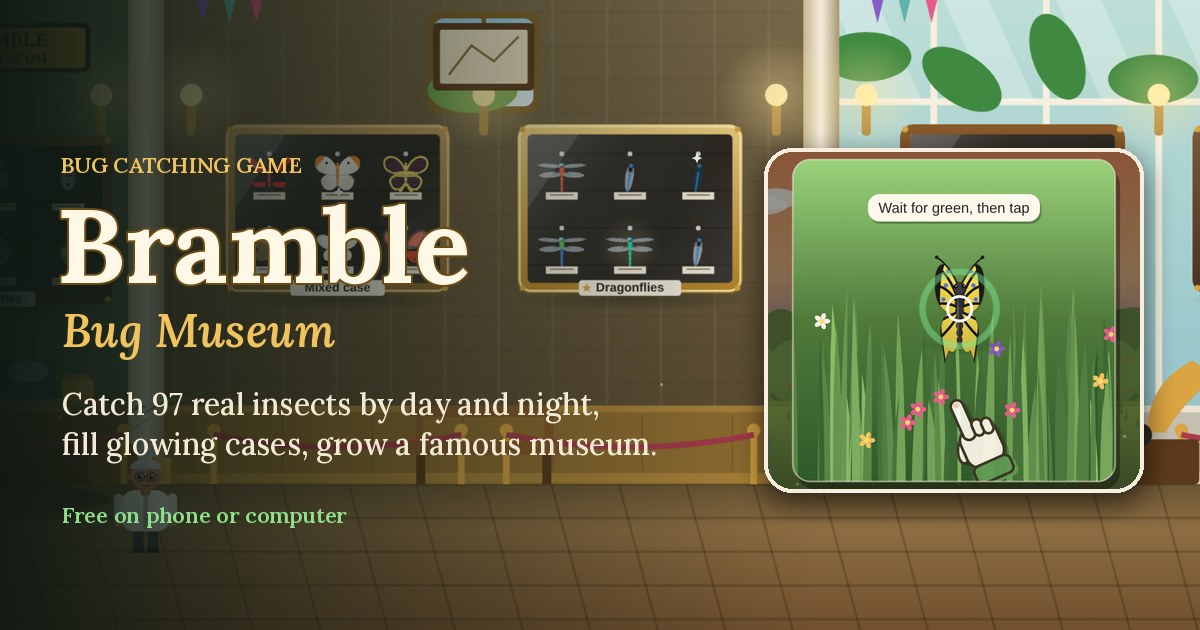
Rare and legendary bugs need three good sneak taps instead of two, and their rings close faster. Two bad taps and the bug flies off. Wait for the ring to sit right on the green band, even if that means letting a cycle go by. Quiet Feet widens the sneak window, and at level 4 it cuts one tap off every approach. Your net, jar and lamp tiers make the catching steps more forgiving too.
If the pressure isn't fun, Relaxed mode in More, Settings removes the clocks, and bugs never get away.
Shiny bugs
Any catch outside the Daily can be a shiny, a color variant with a sparkle. The base chance is 2.5% per encounter, and Keen Eye and the Field Guide both raise it. You'll see a Something shimmered banner when one appears. A shiny is worth two and a half times as much on display, earns double reputation and gives three times the field notes if you study it.
A plan for your first legendary
- Put early skill points into Keen Eye and buy Field Guide volumes as they unlock.
- Buy every catching tool, so nothing is missing from the draw.
- In summer, walk the Old Forest in the morning for the Purple Emperor, and the High Alpine by day.
- Outside summer, build toward the greenhouse at reputation 18 for the Atlas Moth and Hercules Beetle.
- Keep three bark traps out, and tap the sneak ring only on the green band.
Show them off in a case of all rare or better for +20%. For the rest of the museum, see our full Bramble Bug Museum guide, and for more games like it, tycoon and business games.
Questions
How many legendary bugs are in Bramble Bug Museum?
Five: the Purple Emperor, Apollo, Rosalia Longhorn, Atlas Moth and Hercules Beetle.
Why can't I find a certain bug?
It may be the wrong habitat, time of day or season, or you may be missing the tool it needs, such as a jar, moth lamp, trowel or bait kit. Tap the bug in the Guide tab to see where and when it lives.
How do I get more shiny bugs?
Level up Keen Eye and buy Field Guide volumes. Both raise the shiny chance, which starts at 2.5% per encounter. The Daily never has shinies.
More strategy articles
 How to win at Spider SolitaireMoonlit Spider
 Chess openings for beginnersKingsway Chess
 Three stars every timeCopper Pot Kitchen
 How to win at Mahjong SolitaireMahjong Cloud Steps
 Pinball tips for beginnersPocket Pinball
 Bubble shooter strategyBubble Bay
 How to win at FreeCellFour Cells
 How to win at Klondike solitaireCanyon Klondike
 Color sort puzzle tipsJelly Jars
 Daily word puzzle strategyLetter Lantern
 How to shoot the moon in HeartsHearts Hollow
 Peaks solitaire strategyStar Solitaire
 Sprout Parade tipsSprout ParadeHow to beat the computer at chessKingsway Chess
 Orbit Hop tipsOrbit Hop
You might also like
 NewLong playSaves
Petal & Twine
Flower shopCut stems, build bouquets with color harmony, wrap and tie them, and grow blooms in a greenhouse while you are away.