Games / Guides / Strategy articles / How to win at FreeCell
How to play FreeCell and win
In free cell solitaire every card is face up from the first second, so there's no luck to blame. Almost every deal can be won. Here's how to plan one in Four Cells, from the first look to the last King.
The rules, quickly
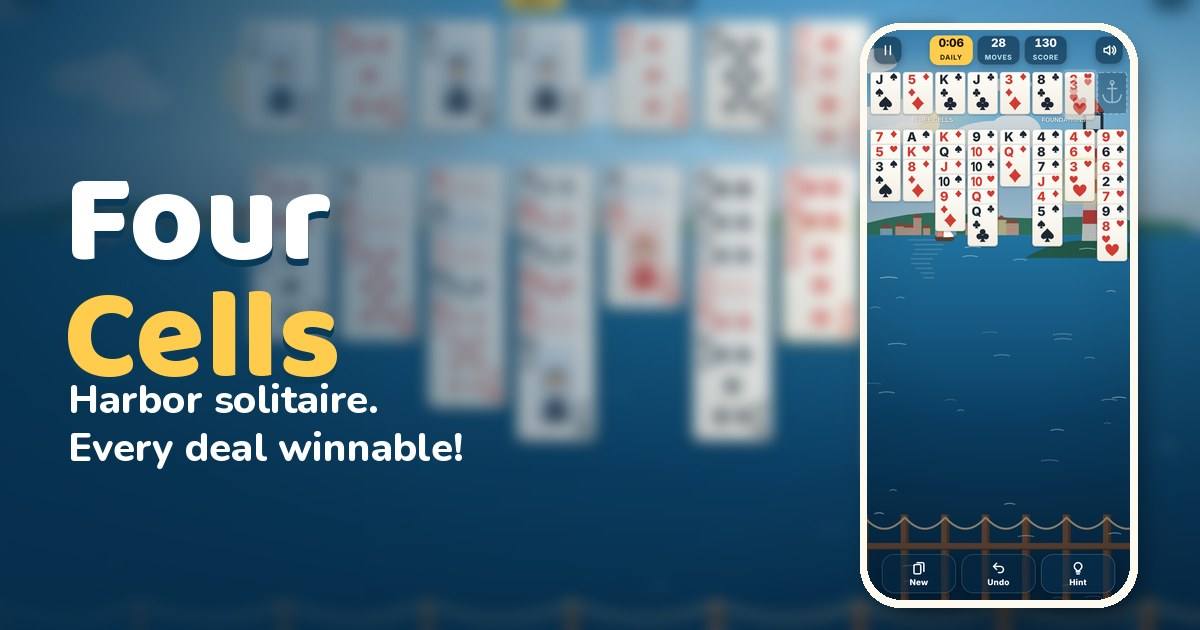
One 52 card deck is dealt face up into eight columns: four columns of seven and four of six. Above them sit four free cells, which hold one card each, and four foundations, one per suit. You win by building every suit on its foundation from Ace up to King.
- In the columns, build down in alternating colors: a red 6 on a black 7.
- Any single card can go into an empty free cell, and come back out whenever it fits somewhere.
- Any card can go into an empty column, not just a King.
- Officially you move one card at a time.
That last rule sounds strict, but in practice you can move an ordered run by shuffling it through your empty cells and columns one card at a time. Most free cell games, including Four Cells, do that shuffle for you and let you move the run in one go, as long as you have room. That's called a supermove.
How many cards can you move?
This one formula is the key to the whole game. The biggest run you can move at once is:
(empty free cells + 1) x 2 for each empty column
| Empty cells | Empty columns | Biggest run you can move |
|---|---|---|
| 0 | 0 | 1 |
| 2 | 0 | 3 |
| 4 | 0 | 5 |
| 1 | 1 | 4 |
| 2 | 1 | 6 |
| 2 | 2 | 12 |
Look at what an empty column does: it doubles everything. Two empty cells and no empty column moves three cards. Add one empty column and it's six. That's why experienced players chase empty columns so hard. One catch: if you're moving a run into the empty column, that column can't also be one of your helpers, so the limit drops.
Before your first move
Because you can see every card, the first ten seconds are the most valuable of the game. Find the four Aces and the 2s. Count how many cards sit on top of each one. A deal where the Aces are near the bottom of tall columns is going to be about digging, and you want to know that before you start filling cells.
Then look for the shortest column, or the one that would be easiest to clear. Emptying a column early is often the move that wins the deal.
Seven habits that win deals
Treat free cells as a loan
A card in a free cell is a card you owe. Every one you park should have a plan for getting out. Filling all four cells with no way to empty them is the most common way to lose, because at that point you can only move one card at a time.
An empty column beats an empty cell
By the formula above, one empty column is worth more than two empty cells. If spending two cells clears a short column, it's usually a good trade.
Don't waste an empty column on one card
Dropping a single card into an empty column turns your most powerful space into an expensive free cell. If a card needs parking, use a cell. Fill a column with a long run, or with a King that can start a run of its own.
Dig toward the low cards
A move that looks neat but doesn't get you closer to a buried Ace or 2 is often wasted. Count the cards above each low card and work on the shortest dig first.
Build on high cards
A run that starts on a King or a Queen can sit there for the rest of the game. A run built on a 5 will have to move again later, which costs space.
Send cards home when it's safe
Playing a card to its foundation frees space, but it also removes a possible landing spot. A black 5 is only useful as a home for the red 4s. Once both red 4s are on their foundations, the black 5s can go up without a second thought. In Four Cells a card on a foundation stays there, so this check matters.
Test a line, then back out
Free cell rewards looking ahead. If a plan stalls, undo a few moves and try the other branch. Four Cells has unlimited undo, so exploring costs nothing except the no Undo bonus.
Is every FreeCell deal winnable?
Very nearly. Free cell deals are often numbered, and the classic numbering runs into the millions. Of the first million numbered deals, only 8 have no solution at all, the most famous being deal #11982. Four Cells uses that classic numbering and simply never deals the 8 impossible ones, so you can type in any deal number and share it with a friend.
Four Cells also checks your position as you play. If a move ever makes the deal impossible to win, a bar slides up to tell you, and Rewind takes you back to the last position that can still be won. Hint looks ahead too, and only shows a move that keeps a way to win.
Scoring and the Daily Deal
Each card sent to a foundation is worth 10 points and a win adds 500. On top of that you get a point for every second under 7 minutes and 150 more for winning without Undo. The Daily Deal is the same shuffle for everyone that day, so it's a good place to compare times with friends.
For controls, ranks and tables, see our Four Cells guide. If you like having every card in view, Yukon Trail is another open solitaire, and our solitaire page has the rest.
Questions
Is every FreeCell game winnable?
Almost. Of the first million classic numbered deals, only 8 can't be won. Four Cells never deals those 8.
How many cards can you move at once in FreeCell?
(Empty free cells + 1), doubled for each empty column. With two empty cells and one empty column you can move six cards.
Can any card go in an empty column in FreeCell?
Yes. Unlike Klondike, any card or any movable run can go into an empty column.
What is the best FreeCell strategy?
Plan before you move, keep free cells empty, and aim for an empty column early, because it doubles how many cards you can move.
More strategy articles
 How to win at Spider SolitaireMoonlit Spider
 Chess openings for beginnersKingsway Chess
 Three stars every timeCopper Pot Kitchen
 How to catch rare bugsBramble Bug Museum
 How to win at Mahjong SolitaireMahjong Cloud Steps
 Pinball tips for beginnersPocket Pinball
 Bubble shooter strategyBubble Bay
 How to win at Klondike solitaireCanyon Klondike
 Color sort puzzle tipsJelly Jars
 Daily word puzzle strategyLetter Lantern
 How to shoot the moon in HeartsHearts Hollow
 Peaks solitaire strategyStar Solitaire
 Sprout Parade tipsSprout ParadeHow to beat the computer at chessKingsway Chess
 Orbit Hop tipsOrbit Hop