Games / Guides / Strategy articles / How to beat the computer at chess
How to beat the computer at chess: play into your rival's blind spots
Our early chess rivals aren't weak engines. They're built to miss things the way people do. Once you know what they miss, beating them gets much easier. We played a few hundred test games to find out how much.
Two kinds of computer rival
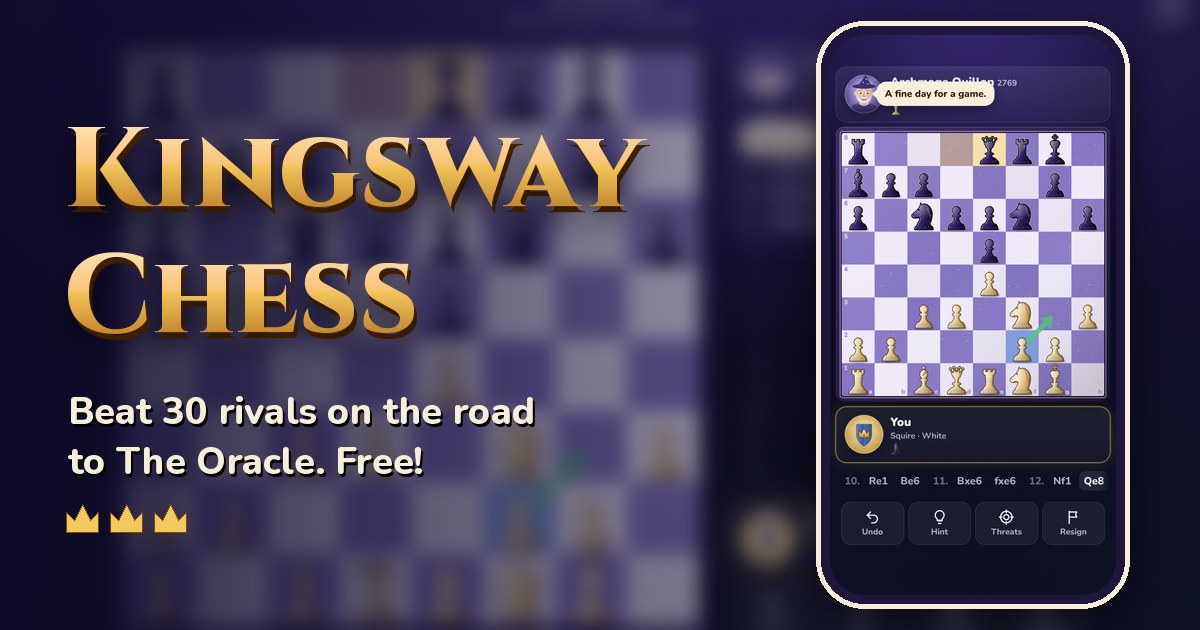
Most chess programs get easier by thinking less, which makes them play strangely: perfect one move, nonsense the next. In Kingsway Chess the first eight rivals on the road work differently. They search honestly, but they don't notice every move on the board. From the ninth rival on, the game switches to its full engine with a shorter or longer think, and the last rivals play at full strength.
That means the early rivals have real blind spots you can aim at, and the later ones don't. This article is mostly about the first group, where the right habits turn losses into wins fast.
What the early rivals miss
Here's how the early rivals decide what they've noticed, straight from the game's code. Pawn moves, king moves and any move of one square are always seen. Everything else can slip past them, and some moves slip past much more often:
- Knight jumps. A knight move is one of the most likely to go unseen.
- Long moves. The farther a bishop, rook or queen travels, the more likely it's missed. A queen sweeping across the whole board is close to invisible to the first rivals.
- Backward moves. A piece moving back toward its own side is easier to miss than one moving forward.
- Their own chances, too. A capture they don't notice is a capture they never make, so sometimes a piece you left loose survives.
Each rival sees a bit more than the one before. Pip, the very first, misses the most. By Mira the Lamplighter, eighth on the road, the blind spots are small.
What our test games showed
We had a very simple player, one that only looks at its own move and the reply, play 20 games against each of the first eight rivals, half with white and half with black. Then we counted the results and every undefended piece it picked up.
| Rival | Style | Won, drawn, lost |
|---|---|---|
| Pip | Jumpy | 19, 1, 0 |
| Old Bess | Pawn pusher | 20, 0, 0 |
| Tobin Thistle | Greedy | 20, 0, 0 |
| Merry Wren | Showy | 18, 1, 1 |
| Brother Alder | Careful | 18, 1, 1 |
| Sir Rowan | Knight rider | 13, 4, 3 |
| Ferryman Gil | Trader | 16, 0, 4 |
| Mira | Steady | 6, 3, 11 |
Two things jump out. First, the Meadows rivals really are beatable by anyone who checks what each move attacks. Second, Mira is a wall for that kind of play. When we let the same player look one more move ahead, it went from 6 wins against her to 10, with 6 draws and only 4 losses. That's the moment to start thinking in pairs of moves.
Against the first seven rivals, about three in five of the undefended pieces our player won came from knight jumps or from long moves of three squares or more. That's exactly the blind spot from the code, showing up on the board.
Habits that win against the early rivals
- Attack from far away. Put bishops on long open diagonals and rooks on open files. Threats from across the board are the ones they miss.
- Use your knights. A knight fork is the classic beginner's win, and here it's even better, because the rival often doesn't see the knight coming.
- Retreat to attack. A bishop or queen stepping back can hit something new. Backward moves are easier for them to overlook.
- Check every capture twice. Before you take, ask what they can take back. Before you move, ask what you've left loose. The rivals hang pieces; try not to hand them yours.
- Use the help. For the first five rivals, a coach points out loose pieces you could grab, and for the first twelve it stops you before a real blunder. Threats circles every one of your pieces that can be taken.
Read the rival's style
Each early rival leans a certain way, and the lean gives you a plan.
- Tobin Thistle is greedy. He likes captures more than he should. Leave a pawn where taking it costs him something, and he'll often take it.
- Pip and Merry Wren are flashy. They love giving check, even when it does nothing. Keep your king tucked in and let the checks run out, then punish the pieces that wandered off to give them.
- Old Bess pushes pawns. All those pawn moves open lines around her king and leave holes behind them. Put a knight on a hole and aim pieces at the open lines.
- Brother Alder is careful. He castles early and likes backing his pieces up. Take space in the center while he's being cautious.
- Sir Rowan rides knights. He'll bring his knights out everywhere. Watch for his forks, and remember a knight on the edge of the board is a weak knight.
- Ferryman Gil trades. He likes even swaps. If you're ahead, trade down with him and win the simpler endgame. If you're behind, avoid the trades he offers.
Higher up the road
From the ninth rival on, the blind spots are gone. These rivals search several moves deep and only choose among moves that are close to the best, with less room for error at every step. The last three in the Sky Citadel play at full strength and think longer. Against them, basic tactics aren't enough. You'll want solid openings (our chess openings for beginners is a good start), and the move by move Review after each game, which labels every move from Brilliant to Blunder and jumps straight to your mistakes.
Questions
How do you beat the computer at chess?
Find out what it misses and play there. In Kingsway Chess the early rivals often miss knight jumps, long moves and backward moves, so attacks from far away and knight forks win the most material.
Are the Kingsway Chess rivals easy?
The first ones are. In our test games a very simple player won almost every game against the Meadows rivals. Mira, eighth on the road, is where it gets hard, and the rivals after her use the full engine.
Which rival is the hardest?
The Oracle at the end of the road, who plays at full engine strength with the most thinking time of any rival.
Does the game help beginners?
Yes. For the first five rivals a coach points out loose pieces you could take, through the twelfth it warns you before a real blunder, and Hint and Threats are always available.
More strategy articles
 How to win at Spider SolitaireMoonlit Spider
 Chess openings for beginnersKingsway Chess
 Three stars every timeCopper Pot Kitchen
 How to catch rare bugsBramble Bug Museum
 How to win at Mahjong SolitaireMahjong Cloud Steps
 Pinball tips for beginnersPocket Pinball
 Bubble shooter strategyBubble Bay
 How to win at FreeCellFour Cells
 How to win at Klondike solitaireCanyon Klondike
 Color sort puzzle tipsJelly Jars
 Daily word puzzle strategyLetter Lantern
 How to shoot the moon in HeartsHearts Hollow
 Peaks solitaire strategyStar Solitaire
 Sprout Parade tipsSprout Parade
 Orbit Hop tipsOrbit Hop