Games / Puzzle Games / Bramble Bug Museum / Guide
Bramble Bug Museum
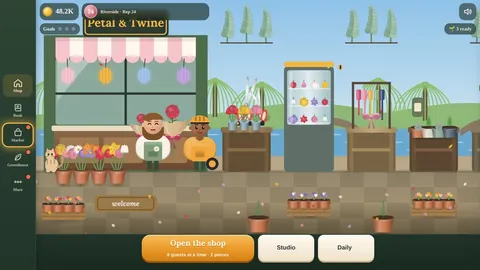
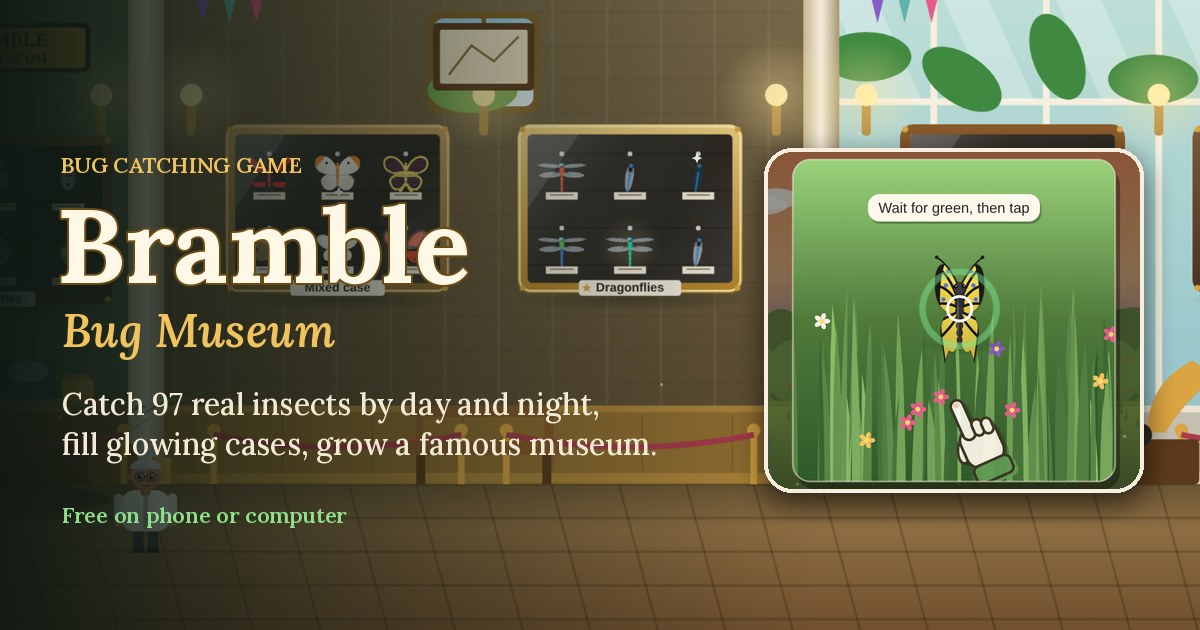
You inherit a dusty one-room bug museum at the edge of a wild meadow. Catch 97 real insects with your fingers, pin them in glowing exhibit cases, answer visitors' questions, and grow the place until the whole county comes to look.
Quick answers
Does Bramble Bug Museum work on my phone?
Yes. Bramble Bug Museum works with touch on phones and tablets, and with a mouse or keyboard on a computer. It runs in the browser you already have, so there is no app to download.
Do I need an account to play Bramble Bug Museum?
No. Just open it and play, with no sign-up. If you like, a free account (username only, no email, for players 13 and older) puts your scores on the leaderboards and backs up your progress so it follows you to any device.
Is there a daily challenge in Bramble Bug Museum?
Yes. Bramble Bug Museum has a new daily challenge every day, the same one for every player, with its own daily leaderboard. Find it alongside the others on our daily challenges page.
Is Bramble Bug Museum OK for kids?
Yes, players of any age can enjoy it. There is no chat and no way to message other players, and nobody needs an account to play. Accounts are for players 13 and older, so younger players just play and their progress stays on their device. For ages 4 to 11 we also have learning games in their own kids area, with no ads, no accounts and no tracking.
What is Bramble Bug Museum?
It's a collecting game with a small business attached. Half the time you're outdoors with a net, sneaking up on butterflies, scooping water beetles out of a pond or holding a lamp steady on a white sheet until a moth lands. The other half you're indoors, pinning finds in cases for visitors.
Every species is a real insect with a true one-line fact, from the seven-spot ladybird to the atlas moth. The game follows your real clock and calendar, so morning, night and each season bring different bugs. It's free, it runs in the browser on a phone, tablet or computer, and there's nothing to download.
How to play a field trip
Tap Go catching, pick a habitat and choose Field trip (2 minutes 30, catch all you can) or Quiet walk (no clock, up to 10 catches). The habitat scrolls sideways. Drag to look around. Tap a rustling hiding spot to start a close-up.
Most catches have two parts. First you sneak up: a ring shrinks onto the bug, and you tap when it sits on the green band. Two or three good taps get you close. Two bad taps and the bug flies off. Then comes the catching step for that species.
The catching steps
There are 12 steps. The first time you meet each one, a little hand shows the motion. You can bring the demos back in More, Settings.
| Step | How to do it |
|---|---|
| Sneak up | Tap when the shrinking ring is on the green band. Do it two or three times. |
| Net swing | One tap when the ring turns green. A bad swing often lets the bug escape. |
| Sweep net | Swipe left and right through the grass on the beat. Watch the dot on the beat bar. |
| Jar scoop | Drag the jar into the dashed box under the pond bug, then flick up. Not too hard, not too soft. |
| Lamp sheet | Press and hold to light the sheet, keep the light in the circle while the wind pushes it, and let go soon after the moth lands. |
| Log flip | Hold to lift the log and let go when the white bar is in the green. Then tap the bug three times before it runs off. |
| Bark trap | Drag the bait pot onto the mark. Come back later to collect what it caught. |
| Gentle pick | Drag the bug slowly along the dotted path to the jar. Rush it and it drops. |
| Follow flight | Trace the glowing flight path with your finger as it appears. |
| Dig | Rub slow, even circles in the soil until the bug shows. Fast scrubbing scores lower. |
| Blink in time | Tap on each flash of a firefly or glow-worm. Three flashes. |
| Cup and card | Tap when the cup is right over the beetle, then swipe left to slide the card under. |
Controls on phone and computer
On a phone or tablet, everything is taps, drags and swipes. On a computer the mouse does the same jobs, and the keyboard works for the timing steps: Space or Enter for the ring, net, lamp, log flip, blink and cup, the arrow keys (or A and D) for the sweep net. Outdoors, the arrows look around and Space walks to the nearest hiding spot. On open days, 1 to 8 pick a visitor and Q W E R and the next letters pick a case (each case shows its letter). Esc pauses.
Stars, condition and value
Each step is graded Perfect, Great, Good or Oops. The average decides the catch: three stars is a Pristine specimen, two is Good and one is Worn. Condition matters on display. A pristine bug is worth almost twice a worn one, and a shiny color variant is worth two and a half times more.
Rarity sets the base value. Bugs are Common, Uncommon, Rare or Legendary, and bigger insects are worth a little more. The Field Guide volumes and the Keen Eye skill raise your odds of rare and shiny finds.
Exhibit cases and open days
Open the Cases tab, pick a case, tap a bug in the drawers and then tap an empty pin. Each case holds six. The total value of everything on display sets your ticket price, so better specimens mean more money from every visitor.
Cases with a theme earn a bonus. If four or more pinned bugs share a family the case gets +25%, all rare or better gives +20%, and all from one habitat gives +15%. Filling all six pins with a theme the first time also gives reputation.
Tap Open the museum to run an open day. Visitors arrive with a picture of the bug they want to see, or a riddle like "something that glows" or "your rarest bug". Tap the visitor, then the case that holds the answer. Right answers pay a ticket plus shop sales that grow with the specimen's value, your speed and your streak. Some days bring an event: a school trip, a rainy day, a free entry day, a critic who asks three questions, a TV naturalist or the bug of the day.
Field notes and research
Field notes are the second currency. You get them for every new species, for photos once you own a camera, for the bug of the day and for studying spare bugs in the drawers (1, 3, 8 or 20 notes by rarity, three times as many for a shiny). The Research tab in Cases, or a tap on the notes counter, shows what they buy.
- Habitat monographs. Once you've found enough species in a habitat, write it up. Each of the three volumes makes every bug from that habitat worth 10% more on display, for good.
- Papers. From reputation 4 you can publish a paper for +1 skill point and +30 reputation. Each one costs a few more notes than the last.
- Gear and habitats. Better nets, jars, lamps and guides cost notes as well as coins, and so do new habitats.
Daily school trip and leaderboards
The Daily is a two-minute open day with a loaner collection, the same for everyone that day. All the visitors are kids, students and teachers. Each right answer scores 10 points plus up to 5 for speed and up to 10 for your streak, a wrong answer costs 5, and you get 30 extra points if nobody leaves unhappy. Your first run each day pays coins. Replays are practice. Scores go on the daily leaderboard.
Growing the museum
Reputation comes from catches, happy visitors, themed cases, research and releasing bugs. Each level gives a skill point and unlocks more of the shop.
| Habitat | Reputation | What lives there |
|---|---|---|
| Wild Meadow | Start | Butterflies, hoppers and bees |
| Old Hedgerow | 3 | Shield bugs, peacocks and night moths |
| Mill Pond | 5 (needs wellies) | Striders, diving beetles and dragonflies |
| Old Forest | 7 | Stag beetles, log dwellers and the purple emperor |
| Night Garden | 9 (needs a moth lamp) | Moths, fireflies and glow-worms, always at dusk |
| High Alpine | 13 (needs alpine boots) | The apollo and rare longhorns |
| Tropical Greenhouse | 18 | Morphos, mantises and the giants, all year |
Eight halls add two cases each: the Front Room, East Wing, Butterfly House, Night Hall, Pond Hall, Grand Atrium, Naturalists' Library and the Hall of Giants. Most boost one kind of exhibit. Every case can be upgraded six times, from a clear glass front to museum-grade glass, for +20% value each. Decor makes visitors more patient. Three staff (a docent, a caretaker and a researcher) help on open days and keep earning for up to two hours while you're away.
Ten regulars visit on open days, each hoping to see one particular bug. Show it to them on three visits and they leave a gift.
Tips and strategy
- Don't tap the sneak ring early. Wait for the ring to sit on the green band. One bad tap only makes the bug twitch, but a second one sends it away.
- Check the time. A habitat at night has different bugs than at noon, and the trip menu tells you how many species are about right now. If it's a quiet hour, look under logs for resting bugs.
- Theme your cases early. A case of six beetles earns more than six random bugs of the same value, and family themes give the biggest bonus.
- Put bugs in the hall that boosts them: moths and butterflies in the Butterfly House, night fliers in the Night Hall, pond species in the Pond Hall.
- Write monographs for the habitat that fills most of your cases first. Its +10% applies to every bug from there.
- Set bark traps before you leave. Up to three can run at once, and a stag or rhinoceros beetle is waiting when you come back.
- Use Study all duplicates. It keeps your best copy of each species and turns the rest into notes.
Questions
Is Bramble Bug Museum free?
Yes. It's free in your browser with no download, no ads and nothing to buy. Coins and field notes are earned only by playing.
Are the insects real?
Yes. All 97 species are real insects with their common names, and each one comes with a short true fact you unlock when you catch it.
Why can't I find a certain bug?
It may be the wrong time of day, the wrong season or the wrong habitat, or you may need gear like a jar, a moth lamp, a trowel or a bait kit. Tap the bug in the Guide tab to see where and when it lives and what it needs.
What are field notes for?
Research. Spend them on habitat monographs that raise exhibit value, on papers that give skill points, and on gear and new habitats in the shop. Tap the notes counter at the top of the museum to see what you can afford.
Does my museum save?
Yes. It saves on its own every few seconds and when you leave the page. Tap Continue to pick up again. Sign in on the site to keep the same museum on your phone and your computer.
Is there a mode without a timer?
Yes. A quiet walk has no clock. Relaxed mode in More, Settings removes the clocks from field trips and open days, visitors wait as long as you need, and bugs never get away.