Games / Guides / Strategy articles / Reversi strategy
Reversi strategy: mobility, corners and quiet moves
The most common way to lose at reversi is to win the middle game. Grab lots of discs early and you'll often find, twenty moves later, that every move left to you hands over a corner. Here's the thinking that turns that around.
Why more discs early is usually bad
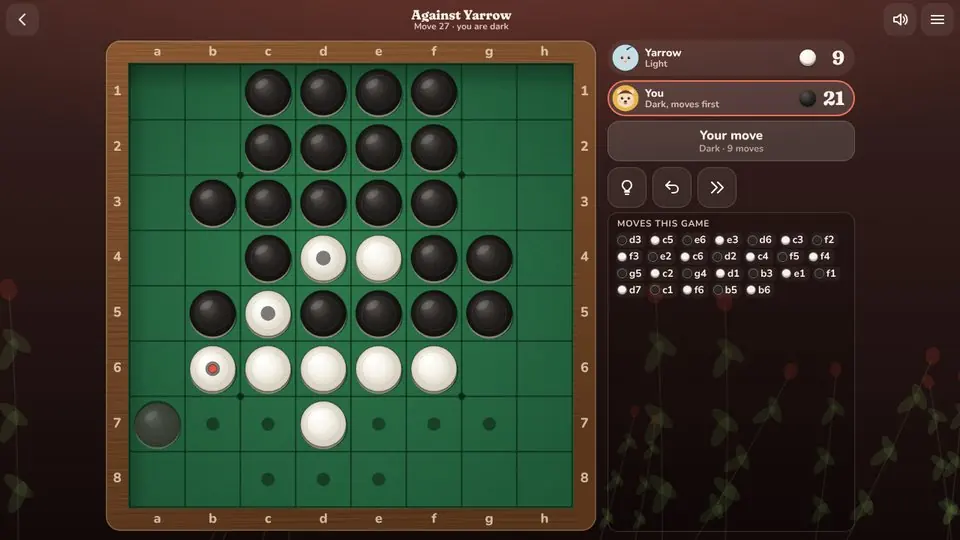
In reversi only the final count matters, and the count can swing wildly in the last dozen moves. Early on, a big pile of your discs mostly gives your opponent things to flip and places to play. What you want instead is options: lots of legal moves for you, few for them. That's called mobility, and it's the single most important idea in the middle game.
When your opponent runs short of moves, they're forced to play somewhere bad: next to an empty corner, or onto an edge where you can take advantage. That's how corners are won. They're rarely grabbed. They're given away by a player with no better choice.
Squares worth knowing
We use the usual names: columns a to h, rows 1 to 8, so a1 is a corner.
| Square type | Where | Why it matters |
|---|---|---|
| Corners | a1, h1, a8, h8 | Can never be flipped. Anchors the edges next to it. |
| X-squares | b2, g2, b7, g7 | Diagonally next to a corner. Very risky while that corner is empty. |
| C-squares | a2, b1 and the like | Edge squares right beside a corner. Risky too, a bit less so. |
| Edges | the outer ring | Harder to flip than inner discs, but can be attacked along the edge. |
Here's why X-squares are so dangerous. Say you play b2 while a1 is empty, and your opponent already has a disc further along that diagonal, at c3 or beyond, with only your discs in between. Now a1 is a legal move for them, it flips your b2, and they own a corner for the rest of the game. Once a corner is filled, its X- and C-squares are safe to use.
Frontier discs and quiet moves
A frontier disc is one that touches an empty square. Every frontier disc you own is a potential move for your opponent, since they need one of your discs next to an empty square to flip anything. So good moves flip few discs, ideally ones inside your own group, and add no new discs next to empty squares. These are called quiet moves.
When you look at your legal moves, ask two questions. How many new frontier discs does it create for you? How many moves does it give your opponent? The move that scores well on both is usually right, even if it flips a single disc while another flips five.
Edges: useful, but not free
Taking an edge square feels safe, and sometimes it is. But an edge disc with empty squares on both sides can be flanked along the edge, and an unbalanced edge (say, five of your discs and a gap) can let your opponent wedge in. A good rule: take an edge when it gains you something now, like a tempo or a stable disc, not just because it's an edge.
Watch out for edges that lead into an empty corner. If you own c1 through f1 and your opponent plays b1, they may be lining up a1 as a future move. Count before you extend an edge toward a corner.
Stable discs
A disc is stable when it can never be flipped again. Corners are always stable, and discs along an edge that run unbroken from a filled corner are too. In the endgame, stable discs are points in the bank. In the middle game they matter less than mobility, so don't overpay for them, but a corner with stable edges growing from it is a strong position.
Parity in the endgame
There are 60 squares to fill after the opening four. If nobody passes, the player moving second gets the last move of the game, and the last move in reversi tends to be a good one because nothing can answer it. Passes change that, so the side that would otherwise move first sometimes fights to force one.
Near the end the empty squares split into small regions. Try to be the one who makes the last move in each region. As a rule of thumb, move into regions with an odd number of empty squares and leave even ones for later. In Rosehip Reversi, the hint can tell you exactly what perfect play gives once the board is nearly full, which is a great way to check your own counting.
Openings without memorising
You don't need an opening book to play well. In the first ten moves, aim for these: play near the middle, flip as few discs as you can, keep your discs together rather than scattered, and avoid the edges and the squares next to corners. If your opponent ends the opening with a big spread of discs and you have a small tight group, you're probably ahead.
A simple plan for each phase
| Phase | Your goal |
|---|---|
| Opening | Few discs, central, compact. Keep options open. |
| Middle game | Maximise your moves, minimise theirs. Quiet moves. Stay off X-squares. |
| Late middle | Force them onto bad squares. Take corners they give you. |
| Endgame | Count. Play for parity in each region. Take the stable discs. |
Learning from the house players
Rosehip Reversi's house players make a good practice ladder because each one plays a little more of this strategy. Clover grabs the move that flips the most, so you can beat her by staying quiet and waiting. Teasel looks one move ahead and likes corners. Sorrel weighs mobility and edges, and plays the last 8 squares perfectly. Burdock and Yarrow play the whole thing well, and Yarrow solves the last 16 squares exactly. The game review after each game shows the moves that cost you the most, which is the fastest way we know to improve.
Mistakes that lose reversi games
- Flipping as many discs as possible every move.
- Playing an X-square while its corner is empty.
- Creating long walls of frontier discs.
- Rushing to the edges in the opening.
- Forgetting parity in the last ten moves.
For the rules, scoring and the Daily Opening, read our Rosehip Reversi guide. If you enjoy two-player strategy, our four in a row strategy and our checkers strategy are good next reads.
Questions
What is the best strategy in reversi?
Focus on mobility rather than disc count: keep many moves for yourself and few for your opponent, play quiet moves that flip few discs, and stay off the squares next to empty corners.
Why shouldn't you play next to a corner?
A disc diagonally next to an empty corner often lets your opponent take that corner, and corners can never be flipped back.
Is it good to have more discs in reversi?
Only at the very end. In the opening and middle game, having fewer discs usually means more options and fewer targets.
Who gets the last move in reversi?
If nobody passes, the second player does, because 60 squares are filled after the opening four. Passes can change that.
Game guides
More strategy articles
You might also like
 Long playSaves
Crown Jump Checkers
CheckersClassic checkers with a world tour of rivals, chain-jump fireworks and a champion who never slips.