
Games / Guides / Strategy articles / Farkle odds and strategy
Farkle odds and strategy: when to roll and when to bank
With five or six dice, keep rolling. With three dice, bank once your turn is worth about 450 points, and with two dice about 300. Farkle is a push-your-luck game, and push-your-luck games have answers. We worked out the odds exactly for Classic scoring, every possible roll, so here's what the numbers say about the two decisions that matter: which dice to keep, and when to stop.
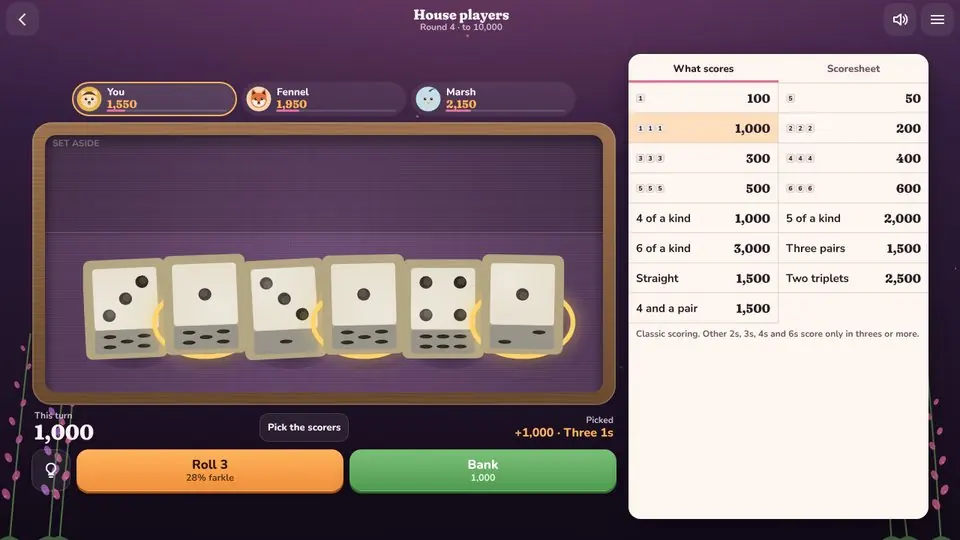
The scoring we used
Everything here uses the Classic scoring in Foxglove Farkle: each 1 is 100, each 5 is 50, three of a kind is 100 times the number (three 1s are 1,000), four of a kind 1,000, five 2,000, six 3,000, and the six-dice sets (three pairs, a straight, two triplets, four of a kind with a pair) score 1,500 to 2,500. Roll all six dice into scorers and you get hot dice: all six come back and your turn total carries on.
The numbers below aim to score as many points as possible in a single turn, with no 500-to-start or 350-a-turn house rule. A race against other players can change the right play, which we'll come to.
The chance of a farkle
A farkle is a roll with nothing that scores. Here are the exact odds for each number of dice, counting every way the dice can land.
| Dice rolled | Farkle rolls | Out of | Chance |
|---|---|---|---|
| 6 | 1,080 | 46,656 | 2.3% |
| 5 | 600 | 7,776 | 7.7% |
| 4 | 204 | 1,296 | 15.7% |
| 3 | 60 | 216 | 27.8% |
| 2 | 16 | 36 | 44.4% |
| 1 | 4 | 6 | 66.7% |
Notice how fast the risk climbs. Five dice are still very safe. Three dice farkle more than one time in four. One die farkles two times in three.
When to bank: the turn totals
We worked out the best play for every turn total and every number of dice, looking all the way ahead, including the chance of hot dice. Here's where banking becomes better than rolling on.
| Dice left to roll | Bank once your turn total reaches |
|---|---|
| 6 | Practically never bank (only past about 18,000) |
| 5 | about 3,100 |
| 4 | about 1,050 |
| 3 | about 450 |
| 2 | about 300 |
| 1 | about 350 |
Two things jump out. First, with five or six dice you should almost always roll. Second, one die is slightly more worth rolling than two. That's because a single scoring die is always hot dice: hit a 1 or a 5 (one chance in three) and you get all six dice back, which is worth a lot.
Played this way, a turn is worth about 600 points on average. Keeping every scorer and banking at the first decent total, the way most of us start, is worth closer to 500.
Keep fewer dice early
The most common mistake is keeping every scoring die. Say your first roll is 1, 1, 5, 2, 3, 4. You could keep all three scorers (250 points, rolling 3 dice), keep both 1s (200 points, rolling 4), or keep just one 1 (100 points, rolling 5). Here's what each is worth on average, playing well from there.
| Keep | Points now | Dice to roll | Average value of the turn |
|---|---|---|---|
| 1, 1, 5 | 250 | 3 | about 296 |
| 1, 1 | 200 | 4 | about 347 |
| One 1 | 100 | 5 | about 404 |
Keeping a single 1 is worth over 100 points more than keeping all three scorers, because five dice almost never farkle and have a real chance at three of a kind. The rule: early in a turn, keep the fewest scorers that you need, and spend your dice on chances.
The exception is a scorer that makes hot dice. If you're rolling two dice and both score, take them both: all six come back, and the farkle risk drops to 2.3%.
Fives are weaker than they look
A single 5 is worth only 50. If a roll gives you a 1 and a 5 among five dice, keeping just the 1 and rerolling four is often better than keeping both and rolling three. The same logic as above applies: a die in your hand is worth more as a chance than as 50 points, unless keeping it is what makes hot dice.
Playing the race, not just the turn
The table above maximises one turn. A game is a race to 10,000 (or 5,000), and the race changes things.
- Well ahead: bank a little earlier. Your opponents have to take risks to catch you, so you don't.
- Far behind: push for bigger turns. An average turn won't close a big gap.
- Someone has reached the target: everyone else gets one last turn to beat it, so on that turn you roll until you pass them or farkle. Banking short is the same as losing.
- Three farkles in a row: with that house rule on, the third farkle costs 500. After two in a row, bank sooner.
Marsh, Foxglove Farkle's expert house player, knows the odds of every roll and the state of the race, so watching when Marsh banks is a good lesson in itself.
Combinations only count in one roll
A detail that catches people: sets only score when the dice come up together. A 1 from one roll and two 1s from the next are three single 1s for 300, not three 1s for 1,000. Three pairs and the straight need all six dice in one throw. So don't hold a pair of 2s hoping for a third, since a 2 rolled later won't join them.
A quick checklist
- With five or six dice to roll, roll.
- Keep the fewest scorers you need early in the turn.
- Take scorers that give you hot dice.
- With three dice, bank from about 450. With one or two, bank from about 300 to 350.
- Adjust for the race: earlier when ahead, later when behind.
The light bulb in Foxglove Farkle shows which dice to keep and whether to roll or bank, worked out exactly for every roll that could follow. For rules, house rules and modes, read our Foxglove Farkle guide. If you like odds you can feel, our backgammon strategy for beginners covers shot odds and the doubling cube.
Questions
What are the odds of a farkle with six dice?
About 2.3%, or 1,080 of the 46,656 ways six dice can land.
When should you bank in Farkle?
Playing for the most points per turn with Classic scoring, bank from about 450 with three dice left, about 300 with two and about 350 with one. With four dice, bank only past about 1,050, and with five or six, keep rolling.
Should you keep all your scoring dice in Farkle?
Usually not early in a turn. Keeping one 1 and rolling five dice is worth more on average than keeping 1, 1 and 5 and rolling three.
What is the average score of a Farkle turn?
With Classic scoring and the best play, about 600 points. Simple strategies tend to average closer to 500.
Game guides
More strategy articles


You might also like
 10 minSaves
Bracken Backgammon
BackgammonClassic backgammon with the doubling cube, match play and the Crawford rule. Five house players, hints and a game review, pass and play, online with a friend and Daily Dice.