Games / Guides / Strategy articles / Crossword solving tips
Crossword solving tips: read clues like a setter
To solve crosswords faster, do the fill in the blank clues first, match the tense and number of each clue, and lean on every crossing letter. We write every clue in Wrenword ourselves, so we spend a lot of time thinking about how clues work from the other side. Most of the tricks for solving faster come down to one idea: the clue is giving you more information than it seems to. Here's how to read it.
The clue and the answer always match
A fair clue and its answer are the same part of speech, in the same form. That's a rule setters follow, and it's free information for you.
| If the clue is... | The answer is... | Example |
|---|---|---|
| Plural | Plural | "Garden pests" wants SLUGS, not SLUG |
| Past tense | Past tense | "Ran quickly" wants SPED, not SPEED |
| An -ing word | An -ing word | "Getting bigger" wants GROWING |
| An adjective | An adjective | "Very cold" wants ICY or FROSTY |
| A comparative | A comparative | "More tidy" wants NEATER |
So before you think about meaning, look at the shape of the clue. A plural clue on a five-letter answer often ends in S, which gives you a letter to cross with before you know the word.
Kinds of clues
- Straight definitions. "Large body of water" is SEA or OCEAN. Count the squares to choose.
- Fill in the blank. "Better late ___ never" is THAN. These are usually the easiest clues in a grid, so do them first.
- Clues with a question mark. The question mark means wordplay: a pun, a second meaning or a playful twist. Read it twice and look for the other sense of a word.
- Category clues. "Pear or plum" wants FRUIT. "Tulip, for one" wants a category the tulip belongs to, like FLOWER or BULB.
Some crosswords use lots of abbreviations, foreign words and short odd words that only appear in crosswords. Wrenword doesn't. Answers are everyday words and well known phrases, so if an answer you're trying feels obscure, it's probably wrong.
Where to start
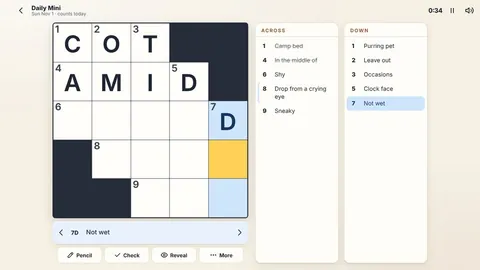
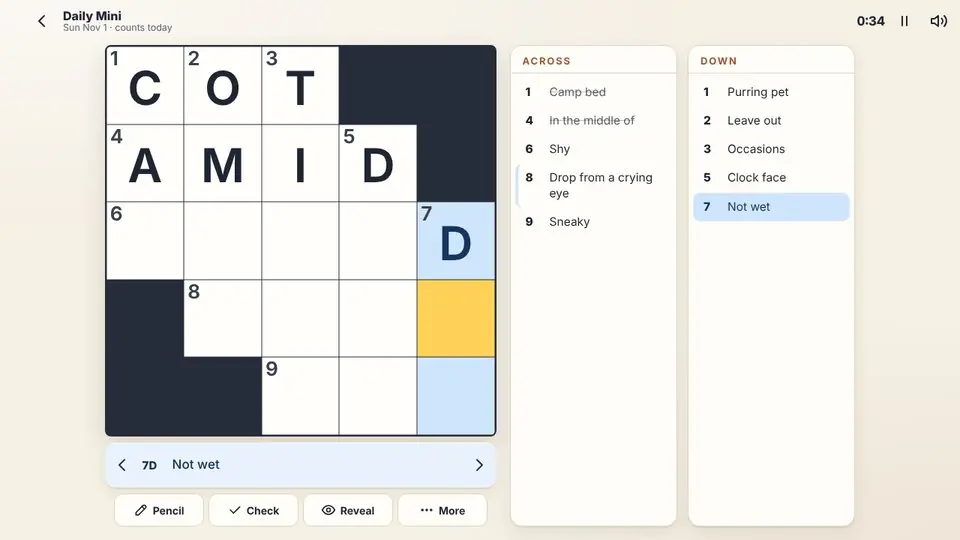
Start where you're sure. In a mini, that's often a short answer in a corner, because its first letter starts a Down answer and an Across answer at the same time. Then read the Down clues early. Many people work only Across, but Down answers often fall faster, and each one fills in a letter of every Across word it crosses.
In a 5 by 5 mini, nearly every white square belongs to both an Across and a Down answer. So a few confident answers give you letters everywhere.
How crossings finish a grid
Here's a tiny 3 by 3 grid with no black squares, to show how crossings work. The same three words read across and down.
| 1 | 2 | 3 | |
|---|---|---|---|
| 1 | C | A | T |
| 2 | A | R | E |
| 3 | T | E | N |
Say the clues are 1 Across "Pet that purrs", 2 Across "Exist" and 3 Across "Number of fingers". This little grid reads the same down as across, so the Down clues match. Solve CAT and you already have the first letter of every Down answer: C, A and T. Now 3 Down is a three-letter number starting with T, which leaves TEN or TWO, and the clue settles it: TEN. That gives you the last letter of all three Across answers. Two answers in, most of the grid is filled.
The lesson: when you're stuck on a clue, don't stare at it. Go solve the words that cross it, then come back with letters in place.
Patterns that give answers away
- An answer that ends in a three-letter space after a stem, with a verb clue in -ing form, is very likely -ING.
- A past tense clue often means an -ED ending, but watch for irregular verbs (RAN, SAW, KEPT).
- English words rarely have three consonants or three vowels in a row in a short answer. If your crossings give you that, recheck one of them.
- If a letter looks wrong, the problem is often the crossing answer, not the one you're looking at.
When you're stuck
- Move on. Solve everything else you can, then come back.
- Say the clue out loud with a different stress. Wordplay often hides in a word that can be read two ways.
- Try the other part of speech. "Bear" can be an animal or a verb meaning to carry.
- Check your crossings. One wrong letter can make an easy clue impossible.
- Use a helper. In Wrenword, Check marks wrong letters in a letter, word or the whole grid, and Reveal fills one in. Helpers keep that day's time off the board but your streak still counts, unless you reveal the whole puzzle.
Solving faster
Speed in a mini is mostly about not stopping. In Wrenword, the cursor moves to the next clue with empty squares when you finish a word, so keep typing. Leave Skip filled squares on in Settings, so going back to fix a word jumps over letters you already have. And use Pencil mode for guesses you're not sure of, so you can see them in gray while you check the crossings.
Difficulty also follows the week: Monday is the gentlest, clues lean more on wordplay toward Saturday, and Sunday eases off. If you're learning, Monday and Tuesday are the days to time yourself.
Getting better over time
Solve a little every day. Crossword skill is mostly pattern recognition: the way clues signal plurals, the stock phrases that fill-in-the-blanks use, the double meanings setters like. The Archive in Wrenword has every past puzzle, and Practice holds hundreds more, so you can do several in a row when one a day isn't enough.
Mistakes that slow you down
- Working only the Across clues.
- Ignoring tense and number in the clue.
- Reading a question mark clue literally.
- Refusing to move on from a hard clue.
- Trusting a crossing letter you guessed.
For the controls, the Daily Mini and the Weekend Grid, read our Wrenword guide. If you like word puzzles, our cryptogram solving guide and our daily word puzzle strategy are good next reads.
Questions
How do you get better at crosswords?
Solve a little every day, start with fill in the blank clues, read Down clues early and match the answer's tense and number to the clue.
What does a question mark mean in a crossword clue?
That the clue involves wordplay: a pun, a second meaning or a playful twist rather than a straight definition.
Should you solve Across or Down first?
Both. Many solvers only work Across, but reading Down clues early gives you letters in every Across answer.
What is a mini crossword?
A small crossword you can finish in a few minutes. Wrenword's Daily Mini is 5 by 5, with a 7 by 7 Weekend Grid on Saturdays and Sundays.