Games / Guides / Strategy articles / Snake game tips
Snake game tips: how to grow a long snake and a high score
To get a high score in a snake game, keep the middle of the board open, move in tidy rows once you're long, and follow your own tail. Every snake game ends the same way: the board fills with your own tail. The trick is to make sure that happens as late as possible. Here's how we plan a run in Tansy Trail, from the first apple to the point where the snake fills half the garden.
Two kinds of run
A snake run has two phases. While you're short, the board is wide open and the risk is low, so you can chase apples directly and build points. Once you're long, your body is the main obstacle and every turn needs a plan. Most crashes happen because a player keeps playing the short-snake way after the snake has grown.
While you're short: chase chains
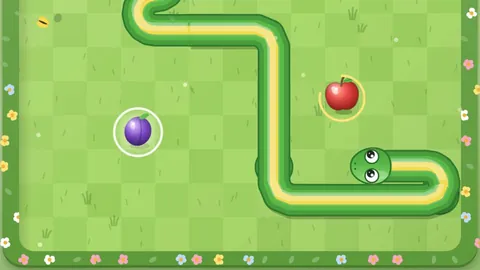
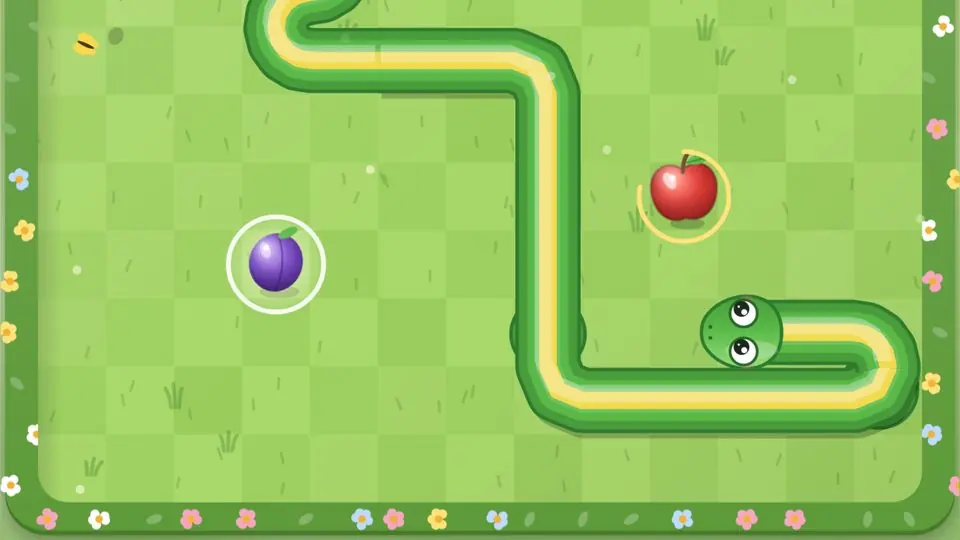
In Tansy Trail each apple has a ring around it, a quick route timer. Eat it before the ring runs out and you build a chain: two quick apples in a row pay one and a half times, then two, two and a half and three times. Miss the ring and the chain starts again.
Early on, chase every ring. With a short body there's little to crash into, and a chain at three times is worth a lot. Speed choice matters too: Steady pays 10 per apple, Quick 15 and Swift 20. Learn a board on Steady, then move up.
Keep the middle open
A good early habit is to travel along the walls and keep the middle of the board clear. The open middle is your escape room later: when your snake is long and an apple appears in an awkward spot, you want space to swing around, not a tangle of your own body.
The opposite mistake is spiralling into the center. A spiral feels efficient, but it leaves your head surrounded by your own tail with only one way out.
When you're long: tidy rows
Once your snake fills a good part of the board, switch to neat back and forth rows, like mowing a lawn. Go along a row, step down one, come back along the next, and so on. When you reach the far side of the board, turn and work your way back the same way.
| Row | Path |
|---|---|
| 1 | → → → → → ↓ |
| 2 | ↓ ← ← ← ← ← |
| 3 | → → → → → ↓ |
| 4 | ↓ ← ← ← ← ← |
Moving this way keeps your tail close behind you and predictable. Your body lies in parallel rows, so you always know where the open squares are. On a board with an even number of rows or columns, there's a route that visits every square once and returns to the start, and a snake that follows it can never trap itself. It's slow, since you don't go straight for apples, but it's the safe pattern to fall back on when things get tight.
Follow your tail
Your tail is always moving away. The square your tail is on now will be empty soon, so heading toward your own tail is one of the safest things you can do. When you're boxed in and unsure, turn toward the tail end of your body rather than the middle of it. As long as your head can reach the square where your tail is, you're not trapped.
The danger comes right after you eat. Each apple adds one square, and that new square sits at the tail, so the tail pauses for a step. If you were counting on that square opening up, leave yourself a step of margin.
Before you eat, check the way out
An apple tucked in a corner or against your body is a trap if there's no way out after you eat it. Before you go for it, trace the path in and the path out. If the exit depends on squares your body is still covering, wait a lap and let your tail clear them. A slower apple is better than a crash.
Using the specials
Every fifth apple brings a special for a short time. Each one is worth more in a different phase of the run.
| Special | What it does | When it's best |
|---|---|---|
| Golden pear | Five times the points | Any time you can reach it safely |
| Plum | Slows everything for 8 seconds | When you're long and the board is tight |
| Pepper | Double points for 10 seconds | While you're short and can chain apples fast |
| Mint | Tail three squares shorter | When you're long and need room |
| Moon drop | Slide through your own body for a moment | To escape a box you've drifted into |
Controls that help
Tansy Trail lines up to three turns ahead, so a quick up then left makes a tight U turn and neither press is lost. On a phone, one long L shaped swipe gives two turns. And if you're about to crash, the game waits a split second for a saving turn, which counts as a close call. Lining up your next turn early is the habit to build: the head leans toward a queued turn so you can see it was heard.
Other modes
- Journey: 60 levels in six gardens. Each has three stars: clear it, beat the par time, and eat all three golden pears. Learn the route on a first clear, then come back for the stars.
- Rush: 60 seconds with three apples out at once. A crash costs you a moment, not the run, so be bolder.
- Calm: open edges and no crashes. A good place to practise tidy rows without pressure.
- Open edges in Classic: leave one side and come back on the other. Each apple pays a little less, since the walls can't catch you.
Mistakes that end runs
- Spiralling into the middle.
- Chasing the quick-apple ring when you're already long.
- Eating an apple with no way out.
- Forgetting that the tail pauses for a step after each apple.
- Turning toward the middle of your body instead of the tail.
For controls, modes and looks, read our Tansy Trail guide. For another quick arcade game, try Catch It If You Can, and for planning around random pieces, our falling blocks tips are a good read.
Questions
How do you get a high score in snake?
Chase quick apples and chains while you're short, keep the middle of the board open, then switch to tidy back and forth rows once you're long so you never trap yourself.
What is the safest way to move in snake?
Back and forth rows that keep your tail close and predictable, and turning toward your tail when you're unsure, since that square will soon be empty.
Can you play snake without walls?
Yes. In Tansy Trail, turn on open edges in Settings for Classic, or play the Calm garden, where you also can't crash into yourself.
Is it possible to fill the whole board in snake?
On a board with an even number of rows or columns there's a route through every square that returns to the start, so in principle a snake can follow it to fill the board.