
Games / Guides / Strategy articles / Ultimate tic tac toe strategy
Ultimate tic tac toe strategy: think about the send
Ultimate tic tac toe takes a game that's a known draw and turns it into one that still surprises strong players. The reason is one rule: where you play decides where your opponent plays next. Once you start thinking about that, the game changes completely.
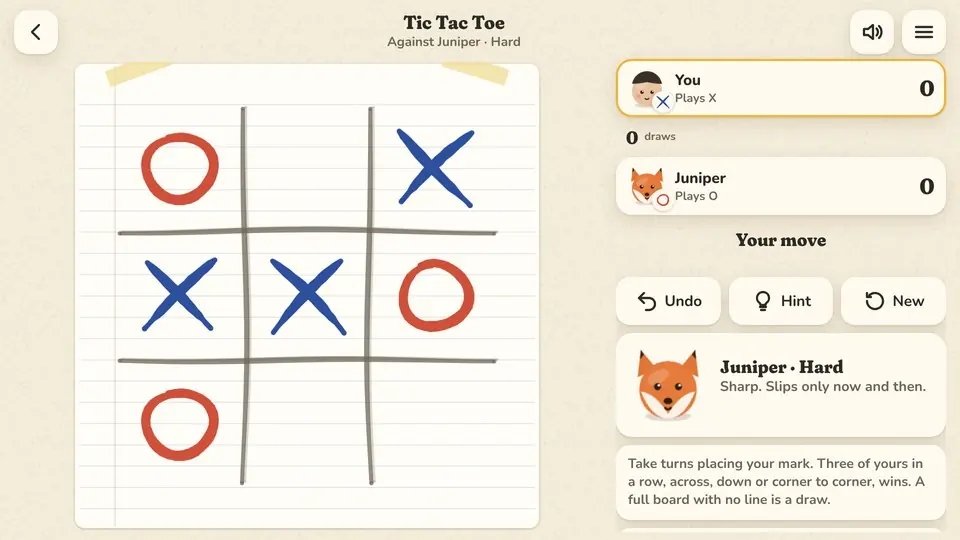
The rules in short
The board is nine small tic tac toe boards arranged in a big three by three grid. Win a small board by getting three in a row on it. Win the game by winning three small boards in a row on the big grid.
The twist: the square you pick inside a small board decides which small board your opponent must play in next. Play the top right square of any board, and they must play somewhere in the top right board. If you send them to a board that's already won or full, they may play in any open board. In Tickseed the board you have to play in lights up, so the rule is always clear.
Every move is two moves
In ordinary tic tac toe you ask: is this a good square? In Ultimate you also ask: where does this send them? A move that looks strong on its own small board can be terrible if it sends your opponent to a board where they can win right away.
So make it a habit. Before every move, look at the board you'd be sending them to. Do they have two in a row there? Could they win it? Could they set up a fork there? If yes, find another square, even a slightly worse one.
Free moves are a gift
Sending your opponent to a board that's already won or full gives them a free move anywhere on the big grid. That's almost always a big gift: they'll pick the one board where it hurts you most. So once boards start finishing, check which squares would send to a closed board, and avoid them unless the free move can't do any harm.
Turn it around too. If your opponent is forced to send you to a closed board, that's your best chance to win a board outright or block their big-board threat.
Think about the big board like tic tac toe
The big grid follows the same logic as the small game. The center board is part of the most big-board lines, then the corners, then the edges. Winning the center board is valuable, and two won boards in a line on the big grid with the third still open is a real threat that your opponent must respect.
Forks work at the big scale too. If you own two small boards that each make a line with a third, still-open board, and those lines need different boards, your opponent can't block both.
You don't have to win every board
New players fight for every small board. Strong players give some up. Losing a corner board that doesn't matter to your big-board lines can be fine if, in exchange, you control where your opponent gets sent for the next several moves. Before you spend moves defending a board, ask whether it actually matters for three in a row on the big grid.
Sending them back to the same board
One well known idea: send your opponent to the same board again and again. Say they keep being sent to the center board. Each time they play there, they send you to the board that matches their square, and you play the center square of that board, which sends them straight back to the center board.
The result is lopsided in an interesting way. They'll probably win the center board, but you'll own the center square of many other boards, which is a strong start on each of them. It's not a winning trick by itself, and a good opponent can break the pattern, but it shows how much control the send rule gives you.
A short checklist for each move
- Can you win a small board that matters for the big grid? Check where it sends them first.
- Does your opponent threaten to win a board? Block it, again checking the send.
- Does this move send them to a board where they have two in a row? Avoid it if you can.
- Does this move send them to a closed board, giving a free move? Avoid it unless it's harmless.
- Otherwise, prefer squares that build toward the center board and toward big-board lines.
Playing the house players
In Ultimate, Tickseed's house players think with a search that plays out thousands of possible games, and Sage is a strong opponent. Ultimate games against the house players can also be rated on the Ladder, which starts everyone at 1000 and counts games with no undo or hints. If you're new, start against Moss or Wren and focus on one thing only: checking every send before you play.
The Puzzles path in Tickseed includes a chapter called Nine boards deeper, with positions to win against Sage's best defense, a good way to practise sends in short bursts.
Mistakes that lose Ultimate games
- Choosing a square only for the small board it's on.
- Sending your opponent to a board where they have two in a row.
- Giving free moves by sending to won or full boards.
- Fighting for boards that don't matter for the big grid.
- Forgetting that the big grid can be forked too.
For all of Tickseed's ways to play, read our Tickseed guide. If you haven't mastered the classic game yet, start with our tic tac toe strategy, and for another game about planning ahead, see our dots and boxes strategy.
Questions
How do you play ultimate tic tac toe?
Nine small boards make a big three by three grid. The square you play in a small board sends your opponent to the matching small board. Win three small boards in a row to win.
What happens if you're sent to a finished board?
You may play in any small board that's still open. That free move is usually a big advantage.
What is the best strategy in ultimate tic tac toe?
Think about where each move sends your opponent, avoid sending them to boards they can win or to finished boards, and focus on boards that matter for three in a row on the big grid.
Is ultimate tic tac toe always a draw?
No. Unlike the classic game, it's rich enough that games between good players are often won, and the side that controls the sends usually comes out ahead.
Game guides
More strategy articles
You might also like
 10 minSaves
Damson Drop
Four in a RowDrop a disc, line up four. Five house players up to a perfect expert, hints, undo and a game review, Drop or Pop and bigger boards, pass and play, online with a friend and a Daily Harvest.
 10 minSaves
Primrose Paddocks
Dots and BoxesDraw a line, close a box, go again. Dots and boxes on notebook paper with a critter in every paddock: boards 3x3 to 8x8, five house players up to a chain expert, hints, undo and a game review, pass and play for 2 to 4, online with a friend and a Daily Paddocks.