
Games / Guides / Strategy articles / Dots and boxes strategy
Dots and boxes strategy: chains, control and the double-cross
Most people play dots and boxes the same way: avoid third sides, grab every box that's offered. That's fine until the board is all chains, and then one player takes almost everything. Here's how to be that player, with the numbers worked out.
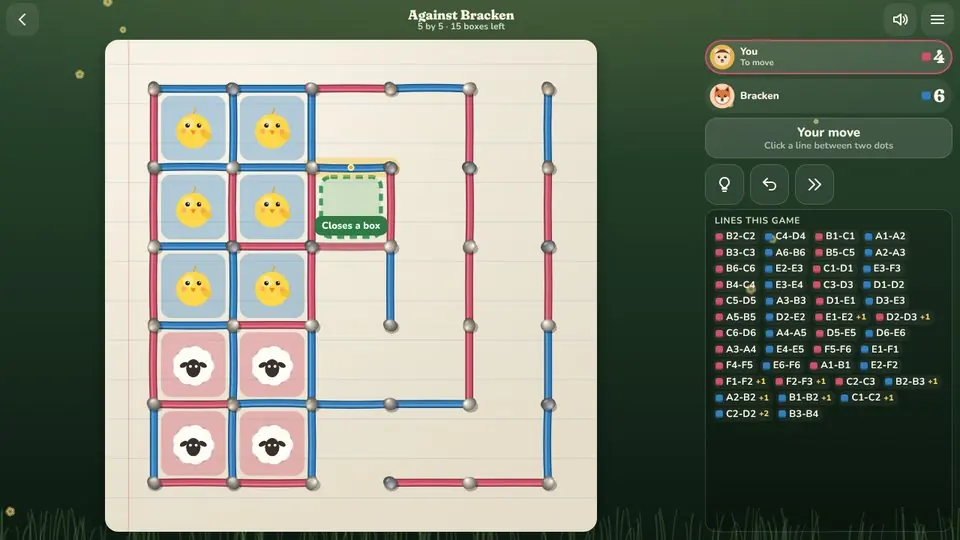
The three phases of a game
Every game of dots and boxes has the same shape. First, safe lines: moves that don't draw the third side of any box, so they give nothing away. Then the safe lines run out, and the board has turned into chains (corridors of boxes where opening one end gives them all away) and loops (closed rings). Finally, players take turns opening chains for each other. The game is usually decided by who has to open the first long chain, and by whether the other player knows what to do next.
The double-cross, with numbers
Say the safe lines are gone and the board holds exactly two chains: one of 3 boxes and one of 4. Your opponent opens the 3-chain. Here are your two choices.
| Plan | You take | They take | Result |
|---|---|---|---|
| Take all three, then open the 4-chain | 3 | 4 | You lose 3 to 4 |
| Take one, leave the last two (double-cross) | 1 + 4 | 2 | You win 5 to 2 |
The double-cross works like this. Take every box in the chain except the last two. Then, instead of taking them, draw the line at the far end of the chain. That leaves a two-box domino with one line down the middle missing. Your opponent takes those two boxes with a single line, and now it's their turn to move, with only the 4-chain left. They have to open it, and you take all four.
You gave away 2 boxes to win 4. That's control: the player with control decides who opens each chain, and it takes 2 boxes per chain to keep it (4 per loop, since a loop leaves two dominoes).
When to keep control and when to cash in
Keeping control costs 2 boxes for every chain you hand back, and 4 for every loop. So it isn't always worth it. Before you decline the last two boxes, add up what's left.
- Long chains coming: keep control. Each later chain of 4 or more pays back the 2 you hand over.
- Only short chains left (1s and 2s): take everything. Short chains can't be double-crossed profitably.
- Loops: they cost 4 to keep control through, so with several loops on the board taking everything can be better.
- Last chain: always take all of it. There's nothing left to control.
A quick check: keeping control pays when the chains still to come are long enough that the 2 boxes per chain (4 per loop) you hand back are less than you'd lose by having to open one yourself. Primrose Paddocks shows this in the review, with notes like "you should have double-crossed here".
Giving away as little as possible
When you're the one forced to open something, open the smallest thing on the board. A single box costs 1. A chain of 2 can be opened two ways, and the difference matters.
- Open a 2-chain at the end and your opponent can choose: take both, or take none and double-cross by drawing the middle line, keeping control.
- Open a 2-chain in the middle and they get two separate single boxes with no double-cross possible. They take both and must move again.
So when you hand over a 2-chain, draw the middle line. It's called the hard-hearted handout, and it's one of the simplest ways to stop a strong player keeping control.
The long chain rule
Since whoever opens the first long chain (3 or more boxes) usually loses, you want to steer the middle game so your opponent runs out of safe lines first. Elwyn Berlekamp's long chain rule gives a way to count it: add the number of dots on the board to the number of long chains you expect at the end. The first player wants that total to be even. The second player wants it odd.
| Board | Dots | First player wants | Second player wants |
|---|---|---|---|
| 3 by 3 boxes | 16 | An even number of long chains | An odd number |
| 4 by 4 boxes | 25 | An odd number of long chains | An even number |
| 5 by 5 boxes | 36 | An even number of long chains | An odd number |
Once you know what you want, you can shape the board: join two short chains into one long one, or cut a long chain into two short ones with a well placed line. Sometimes sacrificing a box or two early to change the count is the winning move. It feels wrong, and it's often right.
Safe lines and counting the endgame early
In the middle game, a safe line doesn't give away a box now, but it may change the chain count later. Before the last few safe lines go, look at the structures forming. Are they long chains or short ones? Is there a loop? Then pick the safe line that steers the count your way. Strong players often know who will win while there are still safe lines on the board.
What perfect play says
Small boards have been solved by computer. The first player wins 2 by 2 boxes three to one, the second player wins 3 by 3 six to three, and a 4 by 5 board is a tie, from searches by Barker and Korf published in 2012. On our default 4 by 4 board the fight for control decides most games between good players.
Practising with the house players
Primrose Paddocks' house players show each stage of skill. Hazel the squirrel plays safe and always takes everything, so she never double-crosses: a good first opponent to try the double-cross on. Bracken the fox double-crosses to keep control. Sage the owl fights for control with sacrifices and solves endings box by box. The Daily Paddocks has a round called Keep control that asks exactly the question from this article: take it all, or double-cross?
Mistakes that lose games
- Drawing a third side early for no reason.
- Taking every box of a long chain when more long chains are coming.
- Opening a 2-chain at the end instead of the middle.
- Keeping control through several loops when cashing in was worth more.
- Never counting dots plus long chains.
For the rules, board sizes and play with friends, read our Primrose Paddocks guide. For more pencil and paper strategy, see our tic tac toe strategy and our sea battle strategy.
Questions
What is the trick to winning dots and boxes?
Keep control in the endgame with the double-cross: when you're handed a long chain, take all but the last two boxes and leave those two, so your opponent has to open the next chain for you.
What is the long chain rule?
Add the dots on the board to the number of long chains. The first player wants the total even, the second player wants it odd. It tells you who will be forced to open the first long chain.
Should you always take boxes in dots and boxes?
Early on, almost always. In the endgame, not always: declining the last two boxes of a long chain often wins you a bigger chain next.
Who wins dots and boxes with perfect play?
It depends on the board. The first player wins 2 by 2 boxes, the second player wins 3 by 3, and 4 by 5 is a tie.
Game guides

More strategy articles
You might also like
 2 minSaves
Tickseed
Tic Tac ToeClassic tic tac toe against five house players from beginner to unbeatable, or two players on one device or by link. Plus Ultimate, bigger boards, five in a row, clever twists, 164 puzzles and Daily Puzzles.