Games / Guides / Strategy articles / Spades bidding strategy
How to bid in spades: count your tricks and dodge the bags
To bid in Spades, count about one trick for each side ace, for each king with a few cards beside it and for each high spade, then bid that number. In Spades the bid decides more hands than the play. Bid too high and you get set for minus 10 a trick. Bid too low and bags pile up until they take 100 points. Here's how we count a hand, two worked examples, and how bidding changes as the score moves.
Why accurate beats greedy
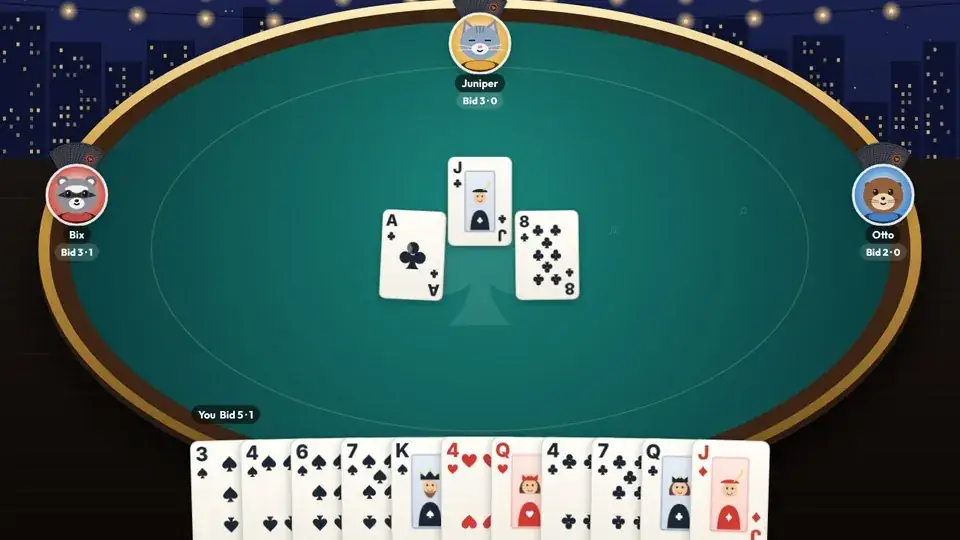
In Spades Club, a team that makes its contract scores 10 per trick bid, plus 1 for each extra trick. Each extra trick is also a bag, and every 10 bags cost 100 points. Fall short and you lose 10 per trick bid. So a bid of 6 that takes 8 scores 62 plus 2 bags, and a bid of 6 that takes 5 loses 60.
That gives two kinds of error. Overbidding costs you right away. Underbidding costs slowly, through bags. Good players aim for exact, and Spades Club even keeps exact bids as a stat.
Counting a hand
Count each card's chance of winning a trick, then round.
- Side aces: about 1 trick each, less if you hold six or more of that suit, since someone will be out of it and trump.
- Side kings: most of a trick with one to three other cards in the suit. A bare king is worth little.
- Side queens: rarely worth counting unless the suit is long and the ace and king are likely to fall early.
- A♠ and K♠: near-certain tricks. Q♠: usually wins with at least two more spades behind it.
- Long spades: each spade past your third or fourth often wins late, when others run out.
- Voids and singletons: with spades to spare, a void is about one extra trick, a singleton maybe one.
Worked hand one
| Suit | Cards | Our count |
|---|---|---|
| Spades | A Q 7 4 | A♠ 1, Q♠ with two more about 0.7, fourth spade about 0.3 |
| Hearts | K 8 3 | K♥ with two guards about 0.7 |
| Diamonds | A 9 6 2 | A♦ 1 |
| Clubs | J 5 | 0, though the short suit may let a spade trump the third round |
That adds to about 3.7. We'd bid 4 if our partner bid low or not yet, and 3 if our partner bid high, since a big partner bid means some of our maybes are covered. Either way, the count says 3 to 4, not 5.
Worked hand two: a nil candidate?
| Suit | Cards |
|---|---|
| Spades | 6 3 |
| Hearts | J 7 4 2 |
| Diamonds | 8 5 3 |
| Clubs | 9 6 4 2 |
No aces, no kings, two low spades, and the highest card a J♥ with three small hearts under it. This is a good nil hand. The risk is the J♥: if hearts are led and everyone plays low, you could be stuck winning with it. Your plan would be to drop it early under a higher heart, and your partner's job is to cover you by playing high. A hand with A♣ or K♦ in it, or a Q♠ with few spades, is not a nil hand, however low the rest looks.
A good nil hand has few spades, all low (under the 8 is a common guide), no aces or kings, and short suits so you can throw dangerous cards early.
Adjusting for your partner
Your bid and your partner's add up to one team contract, and it doesn't matter who takes the tricks. So read their bid.
- Partner bid high: trim yours a little. Some of your borderline tricks will be shared work.
- Partner bid nil: add a trick. You'll be playing high cards over them to protect the nil, which wins tricks you might otherwise have ducked.
- All four bids leave fewer tricks than 13: somebody is likely to pick up bags. If the other team underbid, setting them is hard, but they'll collect bags.
- All four bids add to more than 13: someone is going to be set. Play for your contract first.
Spades Club's bid box does this arithmetic for you, shows each card it counted and warns you if the bids already leave fewer tricks than you're about to bid.
Bags: when an overtrick hurts
Bags only matter near the tenth one, so watch the bag dots on the scoreboard. If your team sits at 8 bags and you bid 5 and take 8, you score 53 but reach 11 bags, lose 100 and end up with minus 47 for the hand. In that spot, once your contract is made, duck tricks instead of winning them.
The flip side: when the other team is close to 10 bags, giving them extra tricks is a weapon. Let them win a few extra tricks once they've made their bid.
Bidding with the score in mind
- Close to 500: bid what you need to get there safely. A small sure contract that crosses the line beats a big risky one.
- Opponents close to 500: think about setting them. Bidding a little higher to steal tricks they need can be right.
- Far behind: this is when a nil, or a blind nil (allowed by default when your team is 100 or more behind), earns its risk.
- Near minus 200: a team that falls to minus 200 loses on the spot in Spades Club, so a struggling team should bid carefully.
Blind nil, briefly
A blind nil is bid before you look at your cards and is worth 200 made or lost. After bids, you and your partner each pass 2 cards. If you're the one going blind, pass your partner your highest cards, spades first. If your partner is going blind, pass them your lowest cards and keep your high spades. In our test games a blind nil with a good swap and a careful partner was made roughly two times in three, so it's a fair comeback move and a poor one when you're winning.
Mistakes in bidding
- Counting bare kings and side queens as tricks.
- Ignoring your partner's bid.
- Bidding nil with an ace or king in hand.
- Winning extra tricks at 8 or 9 bags.
- Chasing a big bid when a small one wins the game.
For the full rules and house rule options, read our Spades Club guide, and our Hearts and Spades page has both games side by side. For more trick-taking, try our euchre strategy.
Questions
How do you count tricks for a Spades bid?
Count side aces as about one trick, guarded side kings as most of one, the A♠ and K♠ as near-certain, a Q♠ with two more spades as likely, and add for long spades and voids.
Is it better to overbid or underbid in Spades?
Neither. Overbidding costs 10 per trick bid when you're set, and underbidding builds bags, which cost 100 at ten. Aim to be exact.
What makes a good nil hand in Spades?
Few spades, all low, no aces or kings, and short side suits so you can throw high cards early.
When should you avoid taking extra tricks in Spades?
When your team is near 10 bags. Once your contract is made, an overtrick can cost you 100 points.