Games / Card Games / Spades Club / Guide
Spades Club
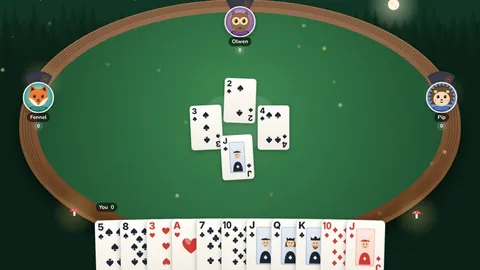
Four-player partnership Spades on a rooftop under string lights. You and Juniper the cat take on Bix the raccoon and Otto the otter, bid your tricks, and try to make them without piling up bags.

What is Spades?
Spades is a trick-taking card game for four players in two teams, with partners sitting across from each other. Every hand starts with a bid: each team says how many tricks it expects to win. Then you play the hand out and try to take at least that many. Spades are always trump, which is where the name comes from.
What makes Spades fun is that bidding too low costs you nearly as much as bidding too high, just more slowly. Extra tricks turn into bags, and bags eventually bite. Good Spades players bid accurately, not greedily.
In Spades Club you play with a computer partner against two computer opponents. It's free, runs in your browser on a phone, tablet or computer, and there's nothing to install.
How to play Spades
The deal
A standard 52-card deck is dealt out completely, so everyone gets 13 cards. Aces are high. The deal moves one seat to the left after every hand.
Bidding
Starting with the player after the dealer, everyone bids how many tricks they think they'll win, from 1 to 13. You and your partner's bids add together into one team goal, called the contract. If you bid 4 and Juniper bids 3, your team needs 7 tricks between you. It doesn't matter which of you takes them.
You can also bid Nil, which is a promise to take zero tricks yourself. Nil is scored on its own, separate from your partner's bid. Your partner still has to make their own number.
Playing tricks
- The player after the dealer leads the first card. Everyone plays one card in turn, going around the table.
- You must follow suit if you can. If you can't, you can play anything, including a spade.
- The highest card of the suit led wins the trick, unless someone played a spade. Then the highest spade wins.
- The winner of a trick leads the next one.
- You can't lead a spade until a spade has been played on an earlier trick. That's called breaking spades. The one exception: if you have nothing but spades, you can lead one.
How Spades scoring works
| Result | Points |
|---|---|
| Make your contract | 10 per trick bid |
| Each trick over your contract | +1 and one bag |
| Fall short (get set) | Minus 10 per trick bid |
| Every 10 bags | Minus 100 |
| Nil made | +100 |
| Nil failed | Minus 100 |
So a team that bids 6 and takes 8 scores 62 and picks up 2 bags. A team that bids 6 and takes 5 loses 60. Bags carry over from hand to hand. When your team's total hits 10, you lose 100 points and the bag count starts again.
A couple of house rules in our version are worth knowing. Tricks taken by a player who bid nil still count as bags for the team, so a busted nil hurts twice. And if a team falls to minus 200, it loses the match on the spot. Otherwise the first team to reach the match target wins: 500 in a classic match, 300 in a quick one. If both teams are tied at the target, play continues.
How to bid in Spades
Bidding is where most hands are won or lost. Here's the method we use, and it's close to what the bid box in Spades Club suggests for you:
- Aces outside spades: count each as a trick, unless you have six or more of that suit (someone will trump it).
- Kings outside spades: count most of a trick when you hold one to three other cards in that suit to protect it. A bare king is worth very little, since the ace will often catch it.
- High spades: the ace and king of spades are near-certain tricks. The queen of spades usually wins if you hold at least two more spades with it.
- Long spades: any spade past your third or fourth often wins a trick late in the hand, after everyone else runs out.
- Voids and singletons: if you're missing a suit and hold spades, you can trump when it's led. Count an extra trick for a void, maybe one for a singleton.
Then look at what your partner bid. If Juniper bids high, you can trim yours a little, since you'll share some of the work. If she bids nil, you'll need to protect her, so bid a touch higher. When you're unsure, the bid box shows a suggested number and tells you what it counted: aces, high spades, long spades and missing suits.
Bidding and playing nil
A good nil hand has lots of low cards, few spades, and no high spades. Something like three or fewer spades, all below the 8, and no aces or kings in any suit. Short suits help too, because they let you throw away dangerous cards early.
When your partner is nil, your job changes. Play high cards over hers so she can duck under. Lead suits where she's likely to be short. Winning an extra trick or two for your team is fine. Letting her get stuck with a trick costs 100 points and adds bags.
When an opponent is nil, try to set it. Lead low cards in suits they haven't shown, and save your own low cards so you can play under them and force them to win the trick.
Controls
Tap a card to play it. If you'd rather not misplay on a small screen, switch Playing a card to Tap twice in settings. Cards you can't legally play are blocked, and the game tells you why (follow suit, or spades aren't broken yet). A lightbulb button gives a hint during play.
On a computer, use the arrow keys to move through your hand and Enter or Space to play. Esc pauses. Settings also let you pick a fast game speed and a four-color deck, which makes the suits easier to tell apart at a glance. You can save and quit mid-match and pick it up later.
Difficulty, Daily Deal and match score
Pick Easy, Normal or Hard on the title screen. Your match score is 100 for a win, plus 50, plus 1 for every 10 points you finish ahead (or minus 1 for every 10 behind). Normal counts x1.5 and Hard counts x2, so the leaderboard rewards tougher tables.
The Daily Deal is three hands with the same cards for everyone that day. Your daily score is your team's points, plus 50 if you beat the other team. It's a nice way to compare your bidding against everyone else on the same hands.
Club ranks, tables and card backs
Every hand earns XP, with extra for tricks taken, hands won and your first hand of the day. XP moves you up 12 club ranks, from Newcomer and Regular through Night Owl, Spade Ace and Big Bidder, up to Hall of Fame. Climbing ranks opens new tables: Velvet Plum, Ruby Room, Midnight Blue and Gold Record, on top of the starting Rooftop Teal.
Milestones unlock new card backs that are shared by every card game on the site: your first match win, five exact bids, your first nil, setting the other team three times, a win on Hard, and ten match wins. The Club screen tracks your stats, including nils made, teams set and exact bids.
Spades strategy tips
- Watch the bag count. Once your team is at 6 or 7 bags, an extra trick can cost you 100 points. Late in a hand, if your contract is already made, think about ducking instead of winning.
- Setting beats overtricks. If the other team is close to its bid, spending your high cards to stop them is usually worth more than padding your own score.
- Don't trump your partner's winner. If Juniper's ace is going to take the trick, throw a low card instead of a spade.
- Lead your partner's suit. If she played high in a suit early, she may hold more strength there.
- Count the spades. There are 13. Once you've seen the ace, king and queen fall, your jack might be the boss card.
- Cash side aces early. An ace you hold onto for too long often gets trumped once someone runs out of that suit.
- Exact is the goal. Making your bid right on the nose is the cleanest result in the game. Spades Club even counts exact bids as a milestone.
Questions
How do you score bags in Spades?
Each trick you take over your team's bid is worth 1 point and counts as a bag. When your team collects 10 bags, you lose 100 points and the count resets.
What happens if you bid nil in Spades and take a trick?
You lose 100 points. In Spades Club, any tricks the nil bidder takes also count as bags for the team.
Can you lead spades on the first trick?
Not unless spades have been broken, meaning a spade was played on an earlier trick because someone couldn't follow suit. The only exception is a hand that has nothing but spades.
How many points do you need to win Spades?
Most games go to 500. Spades Club plays to 500 in a classic match or 300 in a quick match, and a team that drops to minus 200 loses right away.
Is Spades Club free?
Yes. It's free in your browser on a phone, tablet or computer, with no download.