Games / Card Games / Cribbage Cabin / Guide
Cribbage Cabin
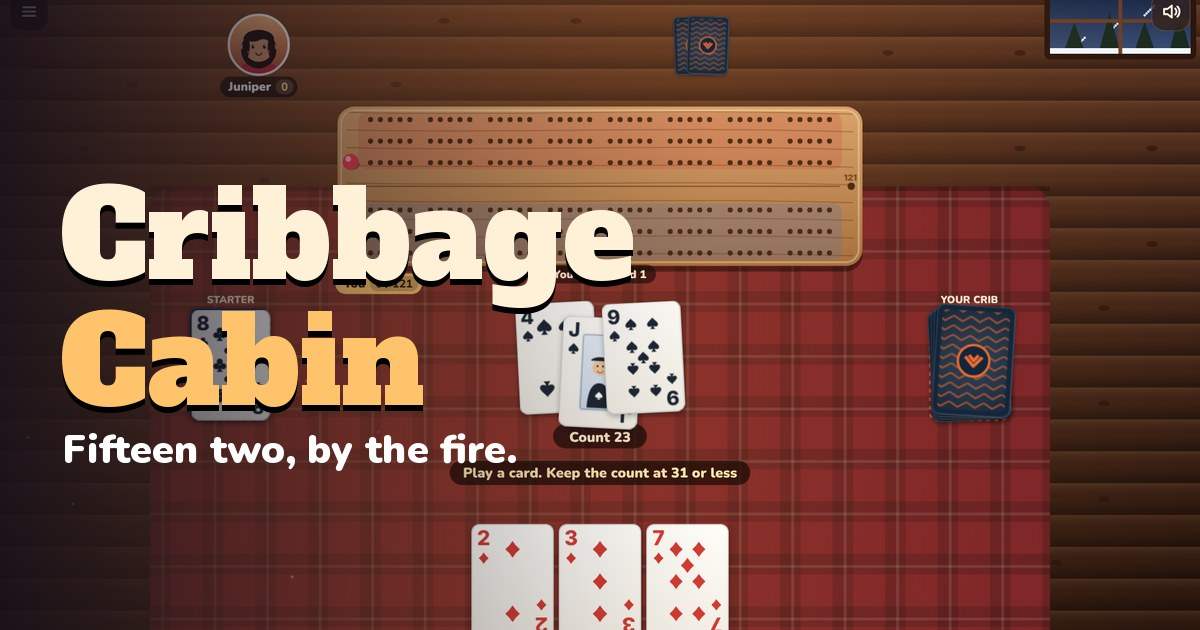
Two-player cribbage by a cabin fire, with a wooden board, three rivals to beat and every fifteen counted out loud for you. It's the easiest way we know to learn the game, and it still has plenty for old hands.
What is Cribbage?
Cribbage is a two-player card game that's been played for about 400 years, and it's still a fixture on kitchen tables, porches and fishing trips. You race two pegs around a board, and you score points in two ways: while you play cards one at a time (pegging) and when you count the hands at the end of each deal. First to 121 wins.
It looks like a lot of arithmetic at first. It isn't, really. Almost everything comes down to spotting fifteens, pairs and runs, and Cribbage Cabin shows every point as it's scored so you pick up the patterns fast. It's free, runs in your browser on a phone, tablet or computer, and there's nothing to download.
How to play cribbage
A game is a series of deals. The dealer switches every hand. Each deal has three parts: the discard to the crib, pegging, and the count.
1. Deal and the crib
Each player gets 6 cards. You each pick 2 cards to put in the crib, a spare hand that belongs to the dealer and gets counted at the very end. That leaves you both with 4 cards. Choosing what to throw is the biggest decision in cribbage, because you're building your own hand and either feeding or starving the crib at the same time.
2. The starter card
The deck is cut and a starter card is turned face up. Everyone uses it when counting their hand, and so does the crib. If the starter is a jack, the dealer pegs 2 right away. That's called his heels.
3. Pegging
The non-dealer plays first. You take turns laying one card face up in front of you and saying the running total out loud. Aces count 1, number cards their number, and jacks, queens and kings count 10. The total can never go over 31. Points you score while pegging:
| Pegging play | Points |
|---|---|
| Bring the count to exactly 15 | 2 |
| Bring the count to exactly 31 | 2 |
| Pair (same rank as the card just played) | 2 |
| Three of a kind (pair royal) | 6 |
| Four of a kind (double pair royal) | 12 |
| Run of 3 or more, in any order | 1 per card |
| Go, or the last card of the hand | 1 |
If you can't play without going over 31, you say go. Your opponent keeps playing any cards they can. Whoever laid the last card before the count resets gets 1 point (2 if they hit 31 exactly, since that already scores). Then the count goes back to zero and play continues until both players are out of cards. The very last card of the hand always earns 1.
Runs during pegging don't need to come in order. If the cards on the table go 4, 6, 5, that's a run of three for whoever played the 5. Pairs only count when the cards are played back to back.
4. The count (the show)
Now everyone picks their 4 cards back up and counts them together with the starter. The non-dealer counts first, then the dealer counts their hand, then the dealer counts the crib. The order matters near the end of a game, because the non-dealer can reach 121 and win before the dealer gets to count.
How to count a cribbage hand
This is the part people search for most, so here's the kitchen-table version. Look at your 4 cards plus the starter (5 cards in all) and count these, usually in this order:
| Combination | Points |
|---|---|
| Each different group of cards adding to 15 | 2 |
| Each pair | 2 |
| Three of a kind (three pairs) | 6 |
| Four of a kind (six pairs) | 12 |
| Run of 3, 4 or 5 in sequence | 1 per card |
| Flush: 4 cards in hand the same suit | 4 (5 if the starter matches) |
| Nobs: jack in hand matching the starter's suit | 1 |
Fifteens
Every different combination of cards that adds to 15 is worth 2. The same card can be used in more than one combination. A 5 and a king make 15. So do 7 and 8, 6 and 9, or 2, 3 and 10. People count out loud as they go: "fifteen two, fifteen four, fifteen six."
Pairs and runs
Every pair is 2 points. Three of a kind is really three different pairs, so it's 6. Runs are three or more cards in a row (ace is low, so A 2 3 counts but Q K A doesn't). When a card repeats inside a run, you get the run twice. 4 5 5 6 is a double run: two runs of three for 6, plus the pair for 2.
Flush and nobs
Four cards of one suit in your hand is a flush for 4, or 5 if the starter is that suit too. The crib is stricter: it only scores a flush if all 5 cards match. Holding the jack of the starter's suit gives you 1 point for nobs.
A worked example
Say you hold 4♣ 5♦ 6♥ J♠ and the starter is 5♠. Fifteens: 4 5 6 using the 5♦, and 4 5 6 using the 5♠, plus J with each 5. That's four fifteens for 8. The two 5s make a pair for 2. The run 4 5 6 appears twice (once with each 5) for 6. The J♠ matches the starter's suit for 1 more. Total: 17.
The best possible hand is 29: three 5s and a jack in your hand, with the fourth 5 turned as the starter in the jack's suit. You can play for years without seeing one. We'll make a fuss if you do.
Controls
On a phone or tablet, tap two cards and send them to the crib, then tap a card to play it during pegging. If nothing fits under 31, the game tells you to say go. On a computer you can do the same with the mouse, or use the keyboard: number keys or arrows with Enter to pick cards, C to send your two cards to the crib, and Esc to pause.
You can save and quit from the pause menu and pick the match back up later from the Play button.
Your rivals and settings
The computer skill setting picks who sits across the fire from you:
- Moss (Easy) is a camp kid learning the game. Keeps cards that look nice and grabs the easy points.
- Juniper (Normal) is a park ranger. Steady pegger, weighs every possible starter and plays the crib well.
- Old Ash (Hard) has been cabin champion for forty winters. Plays the crib and reads the count.
Game length can be Classic 121 or Quick 61. There's also a Muggins toggle. With muggins on, you count your own hand, and any points you miss go to your rival. If you claim too many, we tell you the real number and there's no penalty. It's the best way we know to get sharp at counting.
Win while your rival is still under 91 (under 46 in a quick game) and it's a skunk.
Daily Deal and scoring
The Daily Deal is three hands against Juniper with the same cards everyone gets that day. Your score is simply the points you pegged and counted, so every fifteen matters. Come back each day to build a daily streak, and check the leaderboard to see how your deal stacks up.
In a regular match your final score is 100 plus your points minus your rival's. A blowout scores higher than a nail-biter, so a skunk is worth chasing.
Pegs and card backs
Every point you score goes toward carving new pegs in the Peg Box. There are 12 to collect, starting with Brass and moving through Ruby (120 points), Pine, Bluebell, Antler, Amethyst, Copper, Frost, Ember, Jade and Moonstone, up to Aurora at 4,000 points. The Peg Box also keeps your stats: games won, skunks, best hand and win streak.
Milestones like your first win, your first skunk and your tenth win unlock new card backs. Those backs are shared with every card game on the site, so a win here dresses up your deck in Gin Garden and Hearts Hollow too.
Cribbage strategy tips
Discarding to the crib
- When it's your crib, throw cards that work together: a pair, two cards that make 15 (like 7 and 8), or cards one apart (like 6 and 7). You get those points back later.
- When it's your rival's crib, avoid giving them 5s, pairs, or two cards that add to 15. Wide, awkward pairs like king and 9, or 10 and ace, are the safest throws.
- Fives are gold because so many cards are worth 10. Hang on to them, or put them in your own crib, almost never in your opponent's.
- Don't only count the hand you keep. Think about which starters help it. A 4 5 6 7 hand has lots of good cuts. Four disconnected high cards have very few.
Pegging
- A lead of 4 or lower is safe: your rival can't make 15 with one card. A 5 is the worst lead, because any ten card makes 15.
- Leading a 10, jack, queen or king puts the count at 10, so a 5 from your rival scores. Avoid it when you can.
- Try not to leave the count at 21. Any ten card takes it to 31 for 2.
- Pairing your rival's card scores 2, but it invites a pair royal for 6. Do it when you hold no more of that rank and the risk is low, or when you hold the fourth one yourself.
- Keep a low card for late in the count. Being the one who can still play at 28 or 29 picks up the go, and sometimes a 31.
Playing the board
When you're ahead late in the game, play defensively: give away little in pegging and toss safe cards to the crib. When you're behind, take the chances that could produce a big hand. And near 121, remember the non-dealer counts first.
Questions
How many points do you need to win cribbage?
A standard game is 121 points, twice around a 60-hole board plus one. Cribbage Cabin also has a quick 61-point game.
What is the highest hand in cribbage?
29. You need three 5s and the jack of the fourth suit in your hand, and the fourth 5 turned up as the starter in the same suit as your jack.
What does his heels and his nobs mean?
His heels is when the starter card is a jack: the dealer pegs 2. Nobs is holding the jack of the same suit as the starter in your hand, worth 1 point when you count.
What is a skunk in cribbage?
Winning while your opponent hasn't reached 91 points. In our quick 61-point game, a skunk means your rival is still under 46.
Is Cribbage Cabin free?
Yes. It's free to play in your browser on a phone, tablet or computer, with nothing to install.