Games / Guides / Strategy articles / Gin rummy strategy
Gin rummy strategy: knock early, discard safely
Gin rummy is a game of two jobs at once: building your own melds and starving your opponent of theirs. Most hands are won by the player who gets their deadwood down first and knocks, not by the one who waits for a perfect hand. Here's how to do both jobs well.
The scoring that shapes strategy
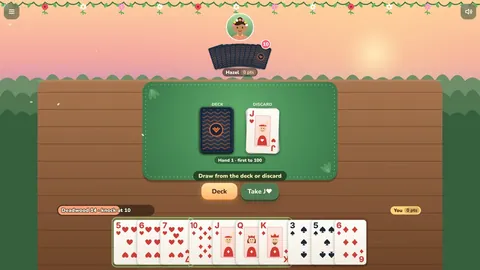
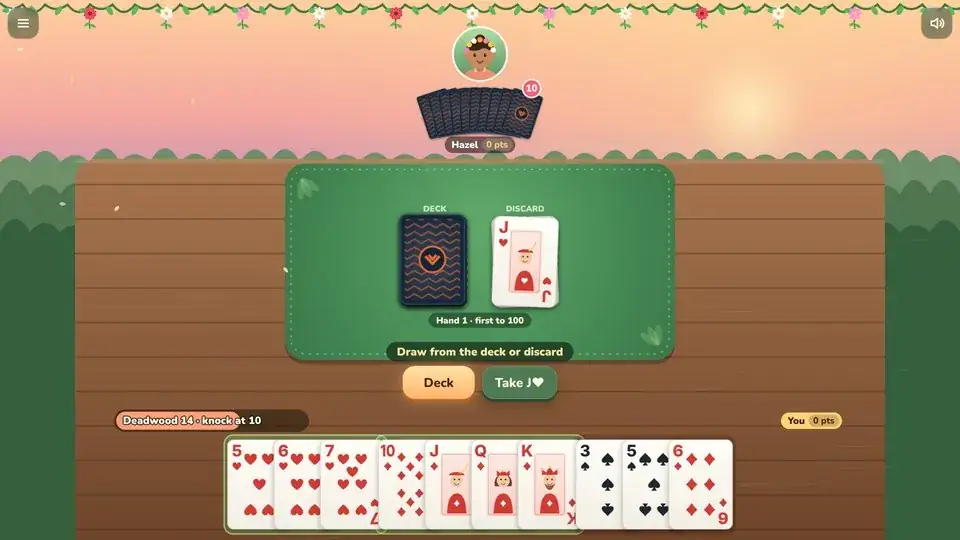
You can knock when your unmatched cards (deadwood) add up to 10 or less after you discard. Your opponent then lays off what they can on your melds, and the lower deadwood wins the difference. Gin, with zero deadwood, scores a 25 bonus plus your opponent's deadwood and can't be laid off on. If the defender ties or beats the knocker, that's an undercut: the defender scores the difference plus 25.
Aces count 1, number cards their value and face cards 10. In Gin Garden a match goes to 100, with a 100 point game bonus and 25 for each hand won.
Knock early
Waiting for gin feels heroic, but every turn you wait is a turn your opponent improves too. If you can knock in the first several turns, it's usually right. Your opponent's hand is still messy early on, so their deadwood is likely high and your win is likely bigger than it looks.
A worked example. On your fifth turn you hold two melds and a 3 and a 4 of different suits. That's 7 deadwood. Knock. Your opponent, five turns in, will often be holding 20 or 30 points of loose cards. Waiting for gin to earn 25 more points risks them knocking first, or catching up and undercutting you.
When to wait instead
- Late in the hand. Your opponent has had time to tidy up. If they've been holding the same cards for several turns and taking few discards, their deadwood is probably low. Knocking with 9 or 10 is risky. Wait for a lower count or gin.
- When your melds give them layoffs. A four-card run of 5♣ 6♣ 7♣ 8♣ lets them lay off the 4♣ or 9♣. Count the layoffs they might have before you knock.
- When you're one card from gin and the stock is deep. Gin's 25 point bonus and immunity to layoffs can be worth one or two more turns.
And mind the stock. If it gets down to 2 cards with nobody knocking, the hand is dead and nobody scores. Late in the stock, a modest knock beats a dead hand.
Get rid of high deadwood first
A loose King costs you 10 if your opponent knocks. A loose 2 costs 2. Early in the hand, throw your unmatched face cards. Low cards do little harm while you hold them and are easy to fit later. This also makes you able to knock sooner, which is the point of the whole game.
The exception: a face card that's close to a meld. Q♦ K♦ needs only the J♦ to become a run, so it might be worth keeping for a few turns while you throw other loose cards.
Keep flexible cards
A card that could join two different melds is worth more than one that could only finish one. Compare these two starts:
| Cards | Ways to grow |
|---|---|
| 7♥ 8♥ 8♣ | 6♥ or 9♥ for a run, any other 8 for a set: lots of outs |
| 7♥ 7♣ K♦ | Only another 7 helps, and the King is dead weight |
When you have to break up something, keep the cards that overlap: a card in a near-run that also has a pair partner is the last thing you throw.
Safe discards: reading the pile
Every discard your opponent makes tells you something, and so does every card they pick up.
- Their discards are safe to match. If they threw the 6♣, they probably aren't collecting 6s or low clubs. Another 6, or the 5♣ and 7♣, are safer than random cards.
- Their pickups are danger signs. If they took the 9♦ off the pile, don't throw them the 9♠ (set) or the 8♦ or 10♦ (run) unless you must.
- Dead cards are the safest of all. If three 7s have been seen in the discards, the fourth can't make a set, and if its neighbors in suit are gone too, it can't make a run either.
Old Thorne, the hard rival in Gin Garden, tracks every card you pick up and never feeds you the card you want. Playing against him is a good way to learn how much the pile gives away.
Taking from the discard pile
Only take the discard when it completes a meld or clearly improves one. Every pickup shows your opponent what you're building. Drawing blind from the stock tells them nothing. The one time to take a card that doesn't help much is late in the hand, to stop it reaching a player you know wants it.
Avoiding the undercut
An undercut swings a hand: instead of you scoring a few points, your opponent scores the difference plus 25. It happens most often when you knock with 8 to 10 points against a player who has been quietly tidying up. Before you knock with a high count, ask two questions. How many turns has your opponent had to improve? Could their likely loose cards fit on your melds? If the answers worry you, wait a turn and see if you can drop a few points.
Playing the match score
Every hand you win is worth 25 at the end of the match, whatever its size, and a shutout doubles the winner's points and game bonus. So near the end of a match, a quick small knock can be worth more than it looks, and when your opponent has won nothing yet, every hand you win keeps the shutout alive.
Mistakes that lose hands
- Waiting for gin when you could knock early.
- Holding loose face cards while discarding low ones.
- Throwing a card next to one your opponent just picked up.
- Taking discards that don't make a meld, and showing your hand.
- Knocking late with 9 or 10 into a patient opponent.
For the rules, controls and the Daily Garden, read our Gin Garden guide. For another two-player card game with lots of counting, see our cribbage pegging strategy.
Questions
Should you always knock in gin rummy?
Early in a hand, usually yes. Late in a hand, a patient opponent may undercut you, so knocking with 9 or 10 is riskier and waiting for a lower count can be better.
What cards should you discard first in gin rummy?
Loose high cards, especially face cards that aren't close to a meld. They count 10 each if your opponent knocks.
What is a safe discard in gin rummy?
A card your opponent is unlikely to want: one matching their recent discards, or a dead card whose set and run partners have already been played.
How do you avoid an undercut?
Knock early, before your opponent's deadwood is low, and late in a hand only knock with a small count. Check which of their cards could lay off on your melds.