Games / Strategy Games / Primrose Paddocks / Guide
Primrose Paddocks
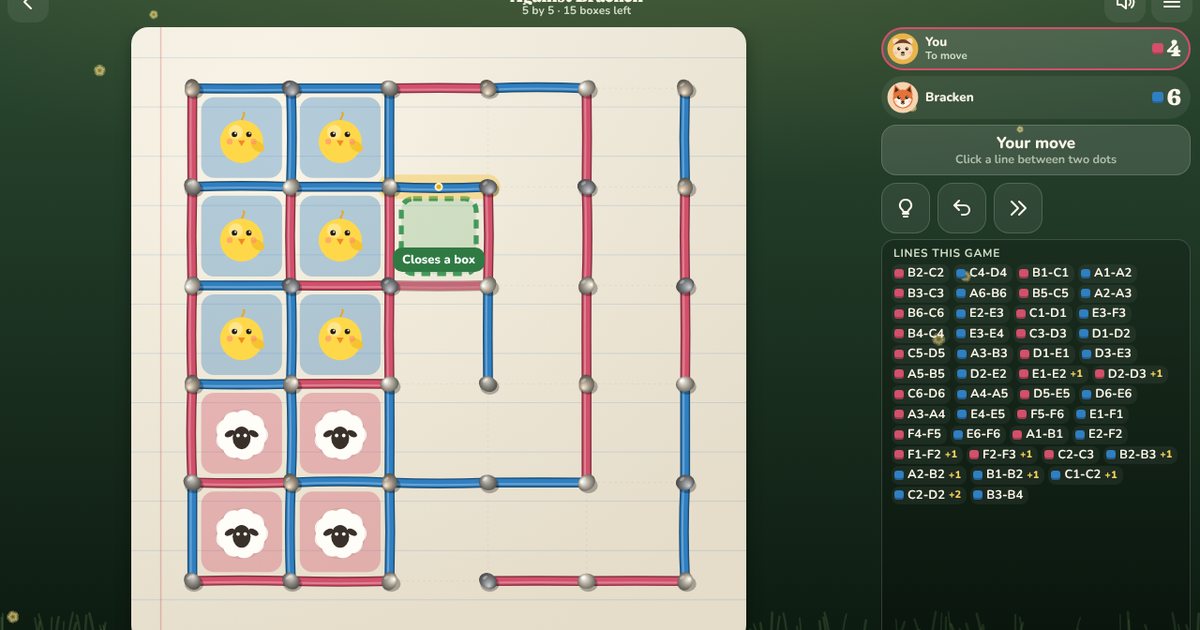
Primrose Paddocks is dots and boxes, the pencil and paper classic, on a sheet of notebook paper in a spring meadow. Draw a line between two dots, close a box to fence in a paddock and claim the critter inside, and go again. It looks like a game for passing notes in class. Played well, it is one of the deepest little strategy games there is.
Quick answers
Does Primrose Paddocks work on my phone?
Yes. Primrose Paddocks works with touch on phones and tablets, and with a mouse or keyboard on a computer. It runs in the browser you already have, so there is no app to download.
Do I need an account to play Primrose Paddocks?
No. Just open it and play, with no sign-up. If you like, a free account (username only, no email, for players 13 and older) puts your scores on the leaderboards and backs up your progress so it follows you to any device.
Is there a daily challenge in Primrose Paddocks?
Yes. Primrose Paddocks has a new daily challenge every day, the same one for every player, with its own daily leaderboard. Find it alongside the others on our daily challenges page.
Does Primrose Paddocks save my progress?
Yes. It saves on this device on its own, so you can close the page and pick up where you left off. Sign in with a free account to keep the same progress on your phone and your computer.
Is Primrose Paddocks OK for kids?
Yes, players of any age can enjoy it. There is no chat and no way to message other players, and nobody needs an account to play. Accounts are for players 13 and older, so younger players just play and their progress stays on their device. For ages 4 to 11 we also have learning games in their own kids area, with no ads, no accounts and no tracking.
What is dots and boxes?
Dots and boxes was first published in 1889 by the French mathematician Edouard Lucas, who called it la pipopipette. It has been drawn in the margins of exercise books ever since, under plenty of names: boxes, squares, paddocks, dots and dashes, the dot game and, our favourite, pigs in a pen.
The rules take ten seconds to learn. The strategy took mathematicians most of the last century to work out, and the late Elwyn Berlekamp wrote a whole book about it. We built Primrose Paddocks so you can enjoy both: a quick, friendly game with the drawing feel of real ink, and house players and hints that quietly teach the ideas strong players use. It's free, it runs in your browser and there's nothing to download.
How to play dots and boxes
- The board. A grid of dots. We play 4 by 4 boxes (5 by 5 dots) by default, and you can pick anything from 3 by 3 to 8 by 8.
- Draw a line. On your turn, join two dots that sit next to each other, across or down. Diagonals don't count.
- Close a box. If your line is the fourth side of a box, the box is yours. We fence it in, wash it in your color and pop your critter inside.
- Go again. Closing a box means you must draw another line. One line can even close two boxes at once.
- The end. When every line is drawn, whoever owns the most boxes wins. On boards with an even number of boxes a tie is possible.
We also offer two classic starts from Scandinavia. On a Swedish board the outside border is already drawn, which makes every box on the edge more dangerous. On an Icelandic board the left and bottom edges are drawn.
Chains, loops and the double-cross
Early in the game nobody wants to draw the third side of a box, because the next player simply takes it. These harmless moves are safe lines. As they run out, the board turns into chains (corridors of boxes where opening one end lets the other player take them all) and loops (closed rings of boxes).
Sooner or later someone has to open a chain. Here's the trick that separates beginners from strong players. When you are handed a long chain, take every box except the last two, then draw the line at the far end instead. That hands two boxes back as a little gift. Your opponent takes them, and now they have to open the next chain for you. This is the double-cross, and the player doing it has control. With a loop you hand back four boxes instead of two.
Giving away two boxes per chain to collect all the rest is usually a bargain. But not always: when the chains left are short, or there are lots of loops, keeping control costs more than it earns, and the right play is to take everything. Our hints and our game review tell you which is which.
The long chain rule
Whoever has to open the first long chain (three boxes or more) usually loses. You can steer that from the middle of the game. The rule, from Berlekamp: count the dots on the board and the long chains you expect. The first player wants dots plus long chains to be an even number; the second player wants it odd. On our 4 by 4 board there are 25 dots, so the first player is hoping for an odd number of long chains.
You change the count by joining two short chains into a long one, or by cutting a long one in two. Sometimes it's worth sacrificing a box or two early just to change who will run out of safe lines first.
Playing Primrose Paddocks
- On a phone or tablet: touch near the line you want. We pick the nearest open line anywhere on the board, so you never have to hit a thin line exactly. Slide to change it, lift your finger to draw it. If a line would give boxes away, the boxes at risk light up and a little label says how many. Turn on Tap twice to draw in Settings if you like to be sure.
- With a mouse: point at a line to see it, click to draw it.
- With a keyboard: Tab to the board, walk the lines with the arrow keys and press Enter to draw. H shows a hint, U takes a line back and Esc opens the menu. Screen readers hear every line by its dots, like B2 to B3, and what drawing it would do.
- Undo, hints and the review: take lines back against house players and in pass and play. The light bulb shows our pick and says why. After a game, the review marks the lines that cost you, with notes like gave away a 4-chain while a safe line was left, or you should have double-crossed here.
High contrast mode gives every player a pattern as well as a color, and there's a less motion setting, pencil guides on the open lines and optional dot names round the board.
The house players
Five critters from the meadow, each a clear step up from the last. We measured every one against the one below it over hundreds of games.
| Player | Level | How they play |
|---|---|---|
| Pip the mouse | Beginner | Grabs boxes when she spots them and draws third sides without a second thought. |
| Clover the rabbit | Easy | Takes every box he is given and keeps to safe lines, then opens chains at random. |
| Hazel the squirrel | Medium | Plays safe, then opens the shortest chain. Takes everything, so she never double-crosses. |
| Bracken the fox | Hard | Double-crosses to keep control and counts the endgame exactly once the board is small. |
| Sage the owl | Expert | Searches deep, fights for control with sacrifices and solves endings box by box. |
Our engine is our own. Once the safe lines are gone and the board is only chains and loops, it knows the exact result straight away, the way Berlekamp's theory says it should.
Daily Paddocks and the ladder
Every day brings three new endings, the same for everyone. Each is a take the most boxes you can round against Sage, who defends perfectly. Short chains is a 3 by 3 board with every safe line gone. In Keep control, a 4 by 4 board, Sage has just opened a chain for you: take it all, or double-cross? Fight for control is a 3 by 4 board with a few safe lines left. Each round is worth 100 points if you take the most boxes there were, and 25 less for each box short. Your first go of the day goes on the daily leaderboard, out of 300, and you can share a spoiler free card.
The ladder is a rating that starts at 1200 and moves after every game against a house player. Beating a stronger player moves it more. Sign in to keep your ladder, streak, awards and unlocked paper and critters on every device.
Play with friends
Dots and boxes is a great game for more than two. In pass and play, 2, 3 or 4 players share one device, each with their own color and critter, and who goes first moves round the table every game. To play someone far away, open Play a friend, host a game and share the four letter room code or link. The host picks the board, and either of you can ask for a rematch. Online games use preset reactions only, with no typed chat.
Tips and strategy
- Before you draw a line, count its box's sides. A third side is a gift to the other player.
- When you must give something away, give the smallest thing: a single box, or a chain of two opened in the middle (that one can't be double-crossed).
- Opening a chain of two at the end lets the other player choose. Opening it in the middle doesn't.
- When you are handed a long chain, stop and count what is left before taking the last two boxes. If more long chains are coming, the double-cross usually wins.
- Loops cost twice as much to keep control of. With several loops on the board, taking everything can be better.
- Count dots plus long chains. If the count is wrong for you, try to make or break a chain, or sacrifice a box early to swap who runs out of safe lines first.
- On a 3 by 3 board the second player wins with perfect play, six boxes to three. Moving first, you need your opponent to slip.
Questions
Is Primrose Paddocks free?
Yes. It's free to play in your browser on a phone, tablet or computer, with no ads and nothing to download.
What is the double-cross in dots and boxes?
When you are handed a long chain, you take all but the last two boxes and draw the line at the far end. Your opponent gets the two boxes but then has to open the next chain for you, so you keep control.
Who wins dots and boxes with perfect play?
It depends on the board. The first player wins 2 by 2 boxes three to one, the second player wins 3 by 3 six to three, and the 4 by 5 board is a tie, as computer searches by Barker and Korf showed in 2012.
Can more than two people play?
Yes. Pass and play takes 2, 3 or 4 players on one device. Online play is for two.
What is the long chain rule?
Count the dots and the long chains of three or more boxes. The first player wants the total to be even and the second player wants it odd. It tells you who will be forced to open the first long chain.
Can I take a line back?
Yes, against house players and in pass and play. Undo is off in the daily and in online games.