Games / Puzzle Games / Mosaic Logic / Guide
Mosaic Logic
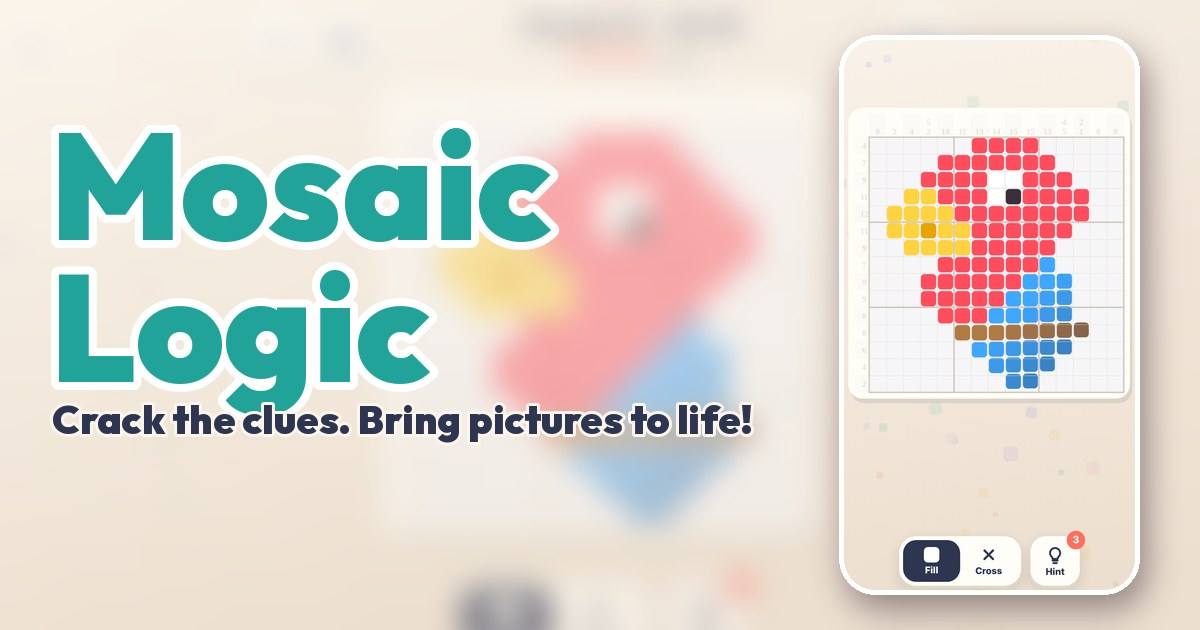
Mosaic Logic is a picture logic puzzle, also called a nonogram or paint by numbers grid. Use the number clues to work out which squares are filled, and a little pixel picture appears and comes to life when you finish.
What is a nonogram?
A nonogram is a grid of blank squares with numbers along the left side and the top. Each row's numbers tell you the lengths of the runs of filled squares in that row, in order from left to right. Each column's numbers do the same from top to bottom. A clue of 3 1 means: somewhere in this line there's a run of three filled squares, then at least one empty square, then a single filled square. Everything else in the line is empty.
That's the whole rule. There's no guessing in a good nonogram. Every square can be worked out by reading rows and columns against each other, and when you're done, the filled squares make a picture.
Mosaic Logic gives you 40 hand-drawn pictures, from a little Heart and a Ghost up to a Castle, a Koi and a Bear, plus endless generated mosaics and a daily puzzle. It's free and plays in your browser on phone, tablet or computer.
How to play Mosaic Logic
- Pick Fill and tap a square you know is filled.
- Pick Cross and tap a square you know is empty. Crossing is how you keep track of what you've ruled out.
- Drag across the grid to fill or cross a whole run in one stroke.
- When every filled square in a row or column is found, the rest of that line is crossed for you.
- Some puzzles start with a few squares already filled in. Those starter tiles are there so the puzzle has only one answer and can be solved with pure logic.
Hearts and mistakes
You have 3 hearts per puzzle. If you fill a square that should be empty, or cross one that should be filled, you lose a heart and the square flips to show the right answer. Lose all three and you're out. If you have a hint saved, Keep going spends one hint to give you one heart back, and you carry on from where you were.
Controls (phone and computer)
On a touch screen, tap or drag. With a mouse, click or drag. With a keyboard:
| Key | What it does |
|---|---|
| Arrow keys | Move the cursor |
| Space, Enter or F | Fill the square |
| X or C | Cross the square |
| Shift + arrows | Keep filling or crossing as you move |
| Tab | Switch between Fill and Cross |
| H | Use a hint |
| R | Restart |
| Esc or P | Pause |
How to solve nonograms: the techniques that matter
These are the same steps experienced solvers use on any nonogram. Use them in a loop: work a row, then check the columns it touches, and keep going back and forth.
1. Start with the big numbers (the overlap trick)
Say a row is 10 squares wide and its clue is 7. Push that run as far left as it can go and it covers squares 1 to 7. Push it as far right as it can go and it covers 4 to 10. Squares 4 through 7 are filled either way, so fill them now. The rule of thumb: if a clue is bigger than half the line, the middle part is always filled. The amount you can fill is the clue minus the free space (line length minus the clue).
It works with several numbers too. Add up the clues plus one gap between each pair. For a 3 4 clue in 10 squares, that's 3 + 1 + 4 = 8, leaving 2 squares of slack. Any run longer than the slack overlaps with itself: the 3 has one sure square and the 4 has two.
2. Lines that add up exactly
If the clues plus the gaps add up to the full width, there's no slack at all. A 2 1 5 clue in a 10-wide row (2 + 1 + 1 + 1 + 5 = 10) can only go one way. Fill it in completely. Clues of 0, or a blank line, mean every square is empty, so cross the whole line.
3. Edges push runs into place
When you have a filled square near the edge of the grid, the first run has to include it. If the first clue in a row is 4 and square 2 is filled, that run must reach at least square 4, so squares 2, 3 and 4 are filled. This is often called edge forcing, and it's one of the biggest sources of progress in the corners of a puzzle.
4. Cross what can't be reached
Once you know where a run sits, look at how far it could possibly stretch. Any square outside that reach is empty. A 2 in a row where you've filled square 6 can only cover squares 5 to 7, so everything else in the row gets a cross. Crosses matter as much as fills, because they create new edges for the next step.
5. Completed runs get walls
When a run is finished, the squares on both sides of it must be empty. If a column's clue is 3 and you've found three filled squares in a row, cross the squares just above and below. If a line's largest clue is 3 and you see a run of three, it must be that clue.
6. Gaps that are too small
Look for pockets of unknown squares boxed in by crosses or edges. If the smallest clue in that line is 3 and a pocket is only two squares wide, nothing fits there. Cross it.
7. Switch directions often
Every square belongs to one row and one column. A fill or cross you find in a row is new information for the column it sits in. The fastest solvers barely finish one line before jumping to the crossing line to see what changed.
Stars, hints and scoring
Stars are about accuracy, not speed. Solve with no mistakes for 3 stars, one mistake for 2, and two for 1.
You start with 3 hints. A hint fills in a square that can be worked out right now from a single row or column, so it nudges you along the way a friend would. You earn a hint for each first 3-star solve and another for your first solve each day.
The Daily Mosaic is the same generated picture for everyone, usually a 12×12. It's scored out of 1,200: you lose 2 points for every second and 200 per mistake, with a floor of 100. If you run out of hearts on the daily, you still get partial credit for how much of the grid you filled. Solve it on back-to-back days to build a streak and see your score on the leaderboard. A total stars board ranks the puzzles you've solved too.
The gallery
Every picture you solve goes into your gallery, where you can watch it animate again or replay it. The 40 pictures are grouped by size:
| Group | Pictures | Grid |
|---|---|---|
| Little ones | 1 to 8 | 5×5 |
| Friends | 9 to 18 | 8×8 |
| Critters | 19 to 28 | 10×10 |
| Big pictures | 29 to 35 | 12×12 |
| Masterpieces | 36 to 40 | 15×15 |
After puzzle 40 the game keeps going with endless mosaics that rotate between 10×10, 12×12 and 15×15 grids. Past daily mosaics are kept in the gallery too.
More tips for Mosaic Logic
- Cross freely. Crosses don't cost anything if they're right, and they make the next deduction obvious. Most mistakes come from filling a square you only think is right.
- Don't guess for speed. A heart lost costs you a star. If you're stuck, a hint is cheaper than a mistake.
- Use the auto-cross. When a line finishes and crosses itself out, glance at the columns those crosses landed in. They often unlock right away.
- Start on the small grids. The 5×5 Little ones are a good place to practice the overlap trick until it's automatic.
Like logic with a bit of drawing in it? Try Firefly Paths, a connect the dots path puzzle, or Dock Jam, a sliding block puzzle.
Questions
How do you solve a nonogram?
Start with rows or columns that have big clues and fill the squares where every possible placement overlaps. Cross squares that can't be reached, then use each new fill or cross in the crossing lines. Repeat until the picture is done.
What do the numbers mean in a picture logic puzzle?
Each number is the length of a run of filled squares in that row or column, in order. Runs are separated by at least one empty square.
Do nonograms need guessing?
A well made one doesn't. Every puzzle in Mosaic Logic has one answer that can be reached with line by line logic. Starter tiles are added where needed to make sure of that.
Is Mosaic Logic free?
Yes. It's free in your browser on phone, tablet or computer, with nothing to download.
What happens if you run out of hearts?
The puzzle ends, but if you have a hint saved you can spend it to get one heart back and keep going.
How do you get 3 stars?
Finish the puzzle without a single mistake. Time doesn't affect stars, only the daily score.