Games / Guides / Strategy articles / Merge numbers strategy
Merge number puzzle strategy: corner, chain and recover
The sliding merge puzzle rewards a plan more than quick fingers. One simple method, keeping your biggest tile in a corner and feeding it a chain, takes most players from stalling at 256 to making the big tile. Here it is in detail, plus what to do when things go wrong.
How the board behaves
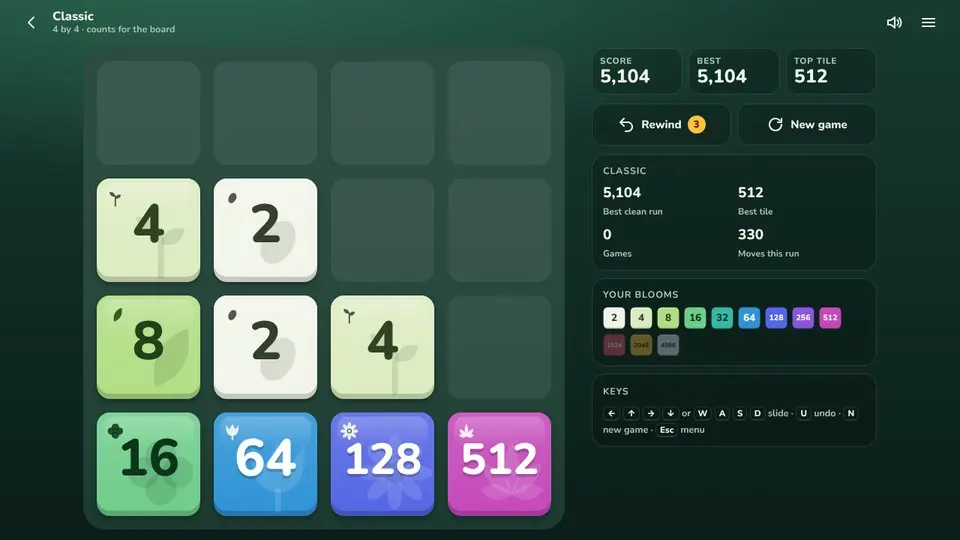
Every swipe slides all the tiles as far as they go. Two equal tiles that meet merge into one worth double, and each tile can merge only once per move, so 2, 2, 2, 2 slid left becomes 4, 4, not 8. When three equal tiles sit in a row, the two nearest the wall you're sliding toward merge first. After any move that changes the board, a new tile appears in a random empty square: a 2 nine times in ten, a 4 one time in ten.
Those last two facts shape the whole strategy. New tiles land in empty squares, and empty squares are wherever you didn't put your tiles. If you keep your big tiles packed in one corner, the new 2s and 4s land away from them, which is exactly what you want.
Step one: pick a corner and stay there
Choose a corner for your biggest tile. Most strong players use a bottom corner, so let's say bottom left. Now your main moves are left and down, with right as a helper. Up is the move you avoid, because it's the one that can pull your big tile out of the corner and let a 2 drop in underneath it.
Avoiding up isn't a strict ban. It's a last resort. If left, down and right are all impossible, you have to swipe up. When that happens, swipe down again as soon as you can to settle things back.
Step two: keep the bottom row full
If every square in the bottom row holds a tile, left and right can't move those tiles out of line, and your corner tile stays put. A gap in the bottom row is where trouble starts, because a right swipe can then slide your big tile away from the corner. When a gap opens, fill it fast, even with a small tile.
Step three: build a chain
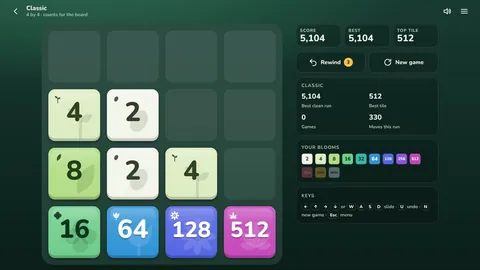
Line your tiles up in falling order along the bottom row, then snake back along the row above. Here's a healthy board in Doubloom heading for the big one:
| c1 | c2 | c3 | c4 | |
|---|---|---|---|---|
| Row 1 | 2 | |||
| Row 2 | 4 | 2 | ||
| Row 3 | 8 | 16 | 32 | 64 |
| Row 4 | 1024 | 512 | 256 | 128 |
Read it as a snake: 1024, 512, 256, 128 along the bottom, then 64, 32, 16, 8 coming back along row 3. When the 8 doubles into a 16, it merges into the 16, which becomes a 32 and merges into the 32, and so on. One lucky stretch of swipes can roll the whole chain into the corner. The work is in feeding the far end of the snake with small tiles, so build your 4s and 8s near the end of the chain, not in random corners of the board.
Don't rush merges
A merge you can make now is often still there next move. If waiting one move lets you set up a second pair, one swipe can make both merges and free two squares instead of one. The question to ask before every swipe is not "can I merge?" but "where will the new tile land, and will it get in the way?"
Count empty squares. With six or more, you have room to plan. With two or three, play the move that opens the most squares, even if it's ugly. With one, every move matters, so check each direction.
When the big tile slips out
It happens to everyone. You're forced to swipe up, and a 2 lands in your corner. Don't panic, and don't start a new plan. Usually the best fix is to merge that small tile up as quickly as possible with tiles beside it until it's big enough to merge into the row, or to swipe so your big tile slides back into the corner before more small tiles pile in. The longer an interloper sits in the corner, the more the board organises itself around the mistake.
In Doubloom you earn a rewind each time you grow a 256 or bigger in a run, and you can bank up to 3. A rewind takes back one move. Saving them for exactly this moment, the swipe that wrecked your corner, is the best use we know. Note that a Classic run that uses one stays off the Classic board.
Scoring big in the Daily Garden
The Daily Garden gives you 300 moves. Here's a useful bit of arithmetic: merging never changes the total of the numbers on the board, so the total only grows by the new tiles, about 2.2 per move on average. After 300 moves the tiles on your board add up to roughly 660. That's why a 512 is a realistic top tile in the Daily Garden and a 1024 isn't.
Your score is the sum of every merge. A tile built from 2s scores its value times the number of doublings after the first, so a 64 is worth about 64 x 5 = 320 points and a 512 about 512 x 8 = 4,096. Per unit on the board, bigger tiles score more. So in the Daily Garden the same corner and chain method still wins: the more of your 660 or so you push into one or two big tiles by move 300, the higher you finish.
Other boards and modes
- 3 by 3: there's barely any room for a chain. Merge small tiles early and keep as many squares empty as you can.
- 5 by 5 and 6 by 6: lots of room, very long games. The corner method works the same, with a longer snake.
- Stone Garden: stones never move, and a merge right beside one cracks it. Build your chain on the side away from the stones, and crack a stone when it starts crowding your corner.
- Goals: fewer moves earn more stars, so plan merges in pairs and don't waste swipes that don't change much.
Mistakes we see most
- Swiping in all four directions evenly, so the big tile wanders.
- Leaving a gap in the corner row.
- Building small tiles far from the end of the chain.
- Merging the first pair you see instead of the pair that opens the most space.
- Starting a new plan after one bad swipe instead of repairing the corner.
For modes, undo rules and themes, read our Doubloom guide. If you like calm number puzzles, our sudoku techniques article is a good next read, and our merge games page has more to try.
Questions
What is the best strategy for the merge numbers puzzle?
Keep your biggest tile in one corner, keep the row along that corner full, and build a falling chain of tiles toward it so merges roll into the corner.
Which direction should I never swipe?
The one that pulls your corner tile out. With the big tile in a bottom corner, avoid swiping up unless no other move is possible.
Can you keep playing after the big tile?
Yes. In Doubloom the board goes on to 4096, 8192 and beyond for as long as you can keep a move open.
How often does a 4 appear instead of a 2?
One time in ten. New tiles only appear after a move that changes the board.