
Games / Guides / Strategy articles / How to solve nonograms
How to solve nonograms: a worked 5x5 and the harder tricks
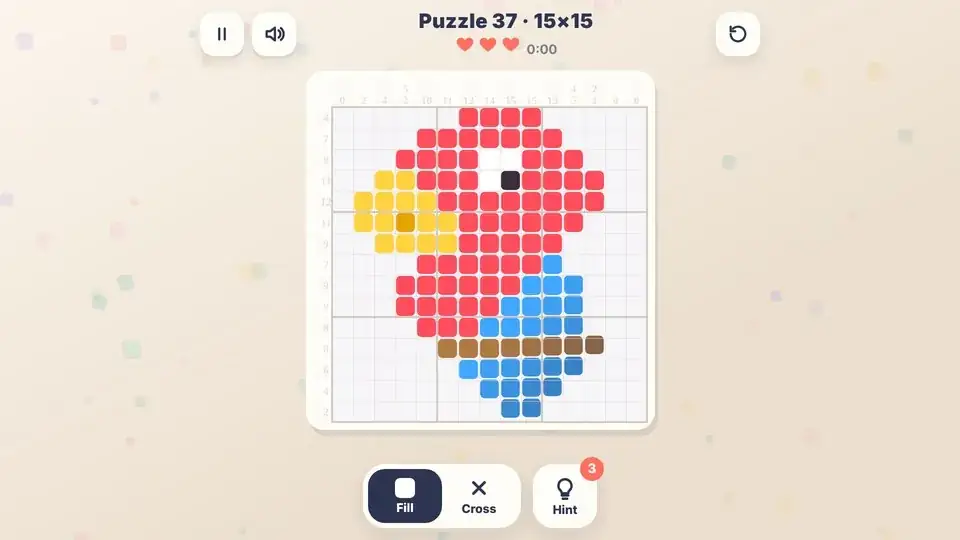
Nonograms, also called picture logic or paint by numbers grids, look like a wall of numbers until you've solved one. So let's solve one together, square by square, then look at the ideas that get you through big 15 by 15 pictures without a single guess.
The rule in one line
Each row and column has a clue. The numbers are the lengths of the runs of filled squares in that line, in order, with at least one empty square between runs. A clue of 1 1 means one filled square, a gap of at least one, then one more. That's all. In Mosaic Logic you fill squares you're sure of and cross squares you know are empty, and the crosses matter as much as the fills.
A worked 5x5, step by step
Here are the clues for a small picture. Rows run top to bottom, columns left to right.
| Line | Clue |
|---|---|
| Row 1 | 1 1 |
| Row 2 | 5 |
| Row 3 | 5 |
| Row 4 | 3 |
| Row 5 | 1 |
| Column 1 | 2 |
| Column 2 | 4 |
| Column 3 | 4 |
| Column 4 | 4 |
| Column 5 | 2 |
- Rows 2 and 3 are full. A clue of 5 in a line of 5 leaves no choice. Fill both rows.
- The big columns overlap. Columns 2, 3 and 4 each have a 4 in a line of 5. Pushed to the top, a 4 covers rows 1 to 4. Pushed to the bottom it covers rows 2 to 5. Rows 2, 3 and 4 are filled either way, so fill row 4 in columns 2, 3 and 4.
- Row 4 is finished. Its clue is 3 and it now has three filled squares in a row. Cross columns 1 and 5 in row 4.
- Columns 1 and 5 are finished. Each has a clue of 2, and rows 2 and 3 already gave it two filled squares in a row. Cross rows 1, 4 and 5 in both columns.
- Row 1 has no slack. Its clue is 1 1, and only columns 2, 3 and 4 are still open. One, gap, one in exactly three squares: fill columns 2 and 4, cross column 3.
- Column 2 is done. It now has filled squares in rows 1 to 4, a run of 4. Cross row 5.
- Column 3 needs one more. It has rows 2, 3 and 4 filled and row 1 crossed, so its run of 4 must reach row 5. Fill it. Row 5's clue of 1 is now complete, and column 4 matches its own 4 with rows 1 to 4.
| Solved | c1 | c2 | c3 | c4 | c5 |
|---|---|---|---|---|---|
| r1 | · | ■ | · | ■ | · |
| r2 | ■ | ■ | ■ | ■ | ■ |
| r3 | ■ | ■ | ■ | ■ | ■ |
| r4 | · | ■ | ■ | ■ | · |
| r5 | · | · | ■ | · | · |
A little heart. Notice the rhythm: fill something, then immediately look at the crossing lines to see what changed. That back and forth is the whole method.
Overlap, exact lines and reach
Three ideas did all the work above, and they'll carry you through most of the gallery.
- Overlap. Slide a run to its leftmost and rightmost spots. Squares covered both times are filled. With several clues, add them up plus one gap between each, and every run longer than the leftover slack has some sure squares.
- Exact lines. When clues plus gaps equal the line length, there's only one way to place them.
- Reach. Once you know roughly where a run sits, any square it can't possibly stretch to is empty. Cross it.
Joining marks that must be one run
Say a row of 10 has the clue 4, and you've found filled squares at positions 3 and 5. There's only one run in the line, so both squares belong to it, and so does square 4 between them. Fill it. Now the run of 4 must include squares 3, 4 and 5, so it starts at 2 or 3. That means it covers 2 to 5 or 3 to 6. Cross square 1 and squares 7 to 10.
The same idea works with more clues whenever two filled squares are too close together to belong to different runs. If they're closer than a gap allows, they're one run.
Which run owns this square?
Harder puzzles hinge on matching filled squares to the right clue. Take a row of 10 with the clue 1 3, and a filled square at position 2. Could it be the 1? Yes. Could it be part of the 3? The 3 has to come after the 1 plus a gap, so it starts at position 3 or later. Position 2 can't be in it. So the filled square is the 1, which means squares 1 and 3 are empty, and the 3 lives somewhere in positions 4 to 10.
When a square could belong to two different runs, don't force it. Look at the crossing column instead. Often one answer breaks the column's clue, and that settles it.
Gaps too small to use
Crosses split a line into pockets. If the smallest run left in a line is 3, any pocket of one or two squares can't hold anything. Cross it. This is where a well placed cross pays off, because it can wipe out a whole stretch of a column at once.
Mosaic Logic helps here: a clue number turns grey once its run is certainly in place, and a whole line greys out when it's done. When the first clue of a line goes grey, the next run starts after it, which shows you where the real open space is.
Color puzzles change one rule
Once you've solved 3 pictures, Mosaic Logic opens 22 color puzzles. In color, two runs of different colors can sit right next to each other with no gap, while runs of the same color still need one. So a red 2 followed by a blue 3 in a line of 5 fills the line exactly. Slack is smaller, which makes overlaps bigger, and many color lines solve faster than black and white ones. The catch is that you have to track color as well as position.
Habits that keep you mistake-free
- Cross freely. A correct cross is free, and it creates the edge the next deduction needs.
- Never fill a square you only think is right. Stars in Mosaic Logic are about accuracy, not speed: three for no mistakes.
- After every fill or cross, look at the crossing line.
- Start each puzzle with the biggest clues, then the exact lines.
- Practice the overlap trick on the 5 by 5 Little ones until you see it without counting.
For controls, stars and the Daily Mosaic, read our Mosaic Logic guide. If this kind of deduction is your thing, our sudoku techniques article and our mines puzzle patterns scratch the same itch.
Questions
How do you start a nonogram?
Look for lines with big clues and fill the squares where every possible placement overlaps. Lines whose clues plus gaps fill the whole line can be filled completely.
Do nonograms ever need guessing?
A well made one doesn't. Every puzzle in Mosaic Logic has one answer that line by line logic can reach, with starter tiles added where needed.
What is the difference in color nonograms?
Runs of different colors can touch with no gap. Runs of the same color still need at least one empty square between them.
Why should I mark empty squares?
Crosses create edges and pockets, and most of the deductions in a hard puzzle start from a crossed square.
Game guides


More strategy articles



You might also like
 10 minSaves
Ninebark Sudoku
SudokuClassic sudoku from Easy to Master, rated by the techniques each puzzle needs. Hints that explain the next step, notes, unlimited undo and a daily sudoku with streaks.