
Games / Guides / Strategy articles / Liar's dice odds and strategy
Liar's dice odds and strategy: when to bid and when to call
Liar's dice feels like a game of nerve, but most good decisions come from one simple sum. Once you know how many of a face to expect under the other cups, every bid becomes a question you can answer: is this likely true, or is somebody stretching?
The one sum that matters
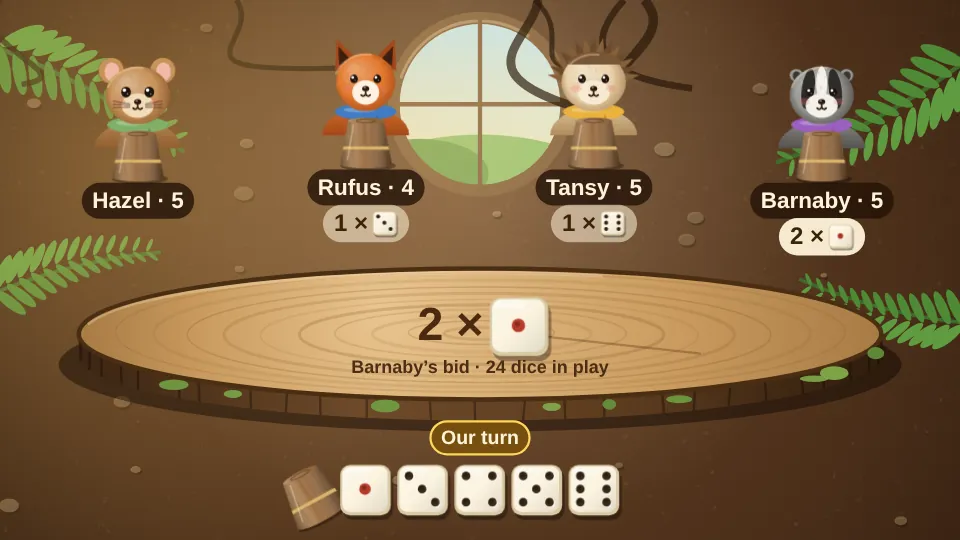
Every die you can't see shows any one face one time in six. So the number of a face you should expect under the other cups is the count of hidden dice divided by six. With fifteen hidden dice, expect about two and a half of any face. Add the dice of that face in your own hand, and you have a good guess at the true total.
In Fibberfern Liar's Dice every die counts only for its own face, so the sum above is all you need. A bid of four 5s when you hold two 5s and fifteen dice are hidden is asking for two more 5s from fifteen dice, which happens about three times in four.
How likely is a bid?
Here is the chance that fifteen hidden dice show at least a given number of one face. Add your own matching dice to the number of the bid, then read the row for what you still need.
| Still needed from 15 hidden dice | Chance it's there |
|---|---|
| 1 | 94% |
| 2 | 74% |
| 3 | 47% |
| 4 | 23% |
| 5 | 9% |
| 6 | 3% |
A good rule: a bid that needs more than one above the expected number from the hidden dice is more likely false than true. With ten hidden dice, needing two is about even and needing three is only about one in four.
When to call
- Call when the bid needs clearly more than the expected count from the hidden dice and you hold none of that face yourself.
- Don't call a bid that needs only the expected count or less. The odds are on the bidder's side.
- Late in a round, with few dice left on the table, bids get risky fast. Small numbers move a lot when only six or eight dice remain.
- If raising would force you into a bid you don't believe either, calling is usually the better of two risks.
Bidding well
The safest raise is a higher face at the same count, if you hold that face. It keeps the bid believable and passes the pressure on. Raising the count is stronger but riskier, so save it for faces you hold two or three of.
Listen to the table too. A player who keeps bidding the same face probably holds it. A sudden jump to a face nobody has mentioned is often a bluff, or a player trying to steer the table away from their weak dice.
Bluffing without getting caught
- Bluff small. Bid one above the expected count, not three.
- Bluff on a face that has not been bid yet, so nobody has information against you.
- Mix it up. If you only ever bid faces you hold, a careful player will learn to read you.
- The best bluff is a bid that is probably true anyway. Let the odds do the lying.
Questions
What are the odds in liar's dice?
Each hidden die shows a given face one time in six, so expect the number of hidden dice divided by six of any face, plus whatever you hold yourself.
When should you call in liar's dice?
Call when a bid needs clearly more than the expected count from the hidden dice, especially when you hold none of that face.
Is there a good opening bid?
Open with the face you hold most of, at a count close to what the whole table probably has. It is hard to call and gives little away.
Game guides
More strategy articles

You might also like
 10 minSaves
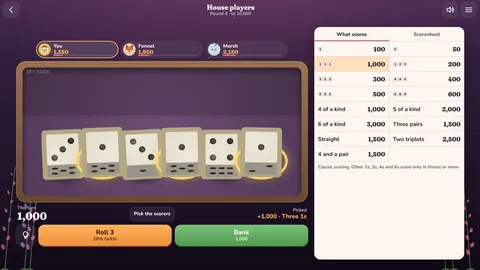
Foxglove Farkle
FarkleRoll six dice, set aside the scorers and push your luck or bank. Real odds on every roll, Classic or Old style rules, five house players, pass and play, online with a friend and a Daily Posy.
 10 minSaves
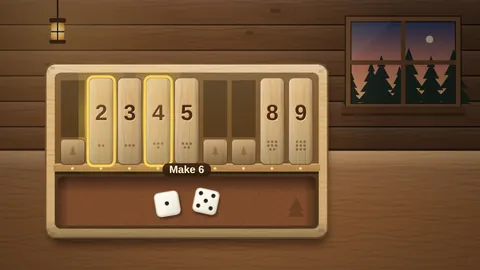
Pinewood Shut the Box
DiceThe classic wooden dice box game. Roll two dice, flip down tiles that add up to the roll, and try to shut all nine. Play solo for a best score, against three house players or pass and play, with a Daily Box and a helpful best flip hint.
 10 minSaves
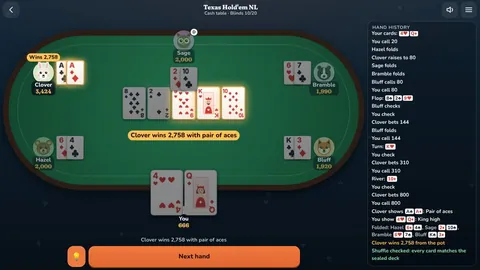
Airscape Poker
PokerA friendly poker room with play chips only: Texas Hold'em, Omaha, Omaha Hi-Lo, Pineapple, Crazy Pineapple, Short Deck, Seven Card Stud, Stud Hi-Lo, Razz, Five Card Draw and 2-7 Triple Draw, with no limit, pot limit and fixed limit tables, sit and go tournaments, seven house players from gentle to sharp, pass and play, friends online with one room code and a Daily Ten.