
Games / Strategy Games / Fibberfern Liar's Dice / Guide
How to play Fibberfern Liar's Dice
Our liar's dice online game, set in a cozy fern burrow: everyone hides five dice under a wooden cup, the bids climb, and somebody has to say the bid is too high.
This is our guide to playing Fibberfern Liar's Dice. Want to jump straight in? Play Fibberfern Liar's Dice right here in your browser.
Missing something you need? Tell us.
Quick answers
Does Fibberfern Liar's Dice work on my phone?
Yes. Fibberfern Liar's Dice works with touch on phones and tablets, and with a mouse or keyboard on a computer. It runs in the browser you already have, so there is no app to download.
Do I need an account to play Fibberfern Liar's Dice?
No. Just open it and play, with no sign-up. If you like, a free account (username only, no email, for players 13 and older) puts your scores on the leaderboards and backs up your progress so it follows you to any device.
Does Fibberfern Liar's Dice save my progress?
Yes. It saves on this device on its own, so you can close the page and pick up where you left off. Sign in with a free account to keep the same progress on your phone and your computer.
Is Fibberfern Liar's Dice OK for kids?
Yes, players of any age can enjoy it. There is no chat and no way to message other players, and nobody needs an account to play. Accounts are for players 13 and older, so younger players just play and their progress stays on their device. For ages 4 to 11 we also have learning games in their own kids area, with no ads, no accounts and no tracking.
Liar's dice online, in a burrow full of friends
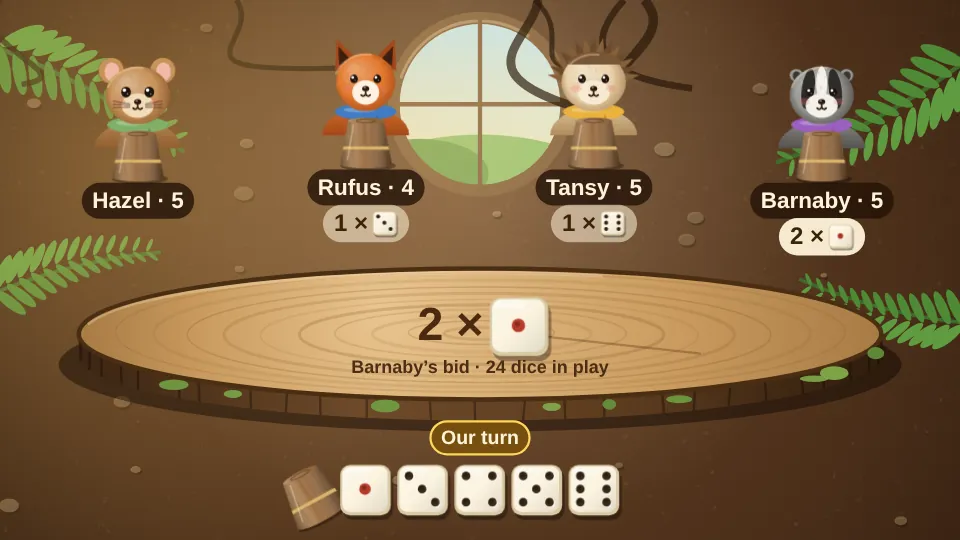
Fibberfern is our take on liar's dice online, free in your browser on a phone, tablet or computer. You sit at a tree stump table in a burrow under the ferns with three, four or five animal friends. Everyone shakes their dice under a cup and peeks only at their own. Then the bidding goes around the table, each guess a little bolder than the last, until somebody calls it and every cup lifts.
It's a game of guessing and gentle bluffing. You never know what's under the other cups, but you know your own dice and how dice tend to fall, and you can listen to what the others bid. There's no money and nothing to win but the burrow's bragging rights. Losing a challenge costs one die, and the last player with dice left wins.
How to play liar's dice
At the start of each round everyone has fresh dice under their cup. The player who starts makes a bid: a number and a face, like three 4s. That bid means "under all the cups together, ours included, there are at least three dice showing 4".
Then it's the next player's turn, going around the table. On your turn you do one of two things:
- Raise the bid. Say more dice of any face (after three 4s, four 2s is fine), or the same number of a higher face (three 5s or three 6s).
- Call it. If you think the last bid is too high, tap Call it! and every cup lifts.
When a bid is called we count the dice. If there are fewer than the bid said, the player who made the bid loses a die. If there are at least that many, the caller was wrong and loses a die instead. Exactly that many is enough: a bid of three 4s holds when there are three 4s.
The player who lost a die starts the next round. Run out of dice and you're out of the game. The last player with any dice left under their cup wins.
House rules you can turn on
The classic rules above are the default, and the Daily Burrow always uses them. On the Choose the table screen you can add two common house rules and pick a shorter game:
- Ones are wild. A 1 counts as whatever face is being bid, so a bid of five 3s counts every 3 and every 1. Bids run higher, and in this version nobody bids ones themselves.
- Spot on call. Instead of calling a bid too high, you can say it's exactly right. If the count matches the bid exactly, you win back a die you lost earlier. If it doesn't, you lose a die.
- Three dice each instead of five, for a quick game of a few minutes.
Controls on a phone and on a computer
On your turn the bid picker sits under the table. Tap a die face to choose it, and use minus and plus to choose how many. The picker only offers bids that are allowed, so if you tap a face that needs a bigger number, it moves up for you. The big button says your bid in words, like Bid four 5s. The red Call it! button lifts the cups.
While a friend is thinking you can tap the table or Go on to hurry them along. Turn on Fast friends in Settings if you'd like quicker turns all the time. The cups lift in about half a second, a tap skips that, and reduced motion settings make it instant.
On a computer, keys 1 to 6 pick a face, the plus and minus keys or the up and down arrows change how many, Enter bids, C calls, S makes a spot on call when that rule is on, O switches the odds helper and P pauses.
The odds helper
The percent button in the corner turns on the odds helper. Next to the number you're about to bid it shows how likely that bid is, and on the Call it! button it shows how likely the bid on the table is. It works from what you can actually see: your own dice, with every other die treated as unknown. It never peeks under anyone else's cup.
With the helper on, a sensible bid is already picked for you each turn, one that also weighs what the others have bid, so tapping Bid is never a wild guess. In the first game for new players a coach also says when a bid looks worth calling. The numbers shown always come from your own dice alone. The Daily Burrow has no odds helper at all and only picks the smallest bid for you, so every score on that board comes from your own judgment.
Meet the house players
Five animal friends can join you, from gentlest to strongest. Each has a habit you can learn to read, and each says a short line when they bid or call. Their lines are about their mood, never about their dice.
| Friend | Style | What to expect |
|---|---|---|
| Hazel the dormouse | Cautious | Bids what she can see and calls early when she gets nervous |
| Clover the rabbit | Bluffer | Loves a cheeky bid on a face she doesn't have, and calls late |
| Rufus the fox | Bold | Jumps the bid up by more than he needs to and rarely calls |
| Tansy the hedgehog | Steady | Counts carefully and keeps calm |
| Barnaby the badger | Wise | The strongest of the five: patient, and he listens to every bid |
None of them sees your dice, and none of them is as sharp as a careful human player. We test them against a sensible robot player many thousands of times: at a table with three copies of the same friend, the robot wins about 85 percent of games against Hazel and still about 36 percent against Barnaby, where a fair share would be 25.
The Daily Burrow
The Daily Burrow is the same for everyone on the same day, and it changes at your own local midnight. The three friends at the table and every cup in every round come from the day's seed, so if two players bid and call the same way, they see exactly the same dice. Classic rules, five dice each, no odds helper.
Your score is 30 points for each friend you outlast, 10 for each die still under your cup at the end, and 10 for every challenge you win (a call you got right, or a bid of yours that held when someone called it). Scores go on the daily leaderboard. You can replay the day afterwards as practice, with the helper back on.
Badges, unlocks and daily goals
Twelve badges cover things like your first win, ten good calls, a bid that held when called, and a win without losing a single die. Winning games unlocks new dice colors (Honey after one win, then Moss, Berry and Sky), and challenges won unlock new cup woods (Walnut at 15, Cherry at 40, Birch at 80). Three small goals each day, such as winning three challenges or making twelve bids, count from your first game of the day.
Liar's dice tips and odds
Know the average
Each die you can't see shows a given face about one time in six. With 20 hidden dice, you'd expect about three of any face, plus whatever you hold yourself. With ones wild, any face other than 1 turns up one time in three, so the same 20 dice hold about six or seven. Bids near that number are safe. Bids well above it are bluffs or hopes.
Bid what you hold, then raise the face
If you have three 5s, a bid on 5s is cheap insurance: the count already starts at three. Raising the face at the same number (three 5s to three 6s) keeps the bid low, while adding one more die pushes everyone closer to a call.
Listen to the table
When a careful friend bids 4s, they probably have a 4 or two. Two players bidding the same face is a good sign that face is plentiful. Clover breaks this rule on purpose, which is exactly why she's fun to catch.
Call before it reaches you
A bid that is a little too high is often better to raise past than to call, but a bid you'd struggle to beat honestly is one to call. If the helper says the bid on the table is under about 40 percent and your best raise isn't much better, lift the cups.
Fewer dice, smaller bids
As players lose dice the totals shrink, and bids that were safe in round one become wild. Recount the dice in play (the corner of the screen shows it) at the start of every round.
Questions
Can I play liar's dice online for free?
Yes. Fibberfern Liar's Dice is free in your browser on a phone, tablet or computer, with no download and no account.
What are the rules of liar's dice?
Everyone hides dice under a cup. Players take turns raising a bid about how many dice of one face are under all the cups, or calling the last bid. If the bid was too high the bidder loses a die, otherwise the caller does. The last player with dice wins.
Are ones wild in liar's dice?
In many family versions they are. Our classic rules count ones as plain ones, and you can turn on Ones are wild on the Choose the table screen.
What happens if the count is exactly the bid?
The bid holds, so the caller loses a die. With the Spot on rule turned on, you can instead claim a bid is exactly right and win back a die if you're correct.
Can I play liar's dice against the computer?
Yes. You play against three to five animal house players, each with their own style, from cautious Hazel to wise Barnaby.
Is there a daily liar's dice challenge?
Yes. The Daily Burrow gives everyone the same friends and the same cups each day, with points and a leaderboard.
Related guides
 How to play Foxglove FarkleFarkle
 How to play Bracken BackgammonBackgammon
 How to play PipfoldFive dice game
 How to play Pinewood Shut the BoxDice
 How to play Grant Central StationTrain tycoon
More to read
You might also like
10 minSavesFoxglove Farkle
FarkleRoll six dice, set aside the scorers and push your luck or bank. Real odds on every roll, Classic or Old style rules, five house players, pass and play, online with a friend and a Daily Posy.