Games / Strategy Games / Steel Frontier / Guide
Steel Frontier
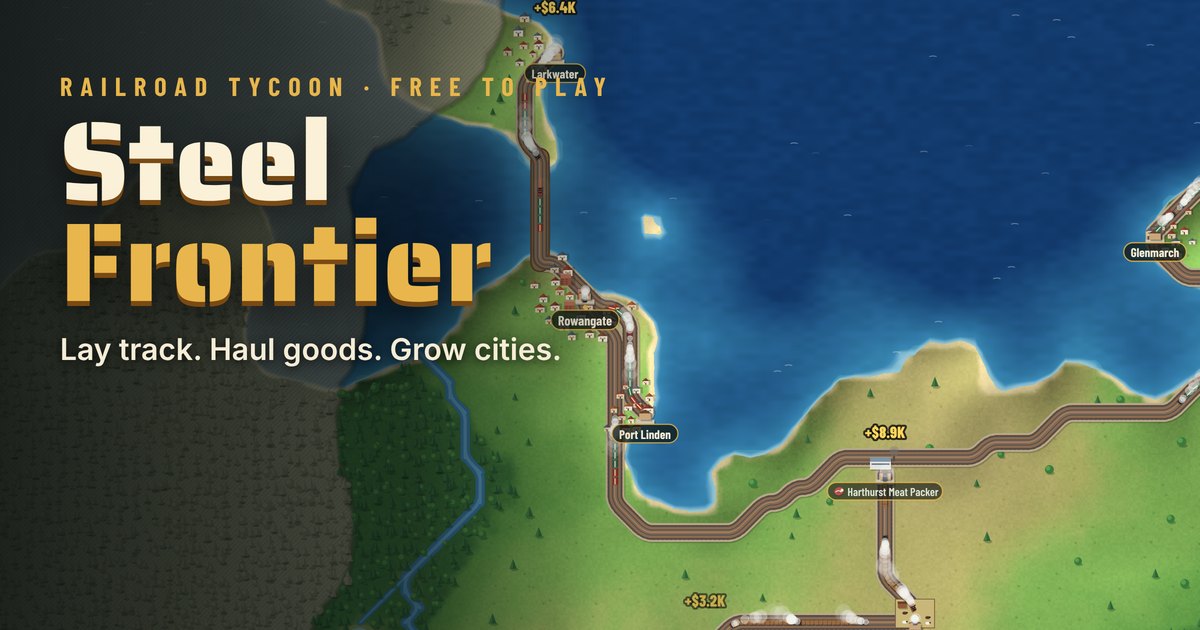
A whole continent of villages, farms, mines and ports, and not a single rail on it yet. Link them up, haul what each place needs, and watch your first little village grow into a city over weeks of play.
What is Steel Frontier?
Steel Frontier is a railroad tycoon game. You start in 1852 with $520K, one surveyed region and a big map of places that need things moved. Farms grow grain, mills turn it into food, towns eat the food and grow. Your job is to build the railroad that connects all of it, then keep it making money as the trains get faster and the towns get hungrier.
It's free and runs in the browser on a phone, tablet or computer. Your railroad saves on your device every few seconds, and if you sign in on the site it follows you to your other devices too.
The main map, called The Frontier, is the same continent for every player, with about 90 places spread over 16 regions. If you want something fresh you can also start on a brand new random map.
How to play
The first few minutes walk you through it with short tips at the top of the screen. You can skip them at any time.
- Lay track. Tap a place, tap Build track, then tap a second place. The game finds a route for you and shows the cost: hills and rivers make it pricier, mountains and water crossings much more. Tap Build to lay it. Both ends get a station.
- Add a train. Right after building, tap Add a train and Buy. The game picks sensible cars for the cargo on that route, and you can change them.
- Watch it work. The train loads, rolls to the other end and gets paid on delivery. Every delivery shows the money it made right over the station.
- Keep going. Tap any place to see what it makes and what it wants, then link the next one.
Track always runs from one place to another, never to a spot in the middle of nowhere. Long lines get passing loops on their own, so trains going opposite ways on a single track wait their turn and pass each other. There are no signals to set.
Controls
Phone and tablet
Drag to pan, pinch to zoom, tap a place, train or piece of track to open its card. To sketch your own route, drag from a station across the map and the track follows your line.
Computer
Drag with the mouse and use the wheel to zoom. Keys: Space pauses, 1 2 3 set the speed to 1x, 2x or 4x, B builds, T opens your trains, G opens goals, C opens the company, the arrow keys pan and Esc closes things. On a wide screen a side panel and a minimap use the extra space.
Cargo, industries and towns
Raw producers make goods on their own once they have a station: farms (grain), ranches (cattle), timber camps (logs), coal and iron mines, oil fields, quarries (stone) and fishing ports. Processors only make something when you bring them the input.
| Processor | Takes | Makes |
|---|---|---|
| Flour Mill | Grain | Food |
| Sawmill | Logs | Lumber |
| Steel Works | Iron ore and coal | Steel |
| Refinery | Oil | Fuel |
| Meat Packer | Cattle | Meat |
| Factory | Steel and lumber | Goods |
Towns make passengers and mail and want different things as they grow. A village wants food and lumber. A town (1,200 people) adds coal, goods and stone. A city (6,000) wants food, goods, lumber, steel, fuel, meat and passengers. A metropolis starts at 30,000 people and adds mail. Where a town sits changes the list too: coastal towns trade some needs for fish, and mountain and desert towns have their own twists.
Each need has a happiness bar on the town card. Keep the bars up and the town grows, its buildings get bigger, and a new tier brings new needs. A town you stop supplying stalls and can shrink slowly, but never below the size it started at.
How deliveries are paid
- Distance: pay rises with the distance between where the cargo was loaded and where it's delivered.
- Speed: a delivery that arrives faster than expected earns up to 25% more. A slow one earns less, and passengers, mail, cattle, meat and fish lose value fastest.
- Demand: a town that's running low on something pays 15% extra for it. Flood a town with one cargo and the price drops, down to 40% of normal.
- Cargo type: goods, meat and steel pay the most per unit, passengers, stone and logs the least.
Train eras
New engines unlock as your total earnings grow. Each one costs money every day it runs, plus a little for every bit of track it covers, so an empty train on a bad route loses money. Trains standing at a station or waiting for the line cost less, but still cost something.
| Engine | Era | Speed | Cars | Unlocks at earnings of |
|---|---|---|---|---|
| Pioneer | Early steam | 50 km/h | 3 | Start |
| Prairie | Improved steam | 70 km/h | 4 | $1.2M |
| Mountaineer | Heavy freight steam | 65 km/h | 7 | $6M |
| Comet | Early diesel | 100 km/h | 7 | $30M |
| Streak | High-speed diesel | 150 km/h | 8 | $120M |
| Volt | Electric | 200 km/h | 10 | $400M |
| Aurora | Maglev | 450 km/h | 8 | $1.2B |
Volt and Aurora only run on electrified track, which you can add to any line once the electric era arrives. You can run up to 160 trains, and the Upgrade button on a train swaps its engine for the newest one while keeping its stops.
Routes and stop modes
A route is a list of up to 8 stops on the same network. Each stop has a mode you can tap to change:
- Auto: drop off whatever this stop wants and pick up whatever a later stop wants.
- Full load: wait until the cars are full before leaving (it gives up after a while if nothing comes).
- Drop off: leave the cargo here so another train can carry it on. This is how you build long relay chains.
Growing the business
- Survey a neighboring region to open it for building. Each survey costs more than the last, so pick the ones with the industries you need.
- Stations start as a Halt. Upgrade to a Station and later a Grand Station (from the Mountaineer era) to store more and load faster. A Warehouse lets a station hold much more cargo.
- Workshops service any train that stops there. Trains wear out over time and break down more often when their reliability drops.
- Double track lets trains pass anywhere on a busy line instead of waiting at loops.
- Loans: the bank lends up to about 45% of your company value at 6% a year.
- Contracts offer a bonus for delivering a set amount of one cargo to one place in time. Missing one has no penalty.
Every 90 days you get a quarterly report card with revenue, running costs, upkeep and your best and weakest trains. Random events keep things lively: harvest booms double a region's output, storms slow trains for a few days, festivals bring extra passengers, and now and then a new mine or oil field is discovered. Close the game and your trains keep earning a share of their usual profit for up to 2 hours.
Goals, the Golden Spike and leaderboards
There are 44 goals, from laying your first track to growing three metropolises and delivering 2,000,000 loads. Every goal pays a cash bonus. The big one is The Golden Spike: link a station on the west coast to one on the east coast with a single connected network.
The Daily Contract drops you into a small valley that's the same for every player that day. You get $420K and 150 game days. Your score is your trains' profit in thousands (what they earned minus what they cost to run), and it goes on the daily leaderboard and keeps your day streak going. The Company value board posts your value automatically as you pass milestones, or any time you tap Post my company.
Tips and strategy
Finish the first chain before branching out
The starting farm, mill and village are placed close together for a reason. Grain to the mill, then food to the village, gives you two paying trains and a growing town within a couple of minutes. Get both running before you spend on anything else.
Use the town card as your to-do list
Every need on a town card shows its nearest suppliers and whether they're linked. A red bar marked Needed is the cheapest growth you can buy: link that supplier and the town starts climbing.
Medium distances pay best early
Pay grows with distance, but so does the price of the track, and a long line through hills or over rivers can take years to pay back with one small steam train. Early on, aim for routes of roughly 50 to 150 kilometers across flat land. Save the cross-country lines for when you can afford diesel and several trains to share the track.
Don't flood a single town
Three trains dumping food into one village will crash its food price. Spread a cargo across two or three towns, or bring a mix of needs to one town so every bar stays up.
Feed the processors
Steel and goods pay well, but a Steel Works needs both iron ore and coal, and a Factory needs both steel and lumber. Industries that ship most of their output also level up each quarter and produce more, so a well served chain keeps getting richer.
Watch for the red numbers
The train list is sorted best first, and the quarterly report names your weakest train. If a train has been losing money for a year, change its stops, trim empty cars, or sell it.
Double the busy lines
If a train card keeps saying it's waiting for the line to clear, that stretch is full. Double track costs about half of what the line cost and lets traffic flow both ways at once.
Put workshops where trains already stop
A workshop at your busiest hub services every train on the routes through it, with no detours. Old trains with low reliability break down more, which hurts the speed bonus on every load.
Questions
Is Steel Frontier free?
Yes. It's a free railroad tycoon game that plays in your browser on phone, tablet or computer, with no download and no purchases.
Does Steel Frontier save my progress?
Yes. It saves on your device every few seconds and when you leave. Sign in on the site and your railroad is kept on your account so you can continue on another device.
How do I unlock new trains?
New engines unlock from your total earnings: the Prairie at $1.2M, then $6M, $30M, $120M, $400M for the electric Volt, and $1.2B for the Aurora maglev.
Why are my trains waiting for the line to clear?
Another train is using that single track. Trains wait at stations and passing loops and then continue on their own. On busy lines, upgrade to double track.
How do towns grow into cities?
Keep their needs supplied. A village becomes a town at 1,200 people, a city at 6,000 and a metropolis at 30,000, and each step brings new needs.
What is the Golden Spike?
It's the big goal of the main game: connect a station on the west coast to one on the east coast with one network of track.