Games / Strategy Games / Mulberry Mancala / Guide
Mulberry Mancala
Mulberry Mancala is the classic seed sowing game on a carved wooden board. Lift the seeds from one of your houses, drop them one by one round the board, and gather more into your store than your opponent. Play Kalah, the rules most people learn first, or Oware, the great game from Ghana.
Quick answers
Does Mulberry Mancala work on my phone?
Yes. Mulberry Mancala works with touch on phones and tablets, and with a mouse or keyboard on a computer. It runs in the browser you already have, so there is no app to download.
Do I need an account to play Mulberry Mancala?
No. Just open it and play, with no sign-up. If you like, a free account (username only, no email, for players 13 and older) puts your scores on the leaderboards and backs up your progress so it follows you to any device.
Is there a daily challenge in Mulberry Mancala?
Yes. Mulberry Mancala has a new daily challenge every day, the same one for every player, with its own daily leaderboard. Find it alongside the others on our daily challenges page.
Does Mulberry Mancala save my progress?
Yes. It saves on this device on its own, so you can close the page and pick up where you left off. Sign in with a free account to keep the same progress on your phone and your computer.
Is Mulberry Mancala OK for kids?
Yes, players of any age can enjoy it. There is no chat and no way to message other players, and nobody needs an account to play. Accounts are for players 13 and older, so younger players just play and their progress stays on their device. For ages 4 to 11 we also have learning games in their own kids area, with no ads, no accounts and no tracking.
What is mancala?
Mancala is not one game but a whole family of them, played across Africa, the Middle East, South and Southeast Asia, Central Asia and the Caribbean. The name comes from an Arabic word for moving things. Boards cut into stone and floors date back at least 1,500 years, and there are hundreds of named games, from Oware in Ghana and Bao in East Africa to Congkak in Malaysia and Toguz korgool in Kyrgyzstan.
They all share one idea: sowing. You lift every seed from one pit and drop them one at a time into the pits that follow. Where your last seed lands decides what happens next. We built Mulberry Mancala with two of the best known rule sets, Kalah and Oware, and we made the sowing feel like the real thing: every seed flies, lands with a click, and the count beside each pit ticks up as it does. It's free, it runs in your browser and there's nothing to download.
How to play Kalah
Kalah is the version most people in North America and Europe learn first, often just called mancala. It was published in the United States in the 1950s, drawing on the African games.
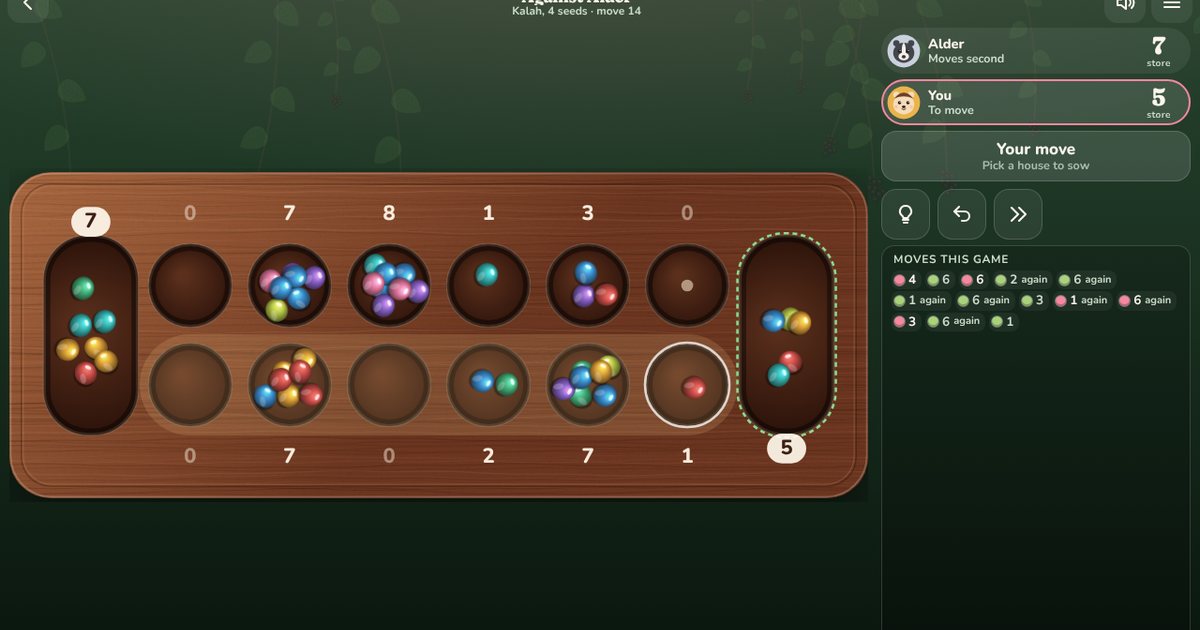
- The board. Each player has a row of six houses and a store at their right end. We start with 4 seeds in every house, 48 in all (you can pick 3, 5 or 6).
- Sowing. On your turn, pick one of your houses that has seeds. Lift them all and drop one into each pit counterclockwise: along your row, into your own store, then along your opponent's row. You skip your opponent's store.
- Extra turns. If your last seed lands in your own store, you go again. There is no limit, so a good turn can chain three or four sows together.
- Captures. If your last seed lands in an empty house on your side, you capture it plus every seed in the house directly opposite, and they all go into your store.
- The end. When one player's six houses are all empty, the game ends. The other player moves the seeds left on their side into their own store. Whoever has more seeds in their store wins.
There is one rule that varies from set to set. With the standard capture, nothing happens when the house opposite is empty. With the empty capture rule, used in most computer research, you still capture your lone last seed. Mulberry Mancala has both.
How to play Oware
Oware (also called awale, awari or warri) comes from the Akan people of Ghana and is played across West Africa and the Caribbean. It is the national game of Antigua and Barbuda. It feels quite different from Kalah: there are no extra turns and the stores only hold what you capture.
- Six houses each, 4 seeds in every house. Seeds are never sown into a store.
- A house with 12 or more seeds goes all the way round the board and skips the house it came from.
- Capturing: if your last seed lands on your opponent's side and makes that house hold exactly 2 or 3 seeds, you take them. Then look at the house before it: if it also holds 2 or 3, take that too, and so on back along their row.
- Grand slam: a sow that would capture every seed on your opponent's side is allowed, but it captures nothing. This is the abapa rule, the most common one in tournaments.
- Feeding: if your opponent's side is empty, you must make a move that gives them seeds. If you can't, you take the seeds on your own side and the game ends.
- The first player to capture 25 seeds wins. If both reach 24, it is a draw. In our game, if 100 turns go by with no capture, each player takes the seeds on their own side.
Playing Mulberry Mancala
Tap or click one of your houses to sow it. With a mouse, point at a house first and a ring shows where the last seed will land: green when it earns another turn, gold when it captures. On a keyboard, the keys 1 to 6 sow your houses counted from your left, or Tab to the board and use the arrow keys and Enter. A tap on the board or Space finishes a sow at once.
On a tall phone screen the board stands up: your houses run down the left side and your store sits at the bottom, so the pits stay big enough to tap. On a wider screen it lies flat, with your row along the bottom.
- Counts sit next to every pit and store, and screen readers hear each sow and both stores.
- Undo takes back your sow and the house player's replies.
- The light bulb gives our pick and says what it does. In Kalah, once about 20 seeds are left in the houses, it tells you the exact result with perfect play.
- The review after a game marks the sows that cost you the most, such as one that turned a win by 4 into a loss.
- Settings include sowing speed (Normal, Quick or Instant), the landing preview, seed counts, high contrast and less motion.
The house players
Five animals from the mulberry grove, each with a different way of going wrong. They see only the board you see.
| Player | Level | How they play |
|---|---|---|
| Fennel | Beginner | Loves big piles and landing in her store, often misses captures |
| Mallow | Easy | Never misses a free turn, grabs the biggest capture he sees |
| Tansy | Medium | Looks a few sows ahead and guards her piles |
| Alder | Hard | Reads nine sows ahead and plays endings perfectly |
| Linden | Expert | Deep search, and solves Kalah endings to the last seed |
Kalah with 4 seeds has been solved by computer: the first player wins with perfect play. So when Linden moves first in Kalah, you are up against it, and we would rather say so than pretend otherwise. By default you and the house player take turns moving first. Oware is a draw with perfect play, which makes it the fairest test.
Daily Sowing and the ladder
The Daily Sowing is three rounds, the same for everyone each day. Big harvest: one turn of Kalah, where you gather as many seeds into your store as you can, extra turns included. Oware capture: a single sow, capture as many seeds as you can. Win from here: a Kalah ending you can win by force, played against Linden's perfect defence. The first two score up to 100 by how close you get to the best. The ending scores 100 for winning by the full margin, 60 for any win and 20 for a draw. Your first Daily Sowing of the day goes on the leaderboard, out of 300.
The ladder is a rating that starts at 1200 and moves after every game against a house player. Beating a stronger player moves it more, and the leaderboard keeps your best.
Play with friends
Pass and play puts two people on one phone or tablet, sitting on either side of the board, and the first player swaps every game. To play a friend on another device, one of you hosts and gets a four letter room code, and the other types it in or opens the shared link. The host picks the rules. If the connection drops, we hold the game for two minutes, and a rematch is one tap. Online games use a few friendly reactions instead of chat.
Tips and strategy
Count your free turns
In Kalah, a house with exactly enough seeds to reach your store gives you another turn. House 6 needs 1 seed, house 5 needs 2, and so on up to house 1 with 6. When two houses are ready, sow the one nearest your store first, so the other still lines up.
Watch their empty houses
Before you sow, look at every empty house on your opponent's side and ask whether one of their sows can end there. If it can, the seeds opposite it on your side are at risk. Moving a big pile out of danger is often worth more than a small capture.
Keep seeds on your side late in Kalah
When one side runs out of seeds, the other player keeps everything left on their own side. A big pile in your house next to the store can quietly decide the game, as long as it is not sitting opposite one of their empty houses.
In Oware, think in 1s and 2s
Houses on their side holding 1 or 2 seeds are targets, because your last seed can make them 2 or 3. Your own 1s and 2s are their targets. Keeping several houses with seeds also keeps your options open, and running out of moves is how many Oware games are lost.
Build a big house in Oware
A house with 12 or more seeds sows all the way round and can end with a run of captures on the far side. Strong players save one up and release it when the other side is full of 1s and 2s.
Questions
Is Mulberry Mancala free?
Yes. It's free to play in your browser on a phone, tablet or computer, with no ads and nothing to install.
What is the difference between Kalah and Oware?
In Kalah you sow into your own store, you go again when your last seed lands there, and you capture by landing in an empty house of yours. In Oware the stores only hold captures, there are no extra turns, and you capture houses on the other side that end up with 2 or 3 seeds.
Does the first player always win at mancala?
In Kalah with 4 seeds a house, yes, with perfect play the first player wins. In Oware perfect play from both sides ends in a draw. Real games are full of mistakes, so either player can win.
How many seeds go in each pit?
Four is the classic start for both Kalah and Oware. In our Kalah you can also pick 3 seeds for a shorter game, or 5 or 6 for a longer one.
What happens to the seeds left at the end?
In Kalah, when one side is empty, the other player puts the seeds left on their side into their own store. In Oware the game usually ends when someone reaches 25, and any seeds still on the board are not counted.
Does it work offline?
Once the page has loaded, the house players and pass and play keep working without a connection. Playing a friend online and posting to the leaderboards need the internet.
You might also like
 Long playSaves
Crown Jump Checkers
CheckersClassic checkers with a world tour of rivals, chain-jump fireworks and a champion who never slips.