
Learning games / Spelling Games for Kids
Spelling games for kids
Spell words with letter cookies, build them from wax blocks that light up a sleepy village, or grow them from roots in a forest. Each game hears the word first, the way a spelling test does, and teaches the pattern behind it.
Spelling games by age
From short words to word roots · 3 games
How kids learn to spell
Spelling grows in layers. Young children spell by sound: they hear /c/ /a/ /t/ and write one letter for each sound. Next comes pattern: the same long a sound can be spelled ai, ay or a_e, and kids learn which one usually goes where. Older kids spell by meaning, noticing that parts like pre-, -ful or the root port keep their spelling across many words.
Memorizing a list for Friday's test helps for a week. Knowing the pattern behind the words helps with every new word that follows it. That's why our spelling games teach the pattern and the rule, not just the word.
Which game practices what
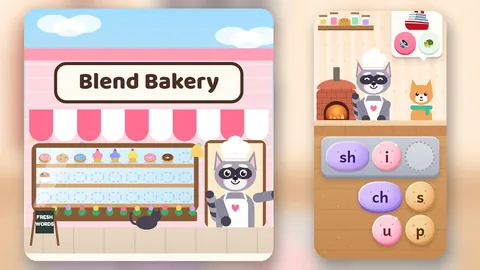
- Blend Bakery (ages 5 to 7): kids hear a word, break it into sounds and spell it with letter cookies. It starts with short vowel words like cat and pig, then sh, ch and th, blends like stop and frog, and magic e words like cake and kite.
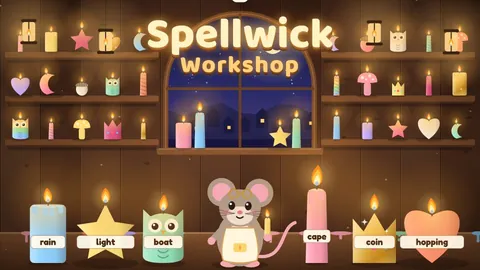
- Spellwick Workshop (ages 7 to 10): the game says a word, then a sentence with it, then the word again. Kids build it from wax blocks that can hold a whole pattern, like igh, tch or a_e. Streets cover silent e, vowel teams, oi and oy, bossy r, tch and dge, adding -ing and -ed, and prefixes and suffixes.
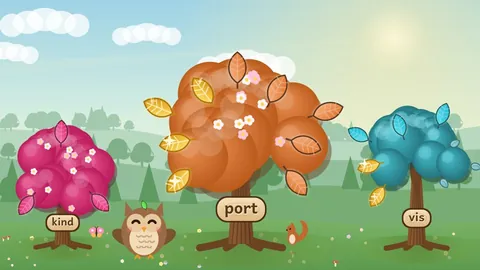
- Root Grove (ages 8 to 12): kids grow real words from prefixes, suffixes and Greek and Latin roots, and learn how the spelling changes when parts join, like use plus able making usable.
Mistakes that teach
When a word comes out wrong, Spellwick Workshop shows what your child made with the wrong part marked, next to the right spelling with the right part glowing, and reads a short rule like "ay usually comes at the end of a word, like in play." Then your child builds the word again, and it comes back later in the round and on later days. Words that sound exactly like another common word, like tail and tale, are left out, so a child is never marked wrong for a spelling that fits the sound.
Every word is read aloud with your device's own voice and can be heard again any time. Nothing is timed, and each game moves up a level when your child is ready and back down without any fuss when they're not.
Tips for grown-ups
- Say it slowly. Stretch a word out together and count the sounds before writing it.
- Sort by pattern. Write rain, play and cake on cards and sort them by how the long a is spelled. Then hunt for more.
- Talk about the rule. Ask why hopping has two p's but hoping has one. Explaining it is how it sticks.
- Break big words apart. Unhelpful is un, help and ful. Each part is easy to spell on its own.
More ways to practice words
Children just starting out can begin with our phonics games, which build the letter sounds that spelling depends on. Kids who are ready for the keyboard can put their spelling to work with our typing games for kids. Our learning games have no ads, no accounts, no chat and no purchases, and they don't use analytics. Progress stays in the browser on your device. Browse all our learning games for more.
Questions
What's the best way for kids to practice spelling?
Hear the word, say its sounds, look for the pattern and write it from memory, then check. Short, regular practice with patterns works better than cramming a list.
Which spelling game is right for my child's age?
Blend Bakery for ages 5 to 7, Spellwick Workshop for ages 7 to 10 and Root Grove for ages 8 to 12.
Does my child need to read to play?
No. Every word is read aloud, and in Spellwick Workshop it comes with a sentence that uses it, just like a spelling test at school.
Are these spelling games free?
Yes. They're free in the browser with no ads, no purchases and nothing to download.
Are they safe for kids?
Yes. No ads, no accounts, no chat and no tracking. Progress is saved only on your device.