
Learning games / 5th Grade Math Games
5th grade math games
Treasure Point has decimals to the thousandths, a coordinate grid to plot and story problems read aloud, and the fraction pizzas get unlike denominators. These games practice fifth grade math with things to build, not just numbers to type.
Math games for 5th grade
Decimals, fractions, big multiplication and volume · 3 games
What kids learn in 5th grade math
Fifth grade is about decimals and fractions working together. Kids read, write, compare and round decimals to the thousandths, then add, subtract, multiply and divide them. With fractions, the big step is adding and subtracting when the denominators are different, which means finding a common size of piece first, and multiplying a fraction by a whole number.
Kids also multiply multi digit numbers, divide with two digit divisors and make sense of remainders, find the volume of a box by counting unit cubes and then with length times width times height, and plot points on a coordinate grid. Longer story problems pull it all together.
Which game practices what
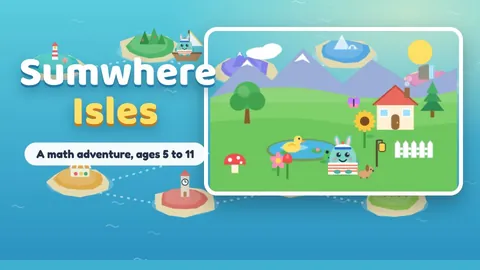
- Sumwhere Isles: Treasure Point, with Skipper the otter, is the fifth grade island. It covers decimal place value with decimal blocks and hundred grids, comparing, rounding, adding and subtracting decimals, the coordinate grid and big story problems read aloud. Fraction Falls adds unlike denominators (cut both fraction bars into matching pieces) and a fraction times a whole number, Times Table Tundra has multi digit multiplication with an area model and division with remainders, and Shape Shore has volume with unit cubes.
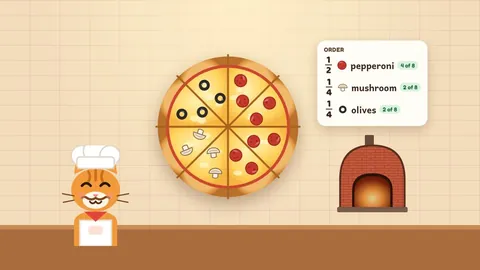
- Fraction Pizzeria: adding fractions with unlike denominators to fill one whole pizza, plus comparing and equal fractions for review.
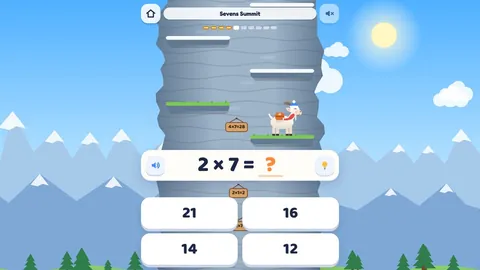
- Multiply Mountain: times facts all the way to 12 x 12, the fast recall that every fifth grade topic depends on.
Why build it instead of just solving it
A lot of fifth grade trouble comes from rules learned without pictures, like lining up decimal points or finding common denominators by rote. Our games ask kids to build the idea first: fill a hundred grid to see that 0.4 and 0.40 are the same, cut two fraction bars into matching pieces before adding them, deal counters into groups to see where a remainder comes from, stack cubes to fill a box. Once the picture makes sense, older kids can switch to typing answers on a number pad.
Questions are still read aloud with a speaker button, which helps with long story problems. A miss brings a hint with a picture and another try, problems that trip your child up come back for review, and nothing is timed.
Tips for grown-ups
- Talk money for decimals. $4.05 versus $4.50 is the clearest way to see why place matters.
- Find the common piece. For 1/3 + 1/4, ask what size piece both thirds and fourths can be cut into. Twelfths.
- Measure a box. A cereal box or a shoebox is a perfect volume problem. Estimate first, then measure.
- Keep times facts sharp. A minute or two a day keeps multiplication and division from slowing everything else down.
No ads, no accounts, no tracking
Our learning games have no ads, no accounts, no chat and no purchases, and they don't use analytics. Progress stays in the browser on your device. For review, see 4th grade math games, or browse all our learning games.
Questions
What math do kids learn in 5th grade?
Decimals to the thousandths and all four operations with them, adding and subtracting fractions with unlike denominators, multiplying fractions, multi digit multiplication and division, volume, and the coordinate grid.
Is there a 5th grade math game for decimals?
Yes. Treasure Point in Sumwhere Isles covers decimal place value, comparing, rounding, adding and subtracting, using decimal blocks and hundred grids.
How do you add fractions with different denominators?
Cut both fractions into pieces of the same size first. For 1/2 + 1/3, both can become sixths: 3/6 + 2/6 = 5/6. Sumwhere Isles shows this with two fraction bars.
Are these 5th grade math games safe?
Yes. No ads, no accounts, no chat, no purchases and no tracking. Progress is saved only on your device.
Will my 10 or 11 year old find these too babyish?
The worlds are friendly, but the math isn't easy. Older kids can type answers on a number pad, and the fifth grade island has longer, harder story problems.