Games / Learning Games / Multiply Mountain / Guide
Multiply Mountain
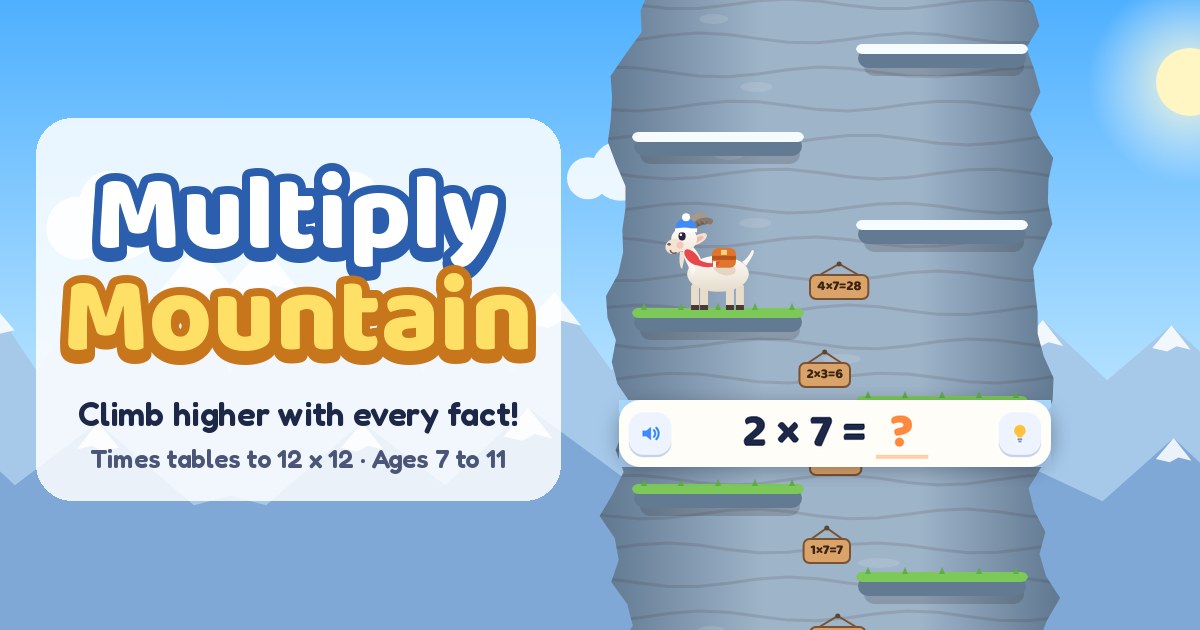
Juniper the goat climbs a mountain one ledge at a time, and every ledge is a multiplication fact. Your child works through the times tables peak by peak, with dot pictures and skip counting there whenever a fact is new or shaky.
What your child learns
- Multiplication facts to 10 x 10, the Grade 3 fluency goal, and on to 12 x 12 for older kids.
- What multiplication means. 4 x 6 is shown as 4 rows of 6 dots, so a fact is something you can see and count, not just a string of numbers.
- Skip counting by the number in each row: 6, 12, 18, 24.
- Division and missing factors (24 ÷ 4 and 4 x ? = 24) once a fact is solid, for kids who type their answers.
- Fact strategies a teacher would use: times 2 is a double, times 9 is times 10 take away one group, times 4 is double and double again, and turn-around facts like 3 x 8 = 8 x 3.
How it works
The mountain has twelve peaks, opened in the order many teachers use: Twos Trail, High Five Hill and Tens Tower first, then Threes Ridge, Fours Falls, Sixes Spire, Sevens Summit, Eights Edge, Nines Needle, Elevens Cliffs and Twelves Crown. The last one, Sky Peak, mixes every fact.
A climb is ten facts. Each right answer sends Juniper up a ledge, and the fact is written on a sign beside the trail. There are two ways to answer, set in the settings sheet. Pick answers shows big buttons (three for ages 4 to 6, four for everyone else). Type answers uses a number pad and is the default for ages 8 to 11. A light bulb button shows the dot picture any time, and a speaker button reads the fact again.
Levels and how it adapts
Every one of the 78 facts is tracked on its own (3 x 4 and 4 x 3 count as one). Facts your child misses come back sooner, and facts they know well show up less often, so practice time goes where it's needed. A climb also mixes in a few facts from peaks they've already done.
New facts start with the dot array on screen. When your child gets one wrong, the game says what their answer really was, like "24 is 4 x 6. One group too many!", then shows the array, a skip-count strip and a strategy tip, and lets them try again. After a second miss it shows the answer and explains it, and the same fact comes back two questions later, turned around.
Getting 9 of 10 right on the first try earns 3 stars, and 7 earns 2. Two stars, or climbing a peak twice, opens the next peak, so no child gets stuck. The Facts grid shows all 78 facts colored from new to mastered, and tapping one shows its array.
Stars buy gear for Juniper, from a red scarf and a cozy beanie to a star cape and a summit crown. Mastering facts changes the mountain weather: golden sunset at 8 facts, then snowfall, a starry night, northern lights, and rainbow skies when all 78 are mastered. Kids also earn stickers for the Sticker Book shared across our learning games.
Today's 12 and speed climb
Today's 12 is twelve facts that are the same for everyone that day. For younger kids it uses the 2s, 3s, 4s, 5s and 10s. For ages 8 to 11 it uses more tables and slips in division and missing-factor questions. Playing it keeps a day streak going.
There's also an optional 60 second speed climb for kids who enjoy a race. It's off by default, and a grown-up or child can switch it on in settings. Everything else in the game is untimed.
Tips for grown-ups
- Find arrays at home: egg cartons (2 rows of 6), muffin tins, window panes. Ask how many rows, how many in each row, and how many in all.
- Skip count out loud on walks or up the stairs: 3, 6, 9, 12.
- Ask your child to teach you their favorite trick, like the times 9 trick or turn-around facts. Explaining it helps it stick.
- Open the Facts grid together now and then and watch the green spread.
Privacy and safety
Multiply Mountain has no ads, no accounts and no leaderboards, and nothing about your child is collected or sent anywhere. Progress, stars and gear are stored only in the browser on your device. The only links lead to our learning games page and the Sticker Book. It's free and plays in the browser on a phone, tablet or computer.
Questions
What grade learns times tables?
Most US schools introduce multiplication in Grade 2 or 3 and expect kids to know facts to 10 x 10 by the end of Grade 3. Many go on to 12 x 12 in Grades 4 and 5.
Which times tables should my child learn first?
Usually the 2s, 5s and 10s, then 3s, 4s and the rest. Multiply Mountain opens its peaks in that order.
Does it include division?
Yes. In Type answers mode, once a fact is solid it also appears as a division fact or a missing factor, like 4 x ? = 24.
Is there a timer?
Only in the optional speed climb, which is off unless you turn it on. Regular climbs and Today's 12 have no timer.
Can I see which facts my child knows?
Yes. The Facts grid on the title screen colors all 78 facts by how well your child knows them.
Is Multiply Mountain free?
Yes, free with no ads and nothing to buy.