
Games / Guides / Strategy articles / Tile rummy strategy
Tile rummy strategy
Tile rummy is easy to start and hard to put down, because the table keeps changing. Every set anyone has played is yours to pull apart and rebuild. Learn a few rearranging moves and when to hold tiles back, and you'll start seeing plays that used to be invisible.
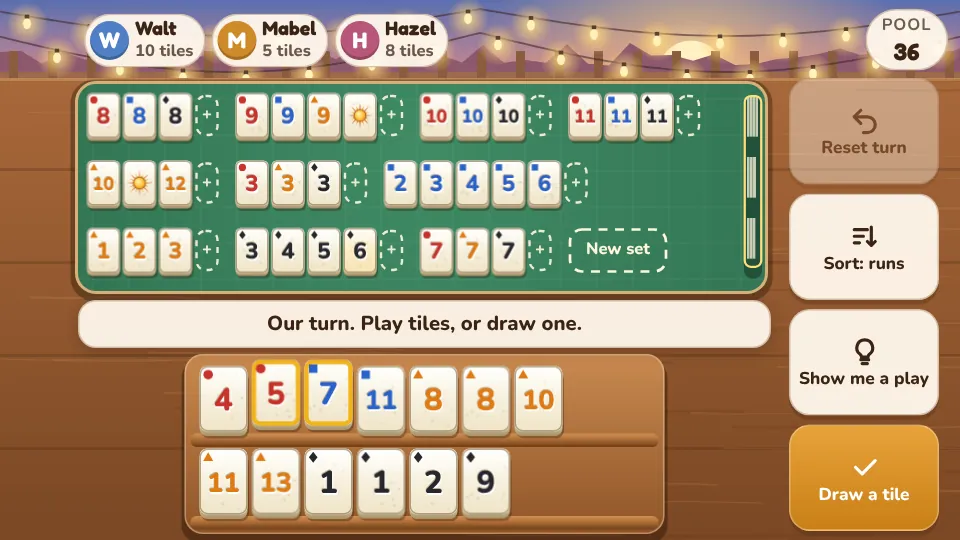
The rules in brief
There are 106 tiles: the numbers 1 to 13 in four colors, two of each, plus two wilds. Everyone starts with 14 on a rack. On your turn you play at least one tile or draw one from the pool. The first player to empty their rack wins the round.
A group is three or four tiles of the same number in different colors. A run is three or more numbers in a row in one color. A 1 is always low, so 12, 13, 1 is not a run. Your first play must be new sets from your own rack worth 30 points or more.
The four rearranging moves
After your first play, any set on the table can be rebuilt. Every tile that was on the table must still be in a good set when you end your turn. These four moves cover most of what you'll ever do.
| Move | Example | Why it works |
|---|---|---|
| Take the spare from a group of four | A group of four 8s: take the blue 8 for your blue 6, 7 | Three 8s are still a group |
| Take the end of a long run | Red 3, 4, 5, 6: take the red 6 for your two other 6s | Red 3, 4, 5 is still a run |
| Split a run | Orange 4 to 9 and you hold a second orange 7: make 4, 5, 6, 7 and 7, 8, 9 | Both halves hold three or more |
| Add, then peel | Black 5, 6, 7 and you hold the black 8: add it, then take the 5 for a group of 5s | The run is still three long |
In Sundown Tile Rummy a set that isn't good yet gets an amber outline, so you can try a plan and see at a glance what still needs fixing. Reset turn puts everything back.
When to play and when to hold
Every tile you put on the table is a tile the other players can use. So the best players don't empty their racks as fast as they can. They play enough to stay close, and keep a few flexible tiles back for a big final turn.
- Early on, get your 30 point start down. Until you do, the table is closed to you and you fall behind.
- In the middle of a round, play tiles that only fit one place and hold the ones that fit several.
- When another rack gets down to four or five tiles, change gears and play everything you can. Tiles left on your rack count against you.
Using a wild
A wild stands for any tile, and it's the strongest thing you can hold. Use it to make your first play if you must, but the best use is the turn you go out. A wild left on your rack when someone else goes out costs 30 points, so don't sit on one when a rival is nearly done.
A wild on the table can be freed. Put down the very tile it stands for in its place, and the freed wild must then go into a set on that same turn.
Small habits that win rounds
- Sort your rack by color, then by number, so runs show up on their own.
- Pairs are half of two different sets. A red 6 and red 7 want a 5 or an 8. A red 6 and blue 6 want any other 6.
- Remember there are two of every tile. If both blue 9s are on the table, your blue 7, 8 needs a 6.
- Before you draw, look hard at the table. A draw is a turn with nothing played.
New to the game? Our tile rummy page has the rules and what we added for first timers, and Sundown Tile Rummy has lessons that teach one move at a time.
Questions
What is the best strategy in tile rummy?
Make your first play early, then hold back flexible tiles and learn the rearranging moves. Play everything once another player is close to going out.
Should I hold on to a wild?
Hold it for the turn it lets you go out, but not too long. A wild left on your rack when someone else goes out costs 30 points.
Can I take tiles from sets on the table?
Yes, after your first play. You can rebuild any sets, as long as every tile from the table is still in a good set when your turn ends.
How do I count the 30 points for the first play?
Add up the numbers on the tiles in the new sets you lay down from your own rack. A wild counts as the tile it stands for.
Game guides
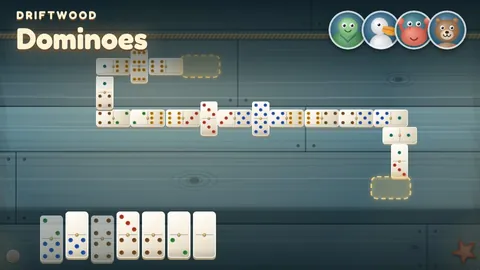
More strategy articles
 How to win at Spider SolitaireMoonlit Spider
 Chess openings for beginnersKingsway Chess
 Three stars every timeCopper Pot Kitchen
 How to catch rare bugsBramble Bug Museum
 How to win at Mahjong SolitaireMahjong Cloud Steps
 Pinball tips for beginnersPocket Pinball
 Bubble shooter strategyBubble Bay
 How to win at FreeCellFour Cells