Games / Strategy Games / Driftwood Dominoes / Guide
How to play Driftwood Dominoes
Driftwood Dominoes is our table for anyone who wants to play dominoes online, free, against the computer. Sit down with one to three house players, match the ends of the line, and try to empty your hand before they do. It plays Draw, Block and Train dominoes, plus All Fives (points whenever the open ends add up to a multiple of five) at your own table, keeps score across a race sized to the table (to 100 in the classic three seat game), and saves the table after every tile.
This is our guide to playing Driftwood Dominoes. Want to jump straight in? Play Driftwood Dominoes right here in your browser.
Quick answers
Does Driftwood Dominoes work on my phone?
Yes. Driftwood Dominoes works with touch on phones and tablets, and with a mouse or keyboard on a computer. It runs in the browser you already have, so there is no app to download.
Do I need an account to play Driftwood Dominoes?
No. Just open it and play, with no sign-up. If you like, a free account (username only, no email, for players 13 and older) puts your scores on the leaderboards and backs up your progress so it follows you to any device.
Is there a daily challenge in Driftwood Dominoes?
Yes. Driftwood Dominoes has a new daily challenge every day, the same one for every player, with its own daily leaderboard. Find it alongside the others on our daily challenges page.
Does Driftwood Dominoes save my progress?
Yes. It saves on this device on its own, so you can close the page and pick up where you left off. Sign in with a free account to keep the same progress on your phone and your computer.
Is Driftwood Dominoes OK for kids?
Yes, players of any age can enjoy it. There is no chat and no way to message other players, and nobody needs an account to play. Accounts are for players 13 and older, so younger players just play and their progress stays on their device. For ages 4 to 11 we also have learning games in their own kids area, with no ads, no accounts and no tracking.
How to play dominoes
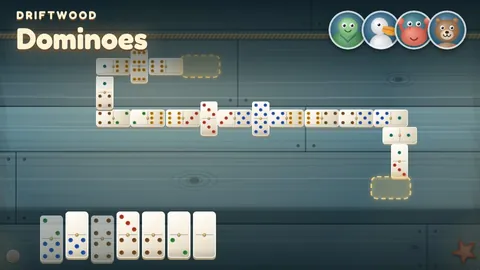
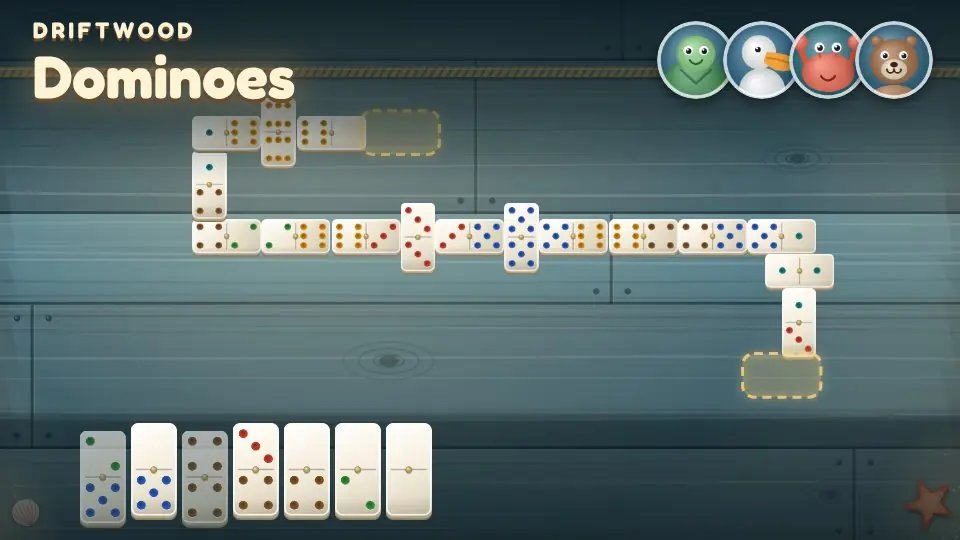
A domino tile has two ends, and each end shows a number of pips from blank to six. The whole game is matching. On your turn you add one tile to the line on the table, and the end you add must show the same number as the open end it touches. A 5 and 3 tile can go next to an open 5, which leaves a 3 showing for the next player.
- In a two player game of Draw, each of us takes seven tiles. With three or four at the table it is five each. The rest wait face down in the boneyard.
- In the first hand, whoever holds the highest double leads with it. After that, the winner of the last hand leads with any tile.
- Play goes around the table. Each turn is one tile on either open end of the line.
- Doubles are laid crosswise. They still count as one end of the line.
- The first player to lay their last tile wins the hand.
The line turns corners by itself when it reaches the edge of the table, and the view pulls back as it grows, so even a whole set of 28 tiles stays readable on a phone.
Controls
| On | Play a tile | Other actions |
|---|---|---|
| Phone or tablet | Tap a raised tile. If it fits in two places, tap the glowing spot you want. You can also drag a tile to an end. | Tap Draw or Pass when nothing fits. Tap a house player to see which numbers they could not match. Tap the boneyard to count the tiles still out. |
| Mouse | Click a tile, then a glowing spot, or drag it | The lightbulb gives a hint. Each hint says why it likes that tile, such as shedding a heavy tile or leaving a number a house player could not match. Click our score to see our own pip count. |
| Keyboard | Arrow keys pick a tile, Enter plays it, left and right choose the end | D draws or passes, H gives a hint, C opens the tile count, 1 to 3 tell us about a house player, P pauses |
A tile with only one legal spot plays in a single tap. Tiles that can play sit a little higher in your hand, and you can turn that help off in Settings. After each hand, Look at the table hides the score card so you can study the finished line.
Settings has a volume slider and a switch for the soft shore sounds in the background, along with sound, vibration, colored pips and faster house players.
Draw, Block and Train: the three games
Draw dominoes
This is the game most people mean by dominoes. If none of your tiles fits, you draw from the boneyard until one does, then play it. When the boneyard is empty and you still have nothing, you pass.
Block dominoes
Block has no drawing at all. Everybody takes seven tiles, the rest sleep for the whole hand, and a player with nothing to play simply passes. Hands are short and often end blocked, so the count in your hand matters as much as going out.
Train dominoes
Train uses a double nine set. One double is the engine in the middle of the table, and every seat builds a train of its own starting from the engine's number. There is also a public train that anybody may add to on any turn.
- If you cannot play, you draw one tile. If that does not fit either, you pass and a flag goes up on your train.
- A flagged train is open: the other players may add to it. The flag comes down when you play on your own train again.
- A double earns one more play, and that play must cover the double. If you cannot cover it, you draw one tile, then pass, and the next player has to cover it before doing anything else.
- The engine steps down one number every hand: double nine first, then double eight, and so on.
On screen, the public train is the top row, the house players are in the middle and your train is the bottom row, nearest your hand. Each row shows the newest tiles of its train, with a small count of the older ones.
All Fives dominoes
Pick Fives under Our own table. It plays like Draw, with points on the go: after every tile, add up the two open ends of the line. When the total is 5, 10, 15 or any multiple of five, the player who just played scores that many points right away. A double sitting at an end counts both halves, so a 5 and 5 double at one end with a blank at the other makes 10. The hand winner still scores the pips left in the other hands, rounded to the nearest five, and the race usually runs to 150.
Scoring and the race
| How the hand ends | Who scores | Points |
|---|---|---|
| Somebody plays their last tile | That player | Every pip left in all the other hands |
| Blocked, with one lowest count | The player holding the fewest pips | The other players' pips minus their own |
| Blocked, with a tie for lowest | Nobody | None |
Points add up from hand to hand until someone reaches the target. Each kind of table has its own three or four targets, picked from thousands of simulated races so the usual one lasts about five to seven hands, and the table screen tells you how many hands to expect.
| Table | Race to (usual one in bold) |
|---|---|
| Draw, two seats | 50, 75, 100 or 150 |
| Draw, three seats | 50, 100 or 150 |
| Draw, four seats | 100, 150 or 200 |
| Draw, four seats, double nine | 250, 350 or 450 |
| Block, two seats | 15, 25 or 40 |
| Block, three seats | 50, 75 or 100 |
| Block, four seats | 50, 75 or 100 |
| Block, four seats, double nine | 100, 150 or 200 |
| Train, two seats | 100, 150 or 200 |
| Train, three seats | 150, 200 or 250 |
| Train, four seats | 150, 200 or 250 |
Block for two races are short on purpose. A blocked hand scores only the difference between the two counts, often just a few points, so a race to 25 is a proper contest. A blocked Train hand is scored the same way as any other block.
The house players
Four regulars sit at our tables, and each plays in a way you can learn to read.
- Tully the turtle is easygoing and often plays the first tile that fits.
- Pepper the pelican gets rid of the heaviest tile every time, doubles first.
- Coral the crab steers the ends toward numbers she holds plenty of.
- Otis the otter keeps his options open and is the one to beat.
None of them counts tiles the way a careful person can. In our testing, a careful counting player beat Otis in about three races out of four.
Shore Tour, Daily Deal and goals
The Shore Tour is ten tables, from the Tide Pool Table with Tully up to the Captain's Table with three house players and a Train race to 200. Winning a table earns a shell. Holding every house player under 70 percent of the target earns a second, and under 40 percent earns the third.
The Daily Deal is one hand of Draw for two, and everyone gets the same tiles that day. A win scores 100 plus the pips you caught. A loss scores 50 minus the pips you were caught with, and a tied block is worth 60. Your first finished play of the day is the score that goes on the leaderboard. You can replay the deal afterwards, just for fun.
Three small goals refresh each day, such as winning two hands or playing four doubles. Finishing all three earns a sand dollar. Shells and sand dollars together unlock new tile finishes: Sea glass, Driftwood, Coral and Lantern night.
The Trophies screen keeps your stats, your record against each house player in races for two, and ten badges to earn, from First domino (go out first in a hand) to The whole shore (all 30 shells).
Tips and strategy
- Play your doubles early. A double fits only one number, so it is the easiest tile to get stuck with.
- Shed heavy tiles when the choice is otherwise even. If someone else goes out, every pip in your hand is their score.
- Keep variety. Holding several different numbers means fewer turns with nothing to play.
- Watch the passes. When a player passes or draws, they hold neither open number. Leave those numbers on the ends and they stay stuck. Tapping a house player shows what they have missed so far.
- Count the sevens. Each number appears on seven tiles in a double six set. If six of the fives are on the table and you hold the last one, a 5 on the end belongs to you. The boneyard button shows how many tiles of each number are still out of sight.
- In Block, a low count wins blocked hands. When the line is closing up, dump pips instead of chasing the win.
- In Train, plan your own train as one long run before you start it, and use the public train for tiles that do not belong in the run.
- A raised flag invites everyone onto your train. Play on it yourself as soon as you can to close it.
Questions
Is Driftwood Dominoes free?
Yes. It is free to play in your browser on a phone, tablet or computer, with no download and no sign up needed.
Who goes first in dominoes?
In the first hand the player with the highest double leads with that tile. In later hands the winner of the previous hand leads with any tile. In Train the lead simply passes around the table.
What happens when nobody can play?
The hand is blocked. Everybody counts the pips left in their hand, and the lowest count wins the hand and scores the others' pips minus its own. If two players tie for lowest, nobody scores.
How many dominoes does each player get?
In Draw, seven each with two players and five each with three or four. In Block, seven each. With the double nine set at a four player table it is seven each in Draw and nine in Block. Train deals twelve tiles for two players, eleven for three and ten for four.
What is the difference between Draw and Block dominoes?
In Draw you take tiles from the boneyard when you cannot play. In Block there is no drawing: you pass, and the unused tiles stay out of the hand.
Can I stop in the middle of a game?
Yes. The table is saved after every tile. The title screen offers Continue to pick it up again, with New game beside it if you would like a fresh table.
Can I play All Fives dominoes?
Yes. Choose Fives under Our own table, with two to four seats. Every time the open ends add up to a multiple of five you score that many points, and the house players chase fives too.
Related guides
 How to play Domino BoardwalkDomino solitaire
 How to play Hearts HollowTrick taking
 How to play Kingsway ChessChess
 How to play Grant Central StationTrain tycoon
 How to play Bracken BackgammonBackgammon