
Games / Strategy Games / Sundown Tile Rummy / Guide
How to play Sundown Tile Rummy
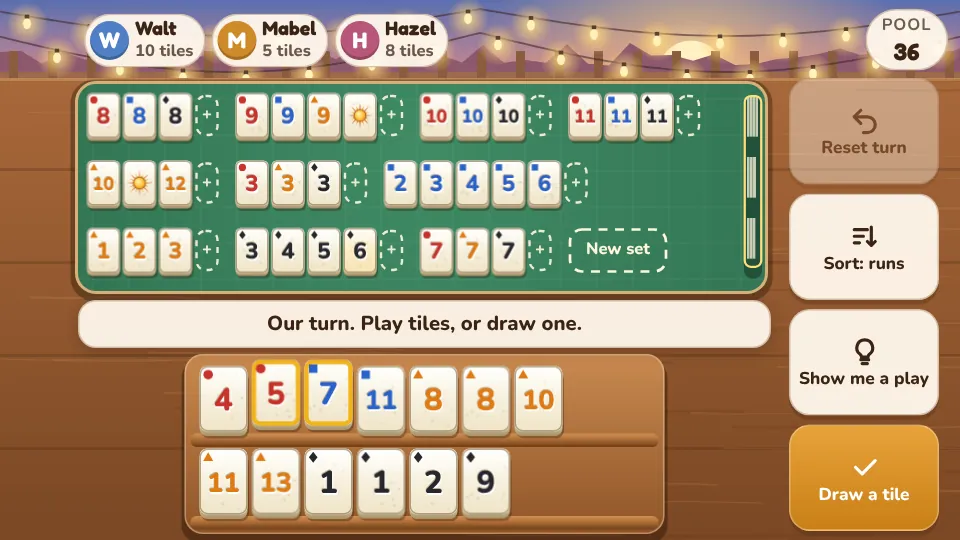
A tile rummy game on a back patio at sundown: lay down runs and groups of numbered tiles, rearrange what is already on the table, and be the first to play your whole rack.
This is our guide to playing Sundown Tile Rummy. Want to jump straight in? Play Sundown Tile Rummy right here in your browser.
Quick answers
Does Sundown Tile Rummy work on my phone?
Yes. Sundown Tile Rummy works with touch on phones and tablets, and with a mouse or keyboard on a computer. It runs in the browser you already have, so there is no app to download.
Do I need an account to play Sundown Tile Rummy?
No. Just open it and play, with no sign-up. If you like, a free account (username only, no email, for players 13 and older) puts your scores on the leaderboards and backs up your progress so it follows you to any device.
Is there a daily challenge in Sundown Tile Rummy?
Yes. Sundown Tile Rummy has a new daily challenge every day, the same one for every player, with its own daily leaderboard. Find it alongside the others on our daily challenges page.
Does Sundown Tile Rummy save my progress?
Yes. It saves on this device on its own, so you can close the page and pick up where you left off. Sign in with a free account to keep the same progress on your phone and your computer.
Is Sundown Tile Rummy OK for kids?
Yes, players of any age can enjoy it. There is no chat and no way to message other players, and nobody needs an account to play. Accounts are for players 13 and older, so younger players just play and their progress stays on their device. For ages 4 to 11 we also have learning games in their own kids area, with no ads, no accounts and no tracking.
A tile rummy game you can play in your browser
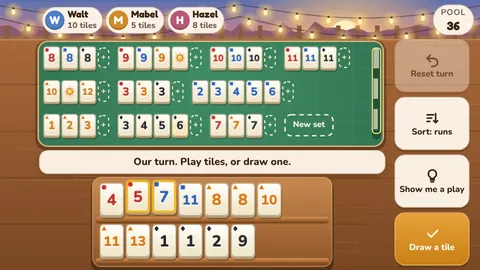
Sundown Tile Rummy is our tile rummy game. If you have played rummy with cards, the idea will feel familiar: make sets, put them down, and empty your hand first. The twist that makes tile rummy so much fun is the table itself. Everything already played belongs to everyone, so on your turn you can pull sets apart and build them back up in new ways to fit your own tiles in.
We set it on a wooden patio table at sundown, with string lights overhead and a tall glass of iced tea nearby. You play against one, two or three friendly house players. It is free, it runs in the browser on a phone, tablet or computer, and there is nothing to download.
How it works
There are 106 tiles: the numbers 1 to 13 in four colors, two of each, plus two sunburst wilds. Each color also has its own corner shape, so the colors are easy to tell apart without relying on color alone: red has a circle, blue a square, orange a triangle and black a diamond.
Everyone gets 14 tiles on a two-row wooden rack. The rest stay face down in the pool. On your turn you either play at least one tile from your rack onto the table, or you draw one tile from the pool. The first player with an empty rack wins the round.
The rules, in order
- Groups. Three or four tiles of the same number, every one a different color. Red 8, blue 8 and black 8 is a group. Two red 8s can never sit in the same group.
- Runs. Three or more numbers in a row in one color, like orange 4, 5, 6, 7. A 1 is always low, so 12, 13, 1 is not a run.
- The first play. Your first play must be new sets made only from your own rack, adding up to 30 points or more. Until then the table is closed to you.
- Every turn after that. Play as many tiles as you like: start new sets, add to sets on the table, or rearrange them. When you end the turn, every set on the table must be a good set, every tile that was on the table must still be on the table, and at least one tile must have come from your rack.
- When you cannot play. Draw one tile and your turn is over. If the pool is empty, you pass instead.
- Winning a round. The first player to play every tile wins. If the pool runs out and nobody can play for a whole lap, the player holding the fewest points wins.
Sets: runs and groups
A set needs at least three tiles. Groups top out at four (one of each color), while a run can stretch from 1 all the way to 13. On the felt, a set that is not good yet gets a soft amber outline with a dashed edge and a small exclamation mark, and the End turn button waits until every amber set is fixed.
You decide which tiles go together; we keep them in order for you. Drop a blue 9 next to a blue 7 and 8 and the run sorts itself. Take a tile out of the middle of a run and the two halves become two sets, so you can see right away whether both halves still hold three tiles.
The 30-point start
Your first play is the only one with a minimum. Add up the numbers on the tiles in the new sets you put down. If the total is 30 or more, you are in. A run of orange 10, 11 and 12 is 33, so it works on its own. A group of three 5s is only 15, so it needs another set beside it.
A wild counts as the tile it stands for, so blue 9, blue 10 and a wild (standing for blue 11) makes exactly 30. On that first turn you can only lay down new sets from your own rack. From the next turn on, the whole table is open to you. The coach line at the bottom keeps a running count, like "First play: 24 of 30 points so far".
Rearranging the table, with three examples
This is the heart of tile rummy. Here are three moves we use all the time.
Taking from the end of a run
The table has a red run 4, 5, 6, 7. Your rack holds a blue 7 and an orange 7, but no third 7. Slide the red 7 off the end of the run and put the blue 7 and orange 7 beside it. The red run is still 4, 5, 6, and you have a new group of three 7s. Two tiles played, and nothing broken.
Splitting a long run
The table has a red run 1, 2, 3, 4, 5, 6 and you hold the other red 4. Pick up the red 5 and 6 together and drop them on open felt. The run is now 1, 2, 3, 4, and the 5 and 6 sit alone with an amber outline, because two tiles are not a set yet. Put your red 4 in front of them and you have 4, 5, 6. Two good runs, one tile played.
Borrowing from a group of four
The table has a group of four 9s (red, blue, orange, black) and a blue run 10, 11, 12. You hold a blue 8. Take the blue 9 out of the group, which leaves a good group of three, and put it in front of the blue run with your 8: blue 8, 9, 10, 11, 12. One tile from your rack, two sets changed, and every set still good.
If a rearrangement goes wrong, Reset turn puts every tile back exactly where it was when the turn began. Nothing is ever lost.
Wild tiles
There are two wilds, each with a sunburst. A wild stands in for any tile. In a run it is the number at its place; at the end of a run it stands for the next number up, and you can tap a wild you just played to move it to the other end. In a group it is one of the colors that is missing. A wild may start a run, and it counts toward the first 30 points.
Once a wild is on the table, it keeps standing for that same tile. To take it, you swap in that very tile from your rack: for a wild standing for red 5, put down your own red 5. For a group of three, any missing color of that number works. The freed wild must go into a set on the same turn. One numbered tile with two wilds is read as a run whenever it can be.
A wild left on your rack when someone else goes out costs 30 points, so do not hold on to one for too long.
Scoring
| What happens | Points |
|---|---|
| You go out first | The total left on every other rack |
| Someone else goes out | Minus the total left on your rack |
| A wild left on a rack | 30 |
| Any other tile left on a rack | Its number |
If the pool runs out and nobody can play for a whole lap, the lowest rack wins. Everyone else loses what they hold above that rack, and the winner collects it. In a Match to 200 the scores carry from round to round until someone reaches 200.
Modes
Quick round is one round, start to finish. Match to 200 plays round after round. Daily Rack is a single turn on a table that is the same for everyone today: play as many tiles as you can, and if two players play the same number of tiles, the faster one ranks higher. Only the first try each day counts, and the result card shows what each house player managed on the same rack, plus how many tiles our own best line plays.
There are four short Lessons (groups, runs, the 30-point start and rearranging), each a single turn with a pointing hand. The House players menu sets how many sit with you and who: Hazel plays what she sees in her own rack, Walt adds on wherever he can, Mabel rearranges one set at a time, and Ray rearranges up to two. A careful player beats all four more often than not.
Tips
- Sort your rack both ways. Sort: runs lines up colors; Sort: groups lines up numbers. Each shows different sets.
- Look for tiles you can add before you look for new sets. A single tile on the end of a run is a whole turn's progress.
- Hold small sets back early on if you can still play something. A rack with options is better than a rack with one big set already down.
- Groups of four are a store of spare tiles. Any one tile can leave and the group is still good.
- Play wilds when they unlock a big turn, not as soon as you can. They are worth 30 against you at the end.
- Watch the house players' tile counts at the top. When someone is down to two or three, play your high numbers first.
Getting better
Strong players think about the table as one big pool of tiles that happens to be split into sets. Before you play, ask which of your tiles almost fit somewhere, then look for one table tile that would complete the picture. Most big turns come from moving just one or two tiles that are already out.
Stuck on a turn? The lightbulb button above the rack finds a legal play when there is one, rearranging included, and moves the tiles slowly so you can follow along. You can end the turn with it, or press Reset turn and try it yourself. When there is no play at all, it says so, and drawing is the right move.
On a computer you can play with the keyboard: arrow keys move, Space picks a tile, Enter places the picked tiles, N makes a new set, R resets the turn, S sorts, H shows a play and E ends the turn.
More games from us
If you like sets and runs, try Gin Garden for gin rummy with cards, Driftwood Dominoes for another tile game against house players, or Meld Parlor for mahjong melds.
Questions
How do you play tile rummy?
Everyone starts with 14 numbered tiles. On your turn, play tiles to the table as runs (numbers in a row in one color) or groups (one number in different colors), or draw a tile. Your first play must add up to 30 points. The first player to empty the rack wins.
Can I take tiles back during my turn?
Yes. Any tile you put down this turn can go back to your rack until you end the turn, and Reset turn puts the whole table back the way it was. Tiles that were already on the table when your turn began must stay on the table.
What if I cannot play?
Tap Draw a tile. You take one tile from the pool and your turn ends. If the pool is empty, the same button passes. When the pool is empty and nobody can play for a whole lap, the round ends and the lowest rack wins.
Can I rearrange tiles that other players put down?
Yes, once you have made your first play of 30 points. Any set on the table can be split, added to or mixed with others, as long as every set is good when you end the turn.
Can two people play?
You can play one on one against a single house player, or against two or three. Pick how many in the House players menu.
Is Sundown Tile Rummy free?
Yes. It is free to play in your browser on a phone, tablet or computer, with nothing to download.
Related guides
 How to play Gin GardenRummy
 How to play Driftwood DominoesClassic dominoes
 How to play Meld ParlorMahjong melds
 How to play Ten Step RummyRummy card game
 How to play TilewoldTile landscape builder
More to read
You might also like
10 minSavesDriftwood Dominoes
Classic dominoesClassic dominoes against one to three house players. Play Draw, Block or Train dominoes, match the ends, empty our hand first and win the race.