
Games / Strategy Games / Ten Step Rummy / Guide
How to play Ten Step Rummy
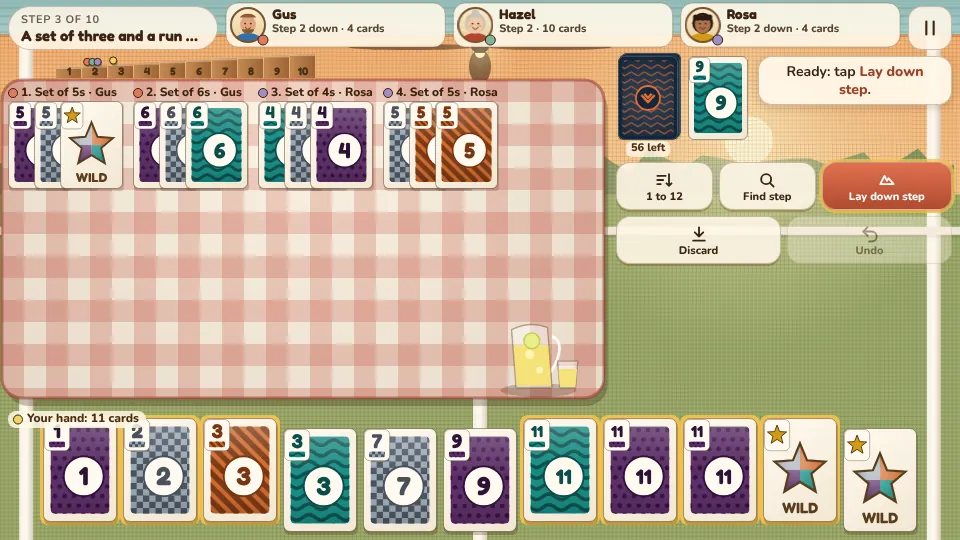
The Ten Step Rummy card game is our rummy game of ten goals: each hand you try to lay down this step's sets, runs or colors, play out your cards, and climb one step higher. First to finish step 10 wins.
This is our guide to playing Ten Step Rummy. Want to jump straight in? Play Ten Step Rummy right here in your browser.
Quick answers
Do I need an account to play Ten Step Rummy?
No. Just open it and play, with no sign-up. If you like, a free account (username only, no email, for players 13 and older) puts your scores on the leaderboards and backs up your progress so it follows you to any device.
Is there a daily challenge in Ten Step Rummy?
Yes. Ten Step Rummy has a new daily challenge every day, the same one for every player, with its own daily leaderboard. Find it alongside the others on our daily challenges page.
Does Ten Step Rummy save my progress?
Yes. It saves on this device on its own, so you can close the page and pick up where you left off. Sign in with a free account to keep the same progress on your phone and your computer.
Is Ten Step Rummy OK for kids?
Yes, players of any age can enjoy it. There is no chat and no way to message other players, and nobody needs an account to play. Accounts are for players 13 and older, so younger players just play and their progress stays on their device. For ages 4 to 11 we also have learning games in their own kids area, with no ads, no accounts and no tracking.
A rummy card game with ten goals
Ten Step Rummy is a rummy game of goals, played on a screened-in porch on a summer evening. Each player works up a wooden staircase of ten steps. Every step is a goal, like two sets of three or a run of seven, and you can only climb when you lay that goal down in a hand. The neighbors at the table are climbing too.
The deck is our own: numbers 1 to 12 in four colors, two of each card, plus 6 Wild cards with a five-point star and 6 Rest cards with a rocking chair, 108 cards in all. Each color has a pattern so we can tell them apart without the color: rust orange has stripes, teal has waves, plum has dots and slate gray has checks. They read well in black and white too.
It plays in the browser on a phone, tablet or computer, with nothing to install and no sign up. Your game saves itself after every card, so you can close the page in the middle of a hand and pick up exactly where you were.
The ten steps
A set is cards with the same number, in any colors. A run is numbers in order, in any colors. Runs go from 1 up to 12 and don't wrap around from 12 back to 1. These are our ten steps, always in this order:
| Step | Lay down |
|---|---|
| 1 | A run of five |
| 2 | Two sets of three |
| 3 | A set of three and a run of four |
| 4 | Six cards of one color |
| 5 | Two runs of four |
| 6 | A run of seven |
| 7 | A set of five and a set of two |
| 8 | A set of four and a run of four |
| 9 | Three sets of three |
| 10 | A set of five and a run of five |
Groups can be longer than the step asks. A set of four counts as a set of three, and a run of eight counts as a run of seven. Seven cards of one color count for step 4.
How a turn works
- Draw one card. Tap the deck, or take the top card of the pile if it helps.
- Lay down your step if you hold all of it. You must lay the whole step at once. Pick the cards and tap Lay down step, or tap Find step and the game picks a valid group for you. The button only lights when the cards you picked make the step.
- Add to the table. Once your step is down, you may add cards to any group on the table, yours or a neighbor's: a 9 onto a set of 9s, a 5 onto the end of a run that stops at 4, a plum card onto a group of plum cards. Drag a card onto a group, or pick it and tap the group.
- Discard one card onto the pile to end your turn. Until you discard, Undo takes back a lay down or an added card.
We always keep one card to discard, so your last card can't go onto the table. The hand ends the moment someone discards their last card. Everyone who laid down their step that hand moves up one step. Everyone else tries the same step again in the next hand, with a fresh deal.
When the deck runs out, the pile under its top card is shuffled into a new deck. In the very rare case that there is nothing at all left to draw, the hand ends right there, and anyone who laid down still moves up.
Wild cards and Rest cards
A Wild stands for any number or any color. The one rule to remember: a group must hold at least one plain card for every wild in it. So a set of three can use one wild, a run of five can use two, a run of seven up to three, and no group can ever be all wild. A wild on the table stays where it was played; nobody can swap it out. In a run, a wild fills a gap first, then goes on the top end, and on the bottom end once the run reaches 12. When you drag a wild onto a run, the half of the run you drop it on picks the end.
A Rest card is discarded onto a neighbor of your choice, who misses their next turn. A player can only have one Rest waiting, and a Rest on top of the pile can't be picked up. Rest cards never join a set or run. You may go out on a Rest card. Our neighbors play their Rest cards on whoever is furthest up the staircase, and break ties at random, so they don't pick on you.
Scoring and winning
When a hand ends, the cards still in your hand count against you. Lower totals are better.
| Card left in your hand | Points against you |
|---|---|
| 1 to 9 | Its own number |
| 10, 11 or 12 | 10 each |
| Wild | 20 |
| Rest | 20 |
The first player to finish step 10 wins. If two players finish it in the same hand, the lower total wins. If that's tied too, whoever went out wins, and after that whoever laid down first. The short game uses the same rules but stops at step 5.
Modes: ten steps, short game and the Daily Hand
Play is the full climb of ten steps against one, two or three neighbors; pick how many on the title screen. Your very first game starts with a coached hand against Gus, where the card you need is waiting on the pile.
Short game is steps 1 to 5, about twenty minutes.
Daily Hand is one deal at a set step, the same for everyone on the same day, against two neighbors. The goal is to go out in as few turns as you can. The hand keeps going until you go out (a neighbor who goes out first just sits back), and you score 1,000 minus 30 for each of your turns, never under 100. Only your first try of the day counts, so it can't be beaten by replaying it; later tries are practice. When you finish, we show how our four neighbors did when each of them played the very same deal from your seat.
Our neighbors at the table
There are four of them, and each plays by the rules from what they can see: their own hand, the table and the pile. None of them ever peeks at your cards or the deck. Hazel hangs on to her wild cards a little too long. Walt gets rid of his big numbers early. Rosa plays it safe and rarely takes from the pile. Gus is steady and balanced. They are friendly and beatable: a careful player wins most games against any of them.
Neighbors take their turns at an easy pace, so you can watch each card go to the pile or the table. If you'd like them faster, switch Neighbors play to Quick in Settings.
Strategy for each step
- Step 1, a run of five. The gentle start. Keep one of each number in a stretch like 4 to 9 and throw away doubles; a wild can fill a gap.
- Step 2, two sets of three. Keep pairs. Two pairs plus one more card of either number is the usual way in, and the pile hands us a third card more often than we'd think.
- Step 3, a set of three and a run of four. Build the run from the middle numbers, 4 to 9, where there are the most ways to finish it, and keep a pair for the set.
- Step 4, six cards of one color. Count the colors right after the deal and commit to the biggest. Sort the hand by color to see it at a glance.
- Step 5, two runs of four. Two runs can share numbers, so a pair like two 5s is useful here, one for each run.
- Step 6, a run of seven. Throw away doubles first. We only need one of each number, so a second 6 does not help. Every run of seven holds 6 and 7, so keep those.
- Step 7, a set of five and a set of two. After step 10 this is the slowest step for most of us, and a wild is worth a lot here. Pick the number we hold the most of and stop collecting everything else.
- Step 8, a set of four and a run of four. Usually quicker than steps 7 and 9. Hold the set's number and let the run come to us from the pile.
- Step 9, three sets of three. Keep every pair. Three pairs and a wild is close.
- Step 10, a set of five and a run of five. Usually the slowest step: it takes most of us a few hands. Decide early which number is the set, and don't let it sit inside the run unless there are spares.
Getting better
We watch the pile. Every card a neighbor takes tells us what they're building, and every card they throw away tells us what they aren't. We try not to hand a neighbor the third card of a set we've seen them pick up.
Once our step is down, the race changes. We want an empty hand, so we play every card that fits the table, keep the cards that might fit later, and throw away high numbers first, since a 12 left in your hand costs 10 and a 2 costs only 2. Wilds and Rest cards cost 20 each, so play wilds onto the table and spend Rest cards before the hand ends.
We use Rest cards with care. The best time is when a neighbor has laid down and is about to go out: one missed turn can keep them on their step. On a computer, the arrow keys move along your hand, Space picks a card, D draws, P takes the pile, H finds your step, L lays it down, X discards and U undoes.
More rummy and card games from us
If you like rummy, try Gin Garden for two player gin rummy, Monsoon Rummy for 13 card Indian rummy, and Canasta Casita for canasta. For something quicker, Crazy Eights is a good shedding game.
Questions
How do you play Ten Step Rummy?
Each hand, draw a card, lay down your step if you hold all of it, add cards to groups on the table once your step is down, and discard one card. Lay down your step in a hand to move up one. The first to finish step 10 wins.
How is this different from gin rummy?
In gin rummy you can form any melds and knock to end a hand. In Ten Step Rummy everyone chases a fixed goal that changes as you climb, you must lay the whole goal down at once, you can add to anyone's groups, and the game is a race across ten hands or more rather than to a point total.
Can two people play?
Yes. You can play against one neighbor for a two player game, or against two or three neighbors for a bigger table. Choose on the title screen.
What does a Wild card do?
A Wild stands for any number or color. Every group needs at least one plain card for each wild in it, so a group can never be all wild. Once played, a wild stays where it is.
What does a Rest card do?
You discard it onto a neighbor of your choice and they miss their next turn. It can't be picked up from the pile, can't be used in a set or run, and you may go out on one.
Can I play Ten Step Rummy on my phone?
Yes. It is made for phones first, with the hand in two rows of big cards, and it also works on tablets and computers, with keyboard play.
Is Ten Step Rummy free?
Yes. It is free to play in your browser, with no download and no sign up.
Related guides
 How to play Gin GardenRummy
 How to play Monsoon RummyIndian rummy
 How to play Canasta CasitaCanasta
 How to play Sundown Tile RummyTile rummy
 How to play Airscape Pot RummyPots card game
More to read
Gin rummy strategy: knock early, discard safelyStrategy article · Gin GardenCanasta strategy: the pile, the freeze and going outStrategy article · Canasta CasitaTile rummy strategyStrategy article · Sundown Tile Rummy Card Games for TwoRules, tips and games like thisGin Rummy OnlineRules, tips and games like this
You might also like
10 minSavesMonsoon Rummy
Indian rummy13 card Indian Rummy on a monsoon night train. Build your pure sequence, play Points, Pool 101 or Deals against the passengers, and ride 36 stations.