Games / Strategy Games / Monsoon Rummy / Guide
Monsoon Rummy
Thirteen cards, a window seat and the rain. Play Indian Rummy against the passengers of a night mail train, from a quick points hand to a long Pool 101.
Quick answers
Is Monsoon Rummy free?
Yes. Monsoon Rummy is free to play right in your browser, with nothing to download and nothing to install.
Do I need an account to play Monsoon Rummy?
No. Just open it and play, with no sign-up. If you like, a free account (username only, no email, for players 13 and older) puts your scores on the leaderboards and backs up your progress so it follows you to any device.
Is there a daily challenge in Monsoon Rummy?
Yes. Monsoon Rummy has a new daily challenge every day, the same one for every player, with its own daily leaderboard. Find it alongside the others on our daily challenges page.
Does Monsoon Rummy save my progress?
Yes. It saves on this device on its own, so you can close the page and pick up where you left off. Sign in with a free account to keep the same progress on your phone and your computer.
Is Monsoon Rummy OK for kids?
Yes, players of any age can enjoy it. There is no chat and no way to message other players, and nobody needs an account to play. Accounts are for players 13 and older, so younger players just play and their progress stays on their device. For ages 4 to 11 we also have learning games in their own kids area, with no ads, no accounts and no tracking.
What is 13 card Indian Rummy?
Indian Rummy is a draw and discard card game. Each player gets 13 cards, and the goal is to sort every one of them into sequences and sets, then show your hand before anyone else does. It is played across India on holidays, at weddings and, very often, on long train rides.
It feels close to gin rummy, with two big differences: jokers, and the rule that your hand only counts if it holds a pure sequence. That one rule shapes almost every decision you make.
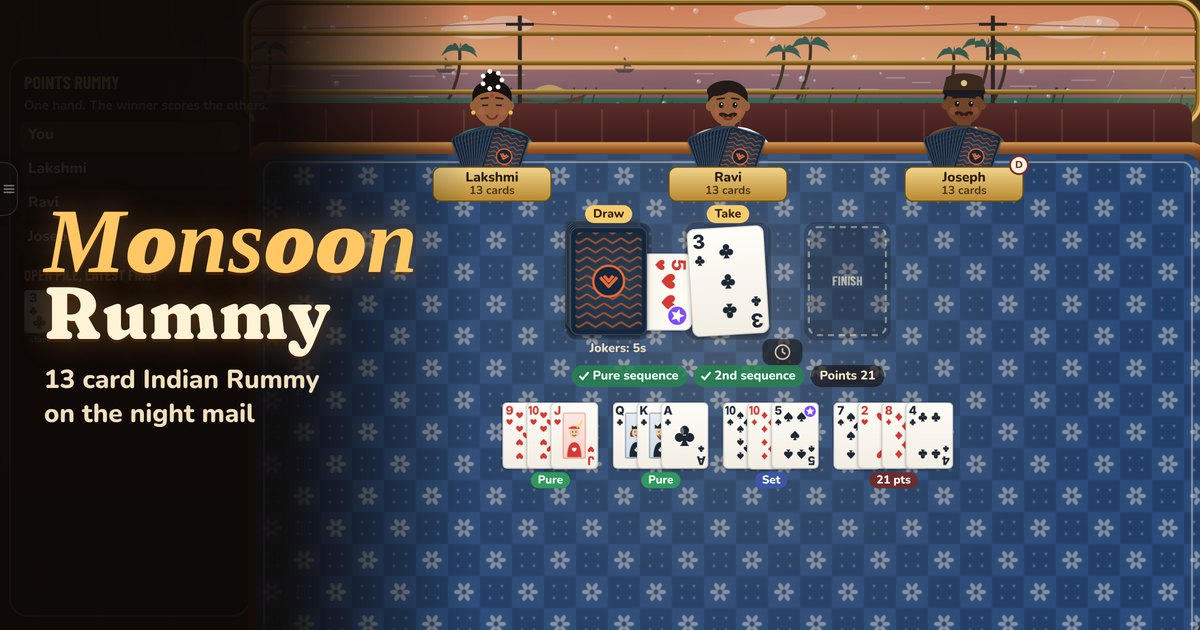
Monsoon Rummy sets the game in a sleeper compartment on a rainy night. Your opponents are fellow passengers: Kamala the retired schoolteacher, Ravi the tea seller, Meera the night shift doctor and nine more. It is free and plays in your browser on a phone, tablet or computer.
How to play
Sequences and sets
- A sequence is three or more cards in a row in one suit, like 4♥ 5♥ 6♥. The ace can be low (A 2 3) or high (Q K A), but a run can't wrap round from K to A to 2.
- A pure sequence has no joker in it. A sequence that uses a joker is called impure.
- A set is three or four cards of the same rank in different suits, like 9♠ 9♥ 9♣. Two cards of the same suit can't sit in one set, even when you play with two decks.
To show, you need at least two sequences, and at least one of them must be pure. Every other card has to be in a sequence or a set too.
Each turn
Draw one card, either the top of the closed deck or the top card of the open pile. Then throw one card face up onto the open pile. You can't throw back the card you just took from the open pile.
Jokers
After the deal, one card is turned face up and tucked under the closed deck. Every card of that rank is a joker for this hand. If a 7 is turned up, all four 7s are jokers. Printed jokers are always jokers, and if a printed joker is the card turned up, aces become the jokers.
A joker can stand in for any missing card in a sequence or a set. One detail trips people up: a joker card used as itself keeps a sequence pure. If 5s are jokers, 4♥ 5♥ 6♥ is still a pure sequence. In Monsoon Rummy every joker wears a small violet star so you never miss one.
Showing your hand
When your cards are ready, draw as usual, then tap Declare or drag a card onto the Finish slot. That card goes face down and your 13 cards are shown. In the usual rules a wrong show counts 80 points against you, so we check every show before it counts. You will never lose points to a slip of the finger.
How points work
When someone shows, everyone else counts the cards that don't fit. Lower is better.
| Card | Points |
|---|---|
| Ace, King, Queen, Jack | 10 |
| 2 to 10 | Face value |
| Any joker | 0 |
- No pure sequence: every card in your hand counts.
- A pure sequence but no second sequence: everything except the pure sequence counts.
- Two sequences including a pure one: only the loose cards count.
- No hand ever counts more than 80.
We arrange each losing hand in its best possible way before counting, so you are never charged for grouping your cards badly.
Dropping
At the start of your turn, before you draw, you may drop (fold). A first drop, before your first draw, counts 20. A middle drop, any time after that, counts 40. In Pool 201 these become 25 and 50. Dropping a hopeless hand early is often the smartest play at the table.
Points, Pool and Deals
Monsoon Rummy offers the three formats people play most.
| Format | How it works |
|---|---|
| Points rummy | One hand. Whoever shows first scores everyone else's points. |
| Pool 101 | Points add up hand after hand. Reach 101 and you are out. The last player left wins. |
| Pool 201 | The same, with a target of 201 and drops of 25 and 50. |
| Deals x2 or x3 | Two or three hands. The lowest total at the end wins. |
Tables seat 2 to 6 players. Two players share one deck with one printed joker. Three or more play with two decks and two printed jokers. If the closed deck runs out, the open pile is shuffled into a new one.
Controls on phone and computer
Tap the closed deck or the open pile to draw. Tap a card to pick it, then Discard, or double tap a card to throw it straight away. Drag cards between groups, onto the open pile, or onto Finish.
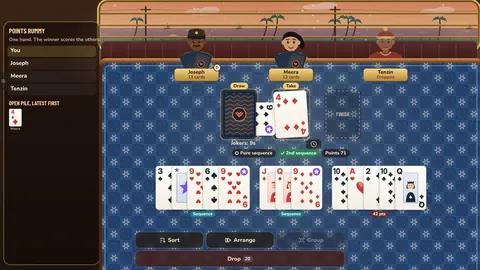
Sort lines your cards up by suit. Arrange finds the best groups for you. Group puts the cards you picked together. Every group gets a live label (Pure, Sequence, Set) and the bar above your hand shows whether you have your pure sequence, your second sequence and how many points you would lose right now.
On a keyboard: D draws from the deck, O takes the open card, arrow keys and Space pick cards, Enter discards, G groups, S sorts, A arranges, F declares, H gives a hint and P drops.
The Monsoon Line, the Daily Deal and the Festival Pool
The Monsoon Line is a 36 station train ride in six legs: the Coast Line, Paddy Country, the Tea Hills, the Backwaters, the Desert Night and the Festival City. Each station is a short game against named passengers, and each one can earn up to three stars. Win a station to open the next one, and if a station keeps beating you, three tries opens the next stop anyway.
Finishing a leg opens its window view, so the scenery outside your window changes as you travel. Stars earn new block print tablecloths, and each leg has two keepsakes to collect.
The Daily Deal is one hand of Points rummy against two passengers, with the same shuffle for everyone that day. Your first finish counts on the daily leaderboard. A win scores 1,000 plus four times the points you collect, plus 15 for each of your turns under 20 and 100 more if you used no hints. Miss one day and we keep your streak, once a week.
The Festival Pool is a Pool 101 game that changes every Monday. Win it once to stamp that week's festival card. Four stamps earn the Festival Patchwork tablecloth.
The passengers
The computer players play fair. They only see their own cards and what everyone at the table can see: the open pile and the cards each player picks up from it. Every deal is a plain shuffle.
They come in three strengths. Easy passengers hold on to the wrong cards now and then. Steady ones play solid rummy. Sharp ones also watch what the next player picks up and avoid feeding them. Each has a little personality too: Arjun drops weak hands quickly, Prakash almost never folds, and Ravi loves the open pile.
Tips for 13 card rummy
- Build the pure sequence first. Without it every card counts, so a hand with three sets and no pure run can still count 80 against you.
- Throw high loose cards early. A lonely king is 10 points waiting to hurt you.
- Save jokers for sequences. A joker that turns two cards into your second sequence is worth more than one that finishes a set.
- Middle cards are flexible. A 6 can join 4 5 6, 5 6 7 or 6 7 8. An ace or king only has one side.
- Watch the open pile. If the next player picked up the 8♣, think twice before throwing the 7♣ or 9♣.
- Count your outs. 6♥ 7♥ waits on two cards (5♥ or 8♥). 6♥ 8♥ waits on only the 7♥.
- Drop early, not late. A first drop counts 20, a middle drop counts 40, and a full loss can count 80.
Questions
How many jokers are in 13 card rummy?
Every card of the rank turned up under the deck is a joker, plus the printed jokers. With two decks that is up to eight cut jokers and two printed ones.
Can you show without a pure sequence?
No. A show needs at least two sequences and one of them must be pure, with no joker. A joker card used as itself still counts as pure.
What is a first drop and a middle drop?
Dropping means folding your hand. Before your first draw it counts 20 points; after that it counts 40. In Pool 201 they count 25 and 50.
What is the maximum points you can lose in a hand?
80. A hand is counted in its best arrangement and capped at 80, even if the cards add up to more.
Is there anything to buy in Monsoon Rummy?
No. Points are only a score, and every tablecloth, window view, card back and keepsake is earned by playing.
Does Monsoon Rummy work on phones?
Yes. It plays in the browser on phones, tablets and computers, in portrait or landscape, with nothing to download.
Is Monsoon Rummy good for 13 card rummy practice?
Yes. It uses the standard 13 card rules, explains every show and checks it before it counts, and the passengers come in three strengths. Our 13 card rummy page sums up the rules.
Related guides
 How to play Gin GardenRummy
 How to play Cribbage CabinCribbage
 How to play Hearts HollowTrick taking
 How to play Spite StreetSpite and Malice
 How to play Updraft DuelDuel solitaire