Games / Guides / Strategy articles / Golf solitaire strategy
Golf solitaire strategy: plan long runs and leave fewer cards
Golf is one of the few solitaires where every card on the course is face up from the start. That means most of the skill is planning: tracing a run before you tap, choosing where it ends, and knowing which cards to save for later. Here's how we do it.
The rules in short
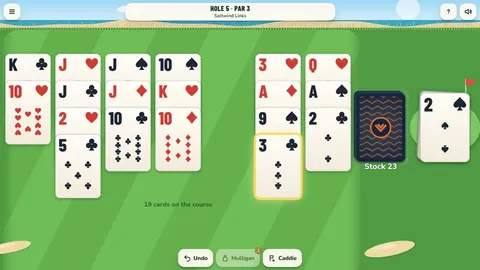
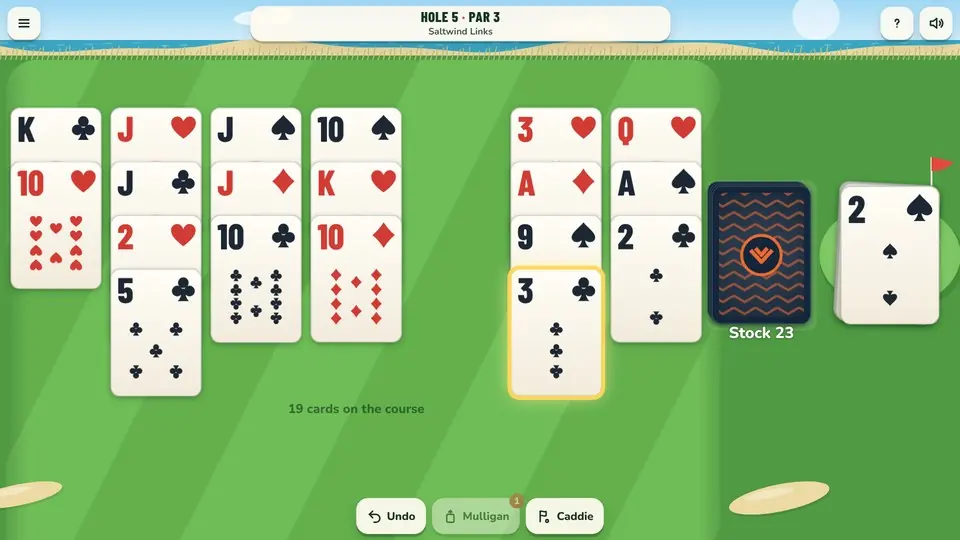
In the classic deal, seven columns of five cards sit face up, one card starts the pile (we call it the green in Saltwind Links), and 16 cards wait in the stock. You can play the bottom card of any column onto the green if it's exactly one rank higher or lower than the top card. Suits don't matter, and you can change direction whenever you like.
Two rules make golf harder than it looks. There's no wrapping: only a 2 goes on an Ace, and nothing goes on a King. And the stock goes through once, with no redeal. Every card left on the course at the end is a stroke, so a low score wins.
Trace the whole run before you tap
The biggest jump in skill comes from planning a run all the way to its end before you play the first card. Runs that bounce up and down usually reach further than straight ones, because each card you play uncovers another option. Here's an example. The green shows a 7, and these are the bottom two cards of each column:
| Column | Bottom card | Card above it |
|---|---|---|
| 1 | 8♠ | 4♥ |
| 2 | 6♦ | 7♣ |
| 3 | K♣ | Q♦ |
| 4 | 9♥ | 8♦ |
| 5 | 5♣ | 6♥ |
| 6 | 2♦ | 3♠ |
| 7 | 10♠ | J♥ |
The obvious play is to climb: 8♠, then 9♥, then the 8♦ it uncovers. That's three cards, and then you're stuck on an 8 with no 7 or 9 free.
Now try going down first: 6♦, then 5♣, then the 6♥ that uncovers, then the 7♣ freed in column two, then 8♠, 9♥ and 8♦. That's seven cards from the same position, all because the run dipped before it climbed. Nothing in it was hidden. It was all there to be counted.
Choose where a run ends
Two runs can clear the same number of cards and leave you in very different places. When a run ends, the top card of the green decides what the next stock card has to be. Finishing on a 7 is good: two ranks (6 and 8) can follow it, and if most of those are still in the stock or on the course, your next turn has a fair chance.
Finishing on a rank whose neighbors are all used up is bad. If every 9 is gone and the green shows a 10, only a Jack can help you, and then only if one is left. Glance at what's been played before you choose your last card.
Kings and Aces
- Kings are bunkers. A King can land on a Queen, but then nothing can follow it. Your run ends, and only the stock can get you out. Play a King as the last card of a run, never in the middle of one you could have stretched.
- Uncover Kings early. A King at the bottom of a deep column blocks every card above it. The only way it leaves is on a Queen, so make sure a Queen will reach the green while that King is free.
- Aces only take a 2. An Ace on the green is almost as bad as a King. If an Ace is still on the course, don't spend your last 2 on a 3.
Dig the tall columns
All columns start the same height in the classic deal, but they don't stay that way. When you have two equal plays, take the card from the taller column. Cards buried deep take the longest to reach, and a column you've almost cleared doesn't need help. Clearing a short column early is satisfying, but in golf an empty column does nothing for you. It's just one fewer place to find the card you need.
When a rank runs out, save its neighbor
Track the ranks that are nearly gone. Say all four 9s have been played. Every 8 left on the course can now only be played on a 7. If you have a chance to play an 8 now, take it, because the chances will only get rarer. The same goes for the middle of the deck: when a rank is gone, the cards next to it become one-way streets.
Timing the stock
Turn the stock only when no course card fits, or when every play left would make your position worse. The stock is your lifeline, and once it's gone the hole is over. If you clear the course with cards still in the stock, each one you never needed is worth minus one stroke, up to five, so saving the stock is how holes go well under par.
Saltwind Links adds two helpers worth knowing. Undo takes back course plays since your last draw, but never a draw. The Mulligan, one per hole, takes back your last draw and puts that card on top of the stock face up. The classic use: you turn a card, then realise a run on the course would have ended right next to it. Take the Mulligan, play the run, and turn the card again.
What par tells you
Each hole has a par of 3, 4 or 5, set by a careful computer player that never peeks at the stock. Par 3 means the hole is friendly. Par 5 means even good play leaves a few cards. If you finish at par on a par 5, you've played it well. Classic golf from a random deck is hard to clear, so the Tour, Daily Round and Cup holes are built from a known clear and tested.
Mistakes that add strokes
- Playing the first card that fits instead of counting the longest run.
- Putting a King on the green in the middle of a run.
- Using the last 2 while an Ace still waits on the course.
- Ignoring the tall columns until the end.
- Turning the stock with a playable card on the course.
For tees, modes and the full scorecard, read our Saltwind Links guide, and see our golf solitaire page for a quick rules summary. If you like short solitaires, our Peaks strategy article uses the same one higher or one lower idea with hidden cards, and our Pyramid article is all about counting.
Questions
What is a good score in golf solitaire?
Fewer cards left is better. In Saltwind Links each hole has a par of 3, 4 or 5, so finishing at par or under is a good hole, and clearing the course with stock to spare is the best result.
Can you put a Queen on a King in golf solitaire?
Not in the classic rules. Nothing goes on a King. The Practice Range in Saltwind Links has a Queen on King house rule if you'd like it easier.
Do suits matter in golf solitaire?
No. Only rank matters. Any card one higher or one lower than the top of the pile can be played.
Is golf solitaire mostly luck?
The stock order is luck, but the course is face up, so planning runs, choosing where they end and saving key ranks make a big difference over many holes.