
Games / Guides / Strategy articles / Pyramid solitaire strategy
Pyramid solitaire strategy: pair to 13 and clear more pyramids
Pyramid looks like a game of spotting sums, and for the first few deals it is. After that, it's a game of counting: which partners are left, which are stuck, and which ones you can afford to spend. Here's how we play it.
A one minute refresher
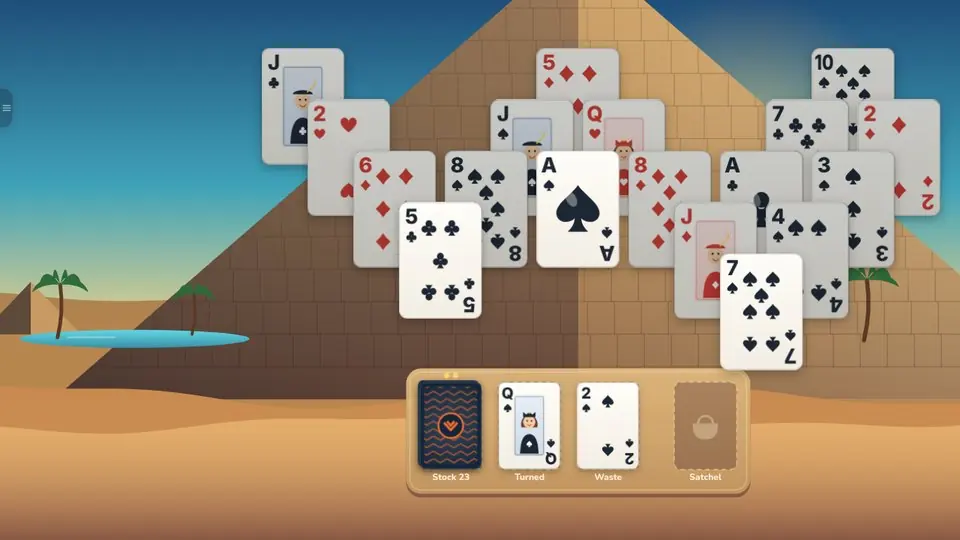
28 cards make a pyramid of seven rows, and each card is partly covered by the two cards in the row below it. The other 24 cards are the stock. You remove pairs of uncovered cards that add up to 13. Aces are 1, Jacks 11, Queens 12, and Kings are 13, so a King leaves on its own.
| Card | Its partner |
|---|---|
| Ace (1) | Queen (12) |
| 2 | Jack (11) |
| 3 | 10 |
| 4 | 9 |
| 5 | 8 |
| 6 | 7 |
| King (13) | Goes alone |
Turn stock cards onto the waste to find partners. In Desert Pyramid the Desert rules give you three trips through the stock, and the Satchel holds one spare card that can pair with anything free. Clear the pyramid and you win, even with cards left in the stock.
Count partners, because there are only four
Every rank has exactly four cards. That sounds obvious, but it's the single most useful fact in Pyramid. If the 2♣ near the top of the pyramid needs a Jack, and three Jacks have already gone, the last Jack is precious. Spending it on a 2 from the stock that you didn't need would leave the 2♣ stranded, and with it every card it covers.
A simple habit: before you pair two cards, ask whether either rank is running low. If it is, check whether a pyramid card still needs that rank. If one does, save it.
Spot blocked pairs early
Under the usual rules, a card can never pair with a card that's covering it. Picture this corner of the pyramid:
| Row | Cards |
|---|---|
| Row 5 | 7♦ (needs a 6) |
| Row 6 | 6♠ and 10♥ cover the 7♦ |
The 6♠ and the 7♦ add up to 13, but they can't pair with each other, because the 7♦ isn't free until the 6♠ is gone. So the 6♠ needs a different 7, and the 7♦ needs a different 6. You've just used up two of the four 6s and two of the four 7s for one pair's worth of work. Spot these early and plan for them. Desert Pyramid's Classic games have an overlap pairs option that allows exactly this pair, if you like that house rule.
Pyramid cards before stock cards
When a free pyramid card and a stock card could both pair with the same thing, use the pyramid card. The stock comes around again on your next trip. The pyramid cards are the ones you have to clear to win, and every one you remove uncovers more.
The same thinking applies to the Satchel. If you turn a 9 and the 4 you need is two layers down, park the 9 in the Satchel and keep going. It holds a single card, so don't fill it with something you might never use.
Open the bottom evenly
The bottom row has seven free cards at the start, and every pair you make there starts uncovering row six. If you only dig the left side, the right half of the pyramid stays locked and the top cards can't come free until late, when you've spent most of your stock trips. Work across the whole bottom so several cards in row six open at once. More free cards means more chances for any stock card to find a partner.
Clearing a complete row of the layout is worth 50 points in Desert Pyramid, which is a nice bonus for exactly the habit that wins games.
Make every pair before you turn
Scoring in Desert Pyramid rewards chains. Each pair or King is worth 10 points times your chain, and the chain grows by one with each removal in a row. Turning the stock or redealing resets it. So the first pair is 10, the fifth is 50, and the twelfth is 120.
That gives you a clear rule: clear every pair you can see, in the order that frees the most cards, and only then turn the stock. It's good for your score and good for your game, since turning too early can bury a useful waste card under a new one.
Using your trips through the stock
With three trips, the stock isn't one chance, it's a deck you'll see again. On your first trip, watch which ranks come past. If the waste has two Queens in it and you have an Ace buried in row three, you know a Queen will come around again on the next trip.
- First trip: pair freely, but don't spend scarce partners on stock cards.
- Second trip: start planning for the specific cards that are holding up the pyramid.
- Last trip: every card matters. Slow down, and check the Satchel before each turn.
If you're playing one trip only, the strict traditional rule, expect to lose most deals even with good play. It's a fine challenge, but three trips is the usual way people play.
Desert rules versus Classic rules
There are two ways to handle the stock. With Desert rules, the top of the waste is your open stock card. With Classic rules, the card you just turned and the top of the waste can both pair, which is how the game works with real cards. Classic gives you one extra free card to look at, so it's a bit kinder. If you learned Pyramid at a kitchen table, that's probably the version you know.
Three stars on the Caravan Road
Stars on the Caravan Road come from clearing on your first trip with cards to spare in the stock. That changes the game: every turn of the stock can cost you a star. Undo is free there, so play a line, back up, and try another. On the open layouts with no stock, every card is face up, so work out the order of the first three or four pairs before you touch anything, starting with the cards that free the most others.
Mistakes that lose Pyramid deals
- Spending the last card of a rank on a stock card when a pyramid card still needs it.
- Missing a blocked pair until it's too late to plan around it.
- Digging one side of the pyramid and leaving the other solid.
- Turning the stock with pairs still on the table.
- Filling the Satchel with a card that has no partner coming.
For the rules, modes and every scoring detail, see our Desert Pyramid guide. If you like quick solitaires, our Peaks strategy article and our golf solitaire article are close cousins.
Questions
What adds up to 13 in Pyramid solitaire?
Ace and Queen, 2 and Jack, 3 and 10, 4 and 9, 5 and 8, and 6 and 7. Kings are worth 13 on their own and leave by themselves.
Why can't I pair two cards that add up to 13?
Usually because one is covering the other. Under the usual rules both cards must be free, and a card is covered until both cards below it are gone.
How often can you win Pyramid solitaire?
It depends a lot on the rules. With one trip through the stock most random deals can't be cleared. With three trips and a spare card slot, good play wins much more often. Desert Pyramid can also deal only checked, winnable deals.
Should I always remove Kings right away?
Almost always. A King needs no partner, so removing it frees cards and grows your chain at no cost.
Game guides
More strategy articles




You might also like
 10 min
TriPeaks Solitaire
Card gameClear the three peaks one card higher or lower. Long streaks, wild Comets, a Sky Tour.