Learning games / Pawprint Rescue / Guide
How to play Pawprint Rescue
Animals arrive at a sunny little clinic feeling nervous, muddy or a bit sore. Your child calms them with slow strokes, picks the right tool for each step, feeds and plays with them, then chooses the family that suits them best. Nothing is scary, nothing is gross, and every animal gets better.
This is our guide to playing Pawprint Rescue. Want to jump straight in? Play Pawprint Rescue right here in your browser.
Quick answers
Do kids need an account to play Pawprint Rescue?
No. Our learning games have no accounts at all, so there is nothing to sign up for. Progress and stickers stay on the device they play on.
What your child practices
- Noticing feelings: each animal arrives with a feeling (nervous, shy, tired or worried) and a face that shows it. The face brightens with every kind step.
- Gentle hands: the first job is always to calm the animal with slow strokes before any tool comes out.
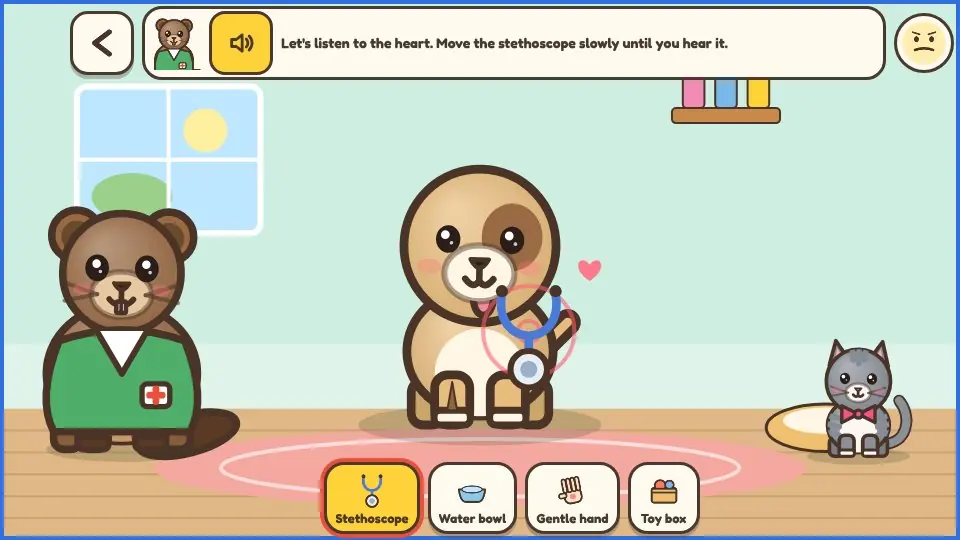
- The right help for the need: four tools sit in the tray and only one fits the step. A stethoscope listens, a cotton pad cleans, a soft bandage wraps.
- What animals really need: each kind has its own food, toy and kind of home. A goat needs a field. A shy cat needs a quiet house.
- Simple numbers (ages 7 and up): reading a thermometer or a scale and deciding if a number is normal, warm, heavier or lighter.
How a clinic day goes
Dr. Juniper, a beaver in a green coat, introduces each animal and says every instruction out loud. A speaker button repeats the line any time.
- Arrival: we hear who has come in, what is the matter and how they feel.
- Calm: stroke gently until the animal settles.
- Checkup and care: two to four short steps, such as finding the heartbeat, pulling out a thorn, wrapping a paw, a bubble bath or brushing teeth.
- Treat, food, water, play: choose the food and the toy that fit this animal.
- A home: three homes are shown in pictures. Exactly one fits. A wrong pick gets a kind reason and another try.
- All done for now: the day ends with a small celebration and a clear stop. The next day never starts by itself.
The animals and the clinic
There are 20 kinds of animal, each in three colors: puppy, old dog, kitten, cat, rabbit, guinea pig, hamster, parrot, ferret, turtle, goat, pony, piglet, lamb, calf, chick, duckling, hedgehog, fawn and owl. The last three are wild animals. They are never adopted. When they are well they go back to the woods.
The clinic grows as days go by. The spa opens on day 2, the play yard on day 3, the barn on day 5 and the wildlife pond on day 7. Postcards from animals your child helped hang on a wall, with gray shapes for friends still to come. Your child can also pick one clinic pet, name it from a list and dress it up. That pet is always happy, however long it has been.
Kind by design
- No blood, no needles, no sad endings. Troubles are small: a thorn, a sniffle, muddy fur, a sore leg that needs a soft wrap.
- No timers, no scores, no lives and nothing to lose. A wrong tool or a wrong food gets a friendly reason, and a second miss shows the answer.
- Nothing is owed for days away. There are no streaks and the clinic pet never gets hungry or lonely.
- Today's visitor is the same for everyone and is only a bonus.
- No ads, no purchases, no accounts, no chat. Up to three children can each keep their own clinic on one device.
Tips for playing together
- Before the home choice, ask: what does this animal like? Which picture shows that?
- Name the feeling at the start and at the end. What changed it?
- Talk about a real pet you know. What does it eat? Who makes sure it has water?
- The game keeps food simple. Real rabbits eat mostly hay and greens, and carrots are only a treat, which is why hay is the right bowl here.
- If your child wants to know more, real vets do use a stethoscope, a thermometer and a scale at nearly every visit.
Good to know
Temperatures are in degrees Fahrenheit and weights are in pounds. The game uses one simple rule for every animal (about 101 or 102 is normal, 104 is a little warm), which is true for dogs and cats and close enough for play. It is a pretend clinic, not a guide for treating a real pet. For a real animal that seems unwell, we always ask a vet.
Questions
Is Pawprint Rescue free and safe?
Yes. It is free with no purchases and no accounts. Nothing is collected and progress stays on the device.
Are there ads?
No. There are no ads anywhere in the game.
Is anything gross or scary?
No. There is no blood, no needles and no sad story. Troubles are small and every animal gets better. The most an animal shows is a worried face that turns into a smile.
What does it teach?
Empathy first: noticing how an animal feels and being gentle. Then matching help to a need, simple responsibility such as food and water, and for older children reading and comparing simple numbers.
What ages is it for?
Ages 4 to 9. Younger children follow the pointing hand and the spoken words. Children 7 and up also read a thermometer and a scale and answer a short question.
Does the pet get sad if we stop playing?
No. The clinic pet is always happy to see your child, even after a year away. It never gets hungry, sick or lonely, and nothing is lost by taking a break.
Can more than one child play?
Yes. Three players can each have their own clinic, postcards and pet on one device. Tap an animal picture on the first screen to switch.
Does it save where we stopped?
Yes, on this device only. If you close the game in the middle of caring for an animal, it picks up at the same animal and the same step.
Does it work on a tablet or phone?
Yes. It plays on tablets, phones and computers, by touch, mouse or keyboard. A tablet is the most comfortable for small hands.
Why does the rabbit get hay and not carrots?
Because that is what real rabbits mostly eat. Carrots are a sweet treat for them, not a meal.