Learning games / Fossil Hollow / Guide
How to play Fossil Hollow
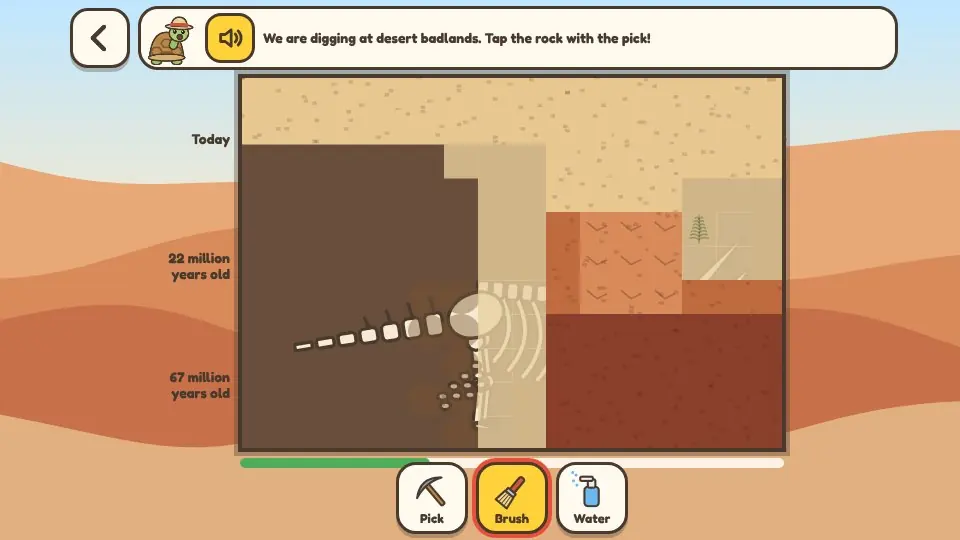
In Fossil Hollow your child is a young paleontologist. They chip away rock with a pick, sweep the dust off with a brush, wash the bones clean, then fit the skeleton together like a puzzle. The animal gains muscle and skin, takes its first steps, and a fact card is read aloud: how to say its name, how big it was, what it ate and when it lived. Every find stands in a museum and lives in a peaceful valley park.
This is our guide to playing Fossil Hollow. Want to jump straight in? Play Fossil Hollow right here in your browser.
Quick answers
Do kids need an account to play Fossil Hollow?
No. Our learning games have no accounts at all, so there is nothing to sign up for. Progress and stickers stay on the device they play on.
What your child practices
- How fossils are found: digging down through layers, using the right tool for hard rock and for delicate bone.
- Deep time: deeper rock is older. Each dig shows three layers with their ages, said out loud.
- Skeletons: skull, neck, ribs and backbone, legs and tail, and where each belongs.
- True facts about 35 animals: from the Triassic, Jurassic and Cretaceous, plus Ice Age mammals and the sea and flying reptiles that were cousins of the dinosaurs.
- Evidence: what teeth, footprints and rock layers can tell a scientist.
How to play
Tap a dig site on the map. Dr. Pebble, a tortoise in a field hat, explains each step out loud, and the speaker button repeats the last thing said. A hand points to the next thing to try whenever your child pauses.
One find, four steps
| Step | What your child does |
|---|---|
| The Dig | Tap with the pick to chip hard rock in chunks. Drag the brush to sweep away the last dusty layer. Drag the water spray to wash the bones. Small bonus finds turn up too: ammonites, shark teeth, amber, trilobites, fern prints and footprints. |
| Skeleton Puzzle | Drag each group of bones onto the faint outline. Pieces click into place when they are close. |
| It Comes to Life | The finished skeleton gains muscle, then skin, walks, calls softly and has a bite to eat. |
| Fact Card | The name and how to say it, its length and weight compared with familiar things, its food, when it lived on a timeline, and one surprising true fact. Tap any line to hear it again. |
Places to visit
- The museum: a wing for each period, with every skeleton found and soft outlines for those still in the ground.
- The valley park: found animals wander in a forest, on a plain, by a river, in a lake or in the sky. Feed them leaves or fish, take photos, and place trees, ferns, rocks, ponds and flowers.
- The field journal: a page for each animal with its picture, your child's photo and their own sticker, and a timeline of every find.
- Dino Detective: four quick evidence puzzles for ages 7 and up.
Gentle by design
Nothing in Fossil Hollow can be broken or lost. If the pick lands on bone, Dr. Pebble says "careful" and suggests the brush, and the fossil is unharmed. Animals in the park never hunt or fight. Calls are soft and low, never a sudden roar. There are no timers and no scores.
How it adapts
Seven dig sites open in order as finds add up, starting with four well known animals in the Red Badlands. For the youngest age band the tools reach further and skeletons come in three or four large pieces. Older children fit five or six pieces onto a fainter outline. Dino Detective adds harder questions (three kinds of teeth, putting three layers in order) after two rounds.
Why kids come back
- 35 animals to find, with the museum showing exactly what is still missing.
- Eggs found at a dig hatch in the park a few hours later. Waiting longer loses nothing.
- Animals in the park remember being fed.
- Today's dig: one special fossil each day, the same for everyone. Missing a day costs nothing.
- Stickers for the shared Sticker Book at real milestones, such as the first skeleton or a full museum wing.
Where the facts come from
We wrote the fact cards from standard museum references and kept the numbers conservative. Sizes and weights of extinct animals are estimates that scientists revise, so the cards say "about" and compare with familiar things.
- Natural History Museum, London: Dino Directory (lengths, diets, ages, pronunciations).
- American Museum of Natural History: dinosaur and fossil pages.
- Smithsonian National Museum of Natural History: Deep Time pages.
- U.S. National Park Service: fossil pages for Ghost Ranch and the Cleveland-Lloyd quarry.
- Published research: feather quill knobs on Velociraptor (2007), the feather color of Microraptor (2012), the paddle tail of Spinosaurus (2020), and the weight of the most complete Stegosaurus (2015).
The cards reflect current science: many small meat eaters had feathers, flying reptiles and sea reptiles were not dinosaurs, and birds are living dinosaurs.
Tips for grown-ups
- Before the fact card, ask what the teeth or the legs tell us. Then listen together.
- Pace out a size outdoors. Twelve big steps is about one Tyrannosaurus.
- Look for layers in a road cut, a cliff or a slice of cake: the bottom layer went down first.
- Say the long names together, one beat at a time. Children love being able to say Pachycephalosaurus.
- Visit a natural history museum, or look for fossils in building stone and beach pebbles.
Privacy and safety
Fossil Hollow has no ads, no accounts, no chat and nothing to buy. Progress for up to three diggers is saved only on the device. The page loads nothing from outside our site.
Questions
Is Fossil Hollow free and safe?
Yes. It is free with no ads, no purchases and no accounts. Nothing is collected and progress stays on the device.
Are the dinosaur facts accurate?
We wrote them from museum references, listed in this guide, and kept them current: feathers where the fossils show them, and sea and flying reptiles named as cousins, not dinosaurs. Sizes are careful estimates.
Is it scary?
No. Nothing hunts, fights or jumps out. Calls are soft, and the saber-toothed cat and Tyrannosaurus are drawn calm with kind eyes.
What ages is it for?
Ages 5 to 10. Everything is read aloud, so younger children can play. Dino Detective suits ages 7 and up.
Does it teach real science?
Yes: how fossils are uncovered, that deeper rock is older, the three dinosaur periods on a timeline, and how scientists read teeth, tracks and layers as evidence.
How do the eggs hatch?
Some digs turn up a nest. The eggs hatch in the valley park about three hours later, whenever the game is next opened. Coming back the next day or next month works just as well.
Does it have ads?
No. There are no ads of any kind.
Can we play on a tablet or phone?
Yes. A tablet gives the biggest dig. On a phone the rock squares are small, so holding the phone sideways helps. On a computer, 1, 2 and 3 pick tools, arrows move and the space bar digs.
Does it save our progress?
Yes, on the device only, for up to three diggers. A dig or puzzle in the middle is kept too.