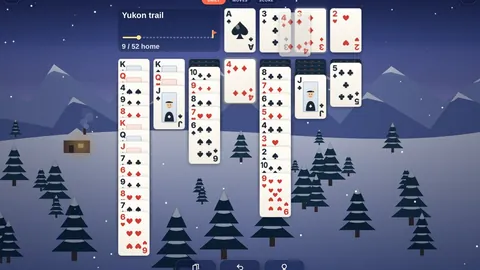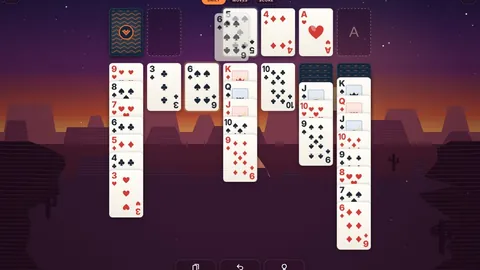
Games / Guides / Strategy articles / Yukon solitaire strategy
Yukon solitaire strategy: how to dig out and win
Yukon has no deck, so luck plays a smaller part than in most solitaires. Nearly every deal is decided by what you choose to dig for and in what order. Here's how we think about a Yukon deal, with worked examples and the mistakes we see most.
The rules that matter for strategy
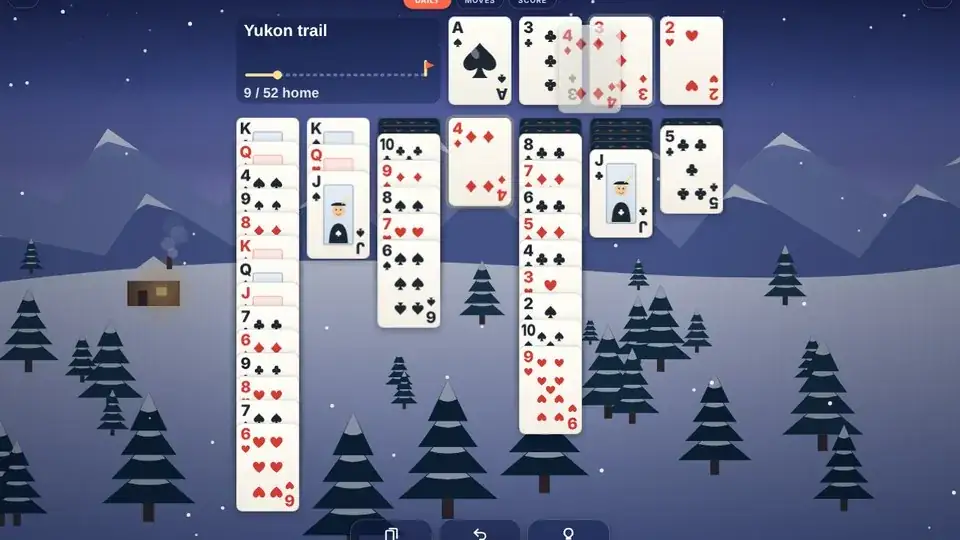
All 52 cards are dealt into seven columns. The first column is a single face-up card. The others each have a few face-down cards (one in the second column, up to six in the seventh) with five face-up cards on top. That's 31 cards you can see and 21 you can't.
You build down in alternating colors, and here's the twist: you can grab any face-up card, along with everything sitting on it, even if those cards are a jumble. Only the card you grab has to fit where it lands. Empty columns take Kings only (plus whatever is stacked on them). Foundations build up by suit from Ace to King.
There's no stock and no redeal. Every card you'll ever play is already on the table. That's what makes Yukon a planning game: the information you need is mostly in front of you, and the 21 hidden cards are the only real unknowns.
Think in handles, not runs
In Klondike you ask which ordered run can move. In Yukon the better question is: which card do you want to reach, and what is sitting on it? Every face-up card is a handle. Lift the card directly above your target and the whole chunk on top comes with it.
Here's a typical spot. Column six reads, from the top of the face-up cards down: 9♠, 4♦, Q♥, 7♣, 2♥. You need the 4♦ to free a hidden card underneath. You don't move the 2♥ first, then the 7♣, then the Q♥. You find a home for the Q♥ (any black King) and move Q♥, 7♣ and 2♥ together in one go. Now the 4♦ is the bottom card and can go onto a black 5.
| Column six before | After moving the Q♥ group |
|---|---|
| 9♠ | 9♠ |
| 4♦ | 4♦ (now free) |
| Q♥ | moved to a black King |
| 7♣ | rides along |
| 2♥ | rides along |
The cost is that the 7♣ and 2♥ are now buried under a Queen in another column. That's fine if you won't need them soon. It's a problem if that 2♥ is the next card your heart foundation wants. Always glance at what's riding along before you move a chunk.
Where to dig first
Most of the hidden cards live on the right. The seventh column hides six and the sixth hides five, so 11 of the 21 face-down cards are in those two columns. Moves that open the right side pay off the most, both in information and in the 5 points Yukon Trail gives for each card you turn over.
- Turn cards over first. Between two moves that look equally useful, take the one that flips a face-down card. A flipped card is a new option and sometimes a whole new plan.
- Free low cards early. An Ace or 2 under a pile holds up a whole foundation. Moving a big messy stack off an Ace is often worth it, even if it buries something else for a while.
- Look for cards that do two jobs. A move that frees a 2 and also uncovers a face-down card beats a move that does only one.
Build on high cards, not low ones
Because anything can ride on top of a grabbed card, it's easy to end up with a tall pile on a 4 or a 5. That pile is a trap. The 4 can't go to its foundation until every card on it has moved, and those cards need homes too.
Try to grow your tall piles on Kings and Queens, cards that won't need to go home for a long time. When you have a choice between two black 6s to put a red 5 on, pick the one that's sitting higher in a pile you don't plan to break up soon.
Empty columns and Kings
An empty column only takes a King. That makes it less flexible than a free space in some other solitaires, but it's still powerful, because a King can carry a huge chunk of cards with it. The right question is: which King sits on top of the most cards you need?
Say the K♣ is the first face-up card in column five, sitting right on top of its face-down cards. Moving that King into an empty column flips a hidden card and starts emptying column five as well. Compare that with a King that's already the only card in its column: moving it does nothing at all.
- Don't rush to empty a column if there's no King worth moving yet.
- If two Kings could go, pick the one that uncovers face-down cards.
- A King with a long, mixed tail is fine. You can sort the tail later with other moves.
Use the foundations as a tool
Sending cards home is usually right, but not always right away. A red 6 on the foundation can't hold a black 5 for you anymore. Early in a deal, keep low middle cards (5s, 6s, 7s) on the table if they're useful as landing spots, and send them up when nothing needs them.
Yukon Trail also lets you pull a card back down from a foundation if you really need it, at a cost of 10 points. It's a rescue, not a habit, but it can save a deal that would otherwise lock up.
Russian solitaire: the same deal, half the homes
Russian solitaire uses the same deal and the same move-anything rule, but columns build down in the same suit. The 7♣ can only go on the 8♣. Each card now has exactly one possible home instead of two, so your options shrink fast.
- Map the suits. Before you move, find where the next lower card of the same suit is. If it's buried under a higher card of its own suit in the same pile, that pile will have to be broken up in a specific order. Plan it before you start.
- Kings matter even more. With fewer homes for each card, an empty column is often the only way to shuffle cards into order.
- Expect to lose some. Russian is hard. Yukon Trail scores it at 1.5x for a reason, and the Winnable deals chip still guarantees a solution exists.
Mistakes that lose Yukon deals
- Moving a chunk without checking what's riding along, then needing a buried card two moves later.
- Building tall piles on low cards.
- Leaving the deep right-hand columns alone until late.
- Filling an empty column with a King that wasn't covering anything.
- Racing cards to the foundations when they're still useful as landing spots.
Undo has no limit in Yukon Trail, so the best way to practice is to play a deal, undo back to a key choice, and try the other line. The win without Undo bonus (150 points) rewards you once you're seeing those lines ahead of time.
Keep going
The Daily Deal in Yukon Trail is one Yukon game that's the same for everyone, a good place to test these habits. For the full rules, scoring and unlocks, read our Yukon Trail guide. If you enjoy deep columns, our Spider strategy article covers a game with the same digging feel, and our Klondike tips cover the classic cousin.
Questions
Is Yukon solitaire easier than Klondike?
Many players find it more winnable, because there's no deck and you can move any face-up card. It asks for more planning per move, though, since there are so many legal moves.
What is the best first move in Yukon solitaire?
Usually a move that turns over a face-down card in one of the deep right-hand columns, or one that frees an Ace or 2.
Can you move cards that aren't in order in Yukon?
Yes. Grab any face-up card and everything on it moves too, in whatever order it's in. Only the card you grab has to fit its new spot.
Is every Yukon deal winnable?
Not with random deals. In Yukon Trail, the Winnable deals chip deals only from shuffles we've checked can be won, for both Yukon and Russian.