
Games / Guides / Strategy articles / Sink or float experiment
Sink or float experiment for kids: what to test and why
A sink or float experiment needs a tub of water, eight or ten small things from around the house, and one rule: guess first, then drop it in. It works for ages 4 to 9, it takes about twenty minutes, and the surprises are where the learning is. Here's how we'd run it at a kitchen table, and how Sink or Float Lab lets kids keep testing afterwards without the wet floor.
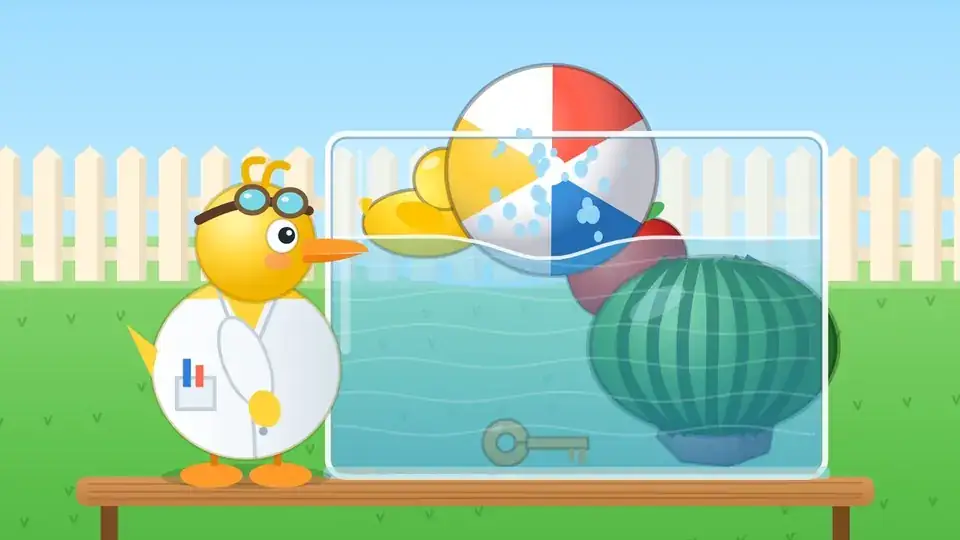
What you need
- A clear tub, a big bowl or the sink, filled most of the way.
- Eight to ten small objects. Mix sure things with surprises (ideas below).
- Paper with two columns, Guess and What happened. Little ones can draw an arrow up or down.
- A towel.
Clear sides help, because kids can see where an object settles: on top, on the bottom, or hanging in between.
Good things to test
| Object | What usually happens | Why it's worth testing |
|---|---|---|
| Apple | Floats | It looks heavy, so most kids guess sink |
| Coin | Sinks | Small and light in the hand, but it still goes down |
| Orange with its peel | Floats | Sets up the best surprise on the list |
| The same orange, peeled | Sinks | The peel was full of tiny pockets of air |
| Ping pong ball | Floats | Full of air |
| Golf ball | Sinks | Same size as the ping pong ball, packed tight |
| Ball of modeling clay | Sinks | Then reshape it |
| The same clay as a little boat | Floats | Same clay, different shape |
| Wooden block | Floats | Big and heavy can still float |
| Pebble | Sinks | Tiny can still sink |
Pairs are the trick. Two things the same size that do different things, or one thing that changes its answer, teach far more than ten unrelated objects.
How to run it
- Hold up one object and ask: will it sink or float? Write the guess down before anything gets wet.
- Let your child drop it in. Watch for a few seconds, because some things bob and then settle.
- Write down what happened. If the guess was wrong, call it a surprise, not a mistake.
- Ask why they think it did that. Any answer is fine. You're after the thinking, not the right words.
- Sort the tested objects into two piles at the end and look for what the floaters have in common.
How to explain why things float
The idea to aim for is heavy for its size. Something floats when it is lighter than the same amount of water, and sinks when it is heavier than the same amount of water. A log is heavy, but it is lighter than a log shaped lump of water, so it floats. A pebble is light, but it is heavier than a pebble sized sip of water, so it sinks.
For ages 4 to 6 you can stop at two plain ideas: things with air inside tend to float, and things that are packed tight tend to sink. For ages 7 to 9, bring in shape: a boat shape pushes a lot of water out of the way, and the water pushes back, which is how a steel ship floats when a steel nail doesn't. The grown-up word for heavy for its size is density, and it's fine to say it once.
Follow-ups that kids love
- Foil boats. Give everyone the same square of aluminum foil. Shape a boat, then count how many coins it holds before it sinks. Which shape held the most?
- Can you make a floater sink? Poke holes in it, fill it with water, load it up.
- Can you make a sinker float? Put it on a jar lid, or wrap it in something full of air.
- Salt water. Stir plenty of salt into a glass of water and try an egg in it, next to an egg in plain water.
Keep going on a screen
Sink or Float Lab is the same experiment with a duck in a lab coat. Dr. Dabble asks whether something will sink or float, your child taps Float or Sink, drops it into the tank and finds out why. Wrong guesses are called surprises, and each surprise shows a balance scale that weighs the object against the same amount of water. There are 62 everyday objects to find for the Lab notebook, thirteen experiments including the orange peel and the clay boat, and a Today's test of 6 objects that is the same for everyone that day.
It has no ads, no accounts and no timers, and every instruction is read aloud. It's a good way to revisit the ideas a few days after the tub is put away.
Mistakes to avoid
- Telling instead of asking. The guess is the experiment. Let it be wrong.
- Saying heavy things sink. It's the rule kids arrive with, and the apple and the log break it. Say heavy for its size.
- Testing only sure things. If every guess is right, nobody learned anything new.
- Rushing the why. One good why question is worth five more objects.
Questions
What age is a sink or float experiment for?
Ages 4 to 9. Younger kids predict and watch. Older kids can also explain why, using ideas like air inside, packed tight and shape.
Why does an orange float but a peeled orange sink?
The peel is full of tiny pockets of air, which makes the whole orange light for its size. Take the peel off and what's left is heavier than the same amount of water, so it sinks.
Why do some heavy things float?
Floating depends on how heavy something is for its size, not on how heavy it is. A big log is lighter than the same amount of water, so it floats, while a small pebble is heavier than the same amount of water, so it sinks.
Is there a free sink or float game for kids?
Yes. Sink or Float Lab is our free sink or float game for ages 5 to 9. Kids predict, drop the object in the tank and find out why, with no ads and no accounts.
Game guides

More strategy articles
 How to win at Spider SolitaireMoonlit Spider
 Chess openings for beginnersKingsway Chess
 Three stars every timeCopper Pot Kitchen
 How to catch rare bugsBramble Bug Museum
 How to win at Mahjong SolitaireMahjong Cloud Steps
 Pinball tips for beginnersPocket Pinball
 Bubble shooter strategyBubble Bay
 How to win at FreeCellFour Cells