Games / Learning Games / Sink or Float Lab / Guide
Sink or Float Lab
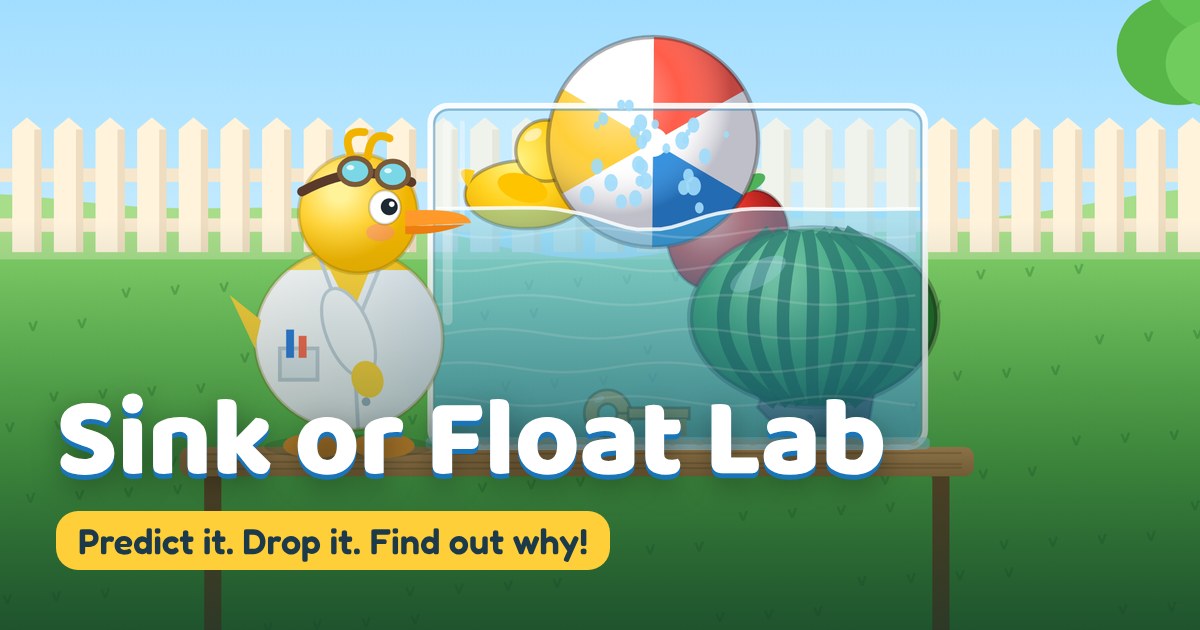
Dr. Dabble the duck has a water tank in the backyard and a pile of things to test. Will the apple float? The golf ball? A peeled orange? Your child predicts, drops each one in, and finds out why, the same way real scientists work.
What your child learns
Sink or float is a classic early science activity, and the game builds it into real ideas about materials:
- Predict, then test. Every object starts with a guess: float or sink? A wrong guess is called a surprise, because surprises are how scientists learn.
- Heavy for its size. The big idea behind floating. A log is heavy but floats, a pebble is tiny but sinks. What matters is how heavy something is compared with the same amount of water.
- Air inside. Ping pong balls, pumpkins and orange peels float because they are full of air. Take the peel off an orange and it sinks.
- Shape matters. A ball of clay sinks, but the same clay shaped like a boat floats. A metal bowl floats right side up while a metal spoon sinks.
- Salt water. A fresh egg sinks in tap water and floats once enough salt is stirred in.
- Density with numbers. Same-size blocks are weighed in grams and compared with 10 grams of water.
How it works
Tap Play and an object hovers over the tank. Dr. Dabble asks "Will the banana sink or float?" and your child taps Float or Sink, then taps the object (or the Drop it! button) to drop it in. It splashes, settles, and a label says what happened. Older kids then pick the reason why from three choices. A short card explains the result.
The Experiments button lists seven experiments:
| Experiment | What happens |
|---|---|
| First splash | Six quick tests with things like an apple, a rock, a rubber duck, a coin and a key |
| Kitchen lab | Fruit, eggs, a pumpkin and a watermelon. Some will surprise you. |
| Toy box | Ping pong ball vs golf ball, a beach ball, a metal toy car, a toy boat |
| Yard and garage | Leaves, ice cubes, nails, a candle, a dry sponge, a brick |
| Heavy or light? | Pick the heavier of two things, then test both. The heavier one often floats. |
| Make it float! | Reshape clay, add salt for an egg, and load a boat with marbles |
| Density detective | Ages 8 and up: grams, how deep a block floats, and sorting by density |
The first four experiments are open from the start. The others open as the one before them earns a star.
Levels and how it adapts
Objects your child predicts wrong come back in later rounds until they make sense, and ones they get right show up less. When the "why" answer is wrong, a balance scale appears that weighs the object against the same amount of water, with a hint like "The apple is lighter than the same amount of water." A second miss shows the right reason. Nothing ends the game and there are no timers.
The age buttons on the title screen change what's asked. On 4 to 6, kids predict, watch and hear the explanation without a quiz on reasons. On 6 to 8 and 8 to 11, they also choose why each thing sank or floated.
Lab notebook, stickers and Today's test
Every object your child tests gets a page in the Lab notebook, with a picture, whether it floats or sinks, the explanation and the balance scale. There are 44 everyday objects to find, plus the density blocks. Stickers go into the Sticker Book shared by all our learning games, for the first experiment, for finishing experiments, for a 3 star round, for testing 10 and 25 objects and for filling the whole notebook. Today's test drops 6 objects that are the same for everyone that day, with a streak counter and a sticker.
Tips for grown-ups
- Test five things in the sink or a tub. Have your child predict and write S or F first, then check.
- Try the orange trick for real: float an orange, then peel it and try again.
- Make boats from aluminum foil and count how many coins each one holds before it sinks. Which shape holds the most?
Privacy and safety
Sink or Float Lab has no ads, no accounts, no chat and no tracking, and nobody types a name. The notebook, stars and stickers are saved only on your device, and the only links go to our other learning games and the Sticker Book.
Questions
Why do some heavy things float?
Floating depends on how heavy something is for its size. A big log weighs a lot, but it's lighter than the same amount of water, so the water holds it up. A small pebble is heavier than the same amount of water, so it sinks.
Does an apple sink or float?
It floats. About a quarter of an apple is air, tucked inside tiny pockets, which makes it lighter than the same amount of water.
Does an egg float in water?
A fresh egg sinks in plain tap water. Stir in enough salt and it floats, because salt water is heavier for its size than plain water. Very old eggs can float too, since air slowly gets inside them.
Is Sink or Float Lab free?
Yes. It plays free in the browser on phones, tablets and computers, with no download, no ads and no in-app purchases.